IQFlow Blog
Quick IQ questions, memory tests, and brain training guides
A growing collection of short cognitive checks and explainers. Start with a puzzle, learn the reasoning behind it, then use IQFlow to see a broader skill profile.
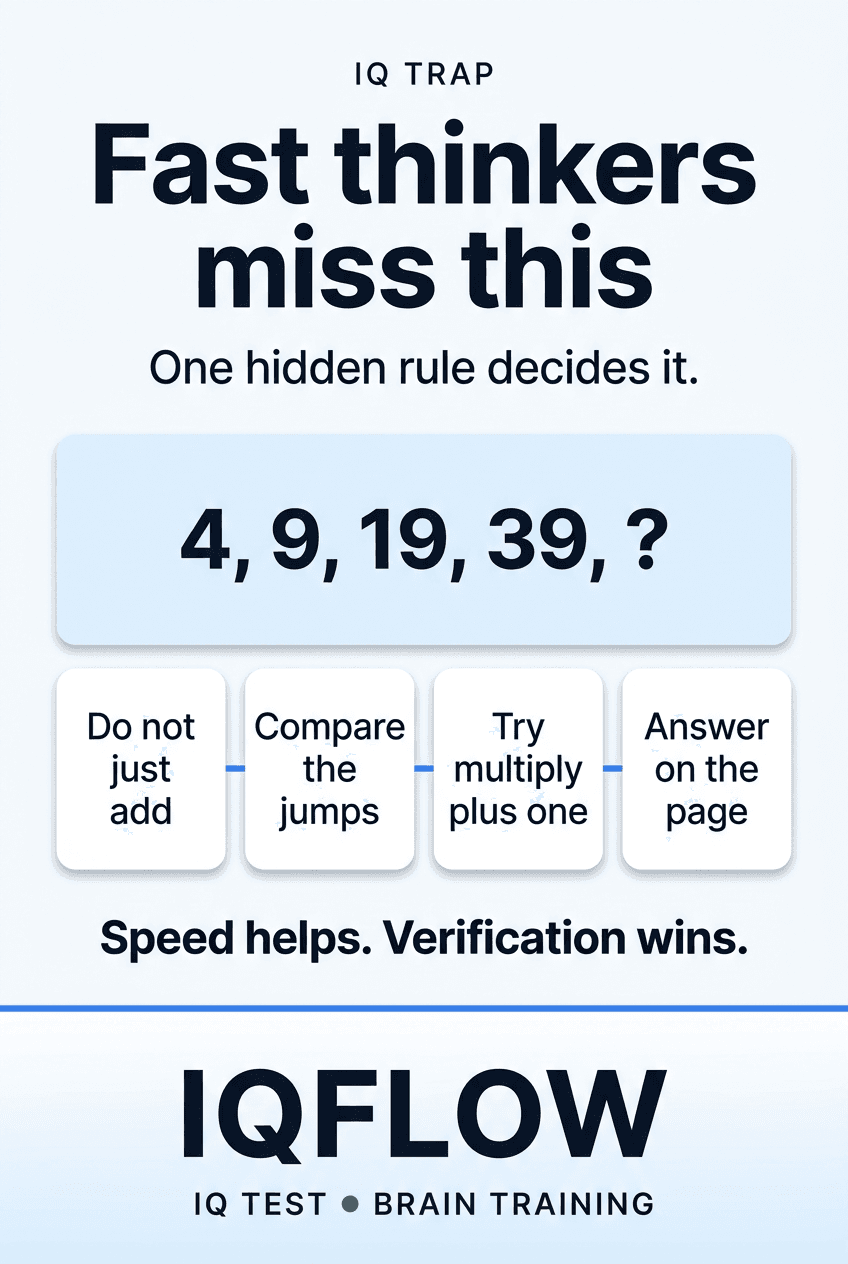
IQ sequence trap
Fast thinkers miss this
A quick number-sequence puzzle where the hidden rule rewards a second look.
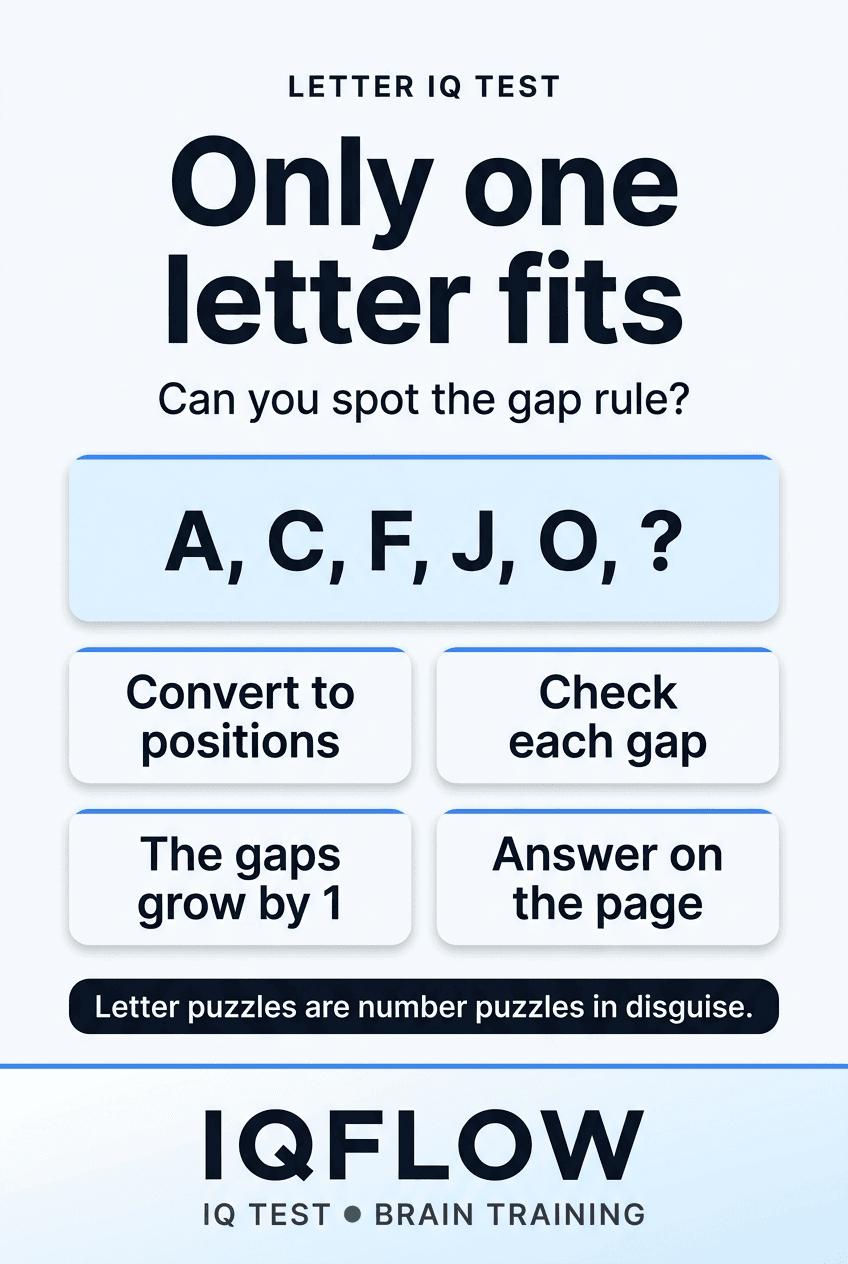
Letter sequence
Only one letter fits
A letter-sequence question that looks simple until you check the alphabet gaps.
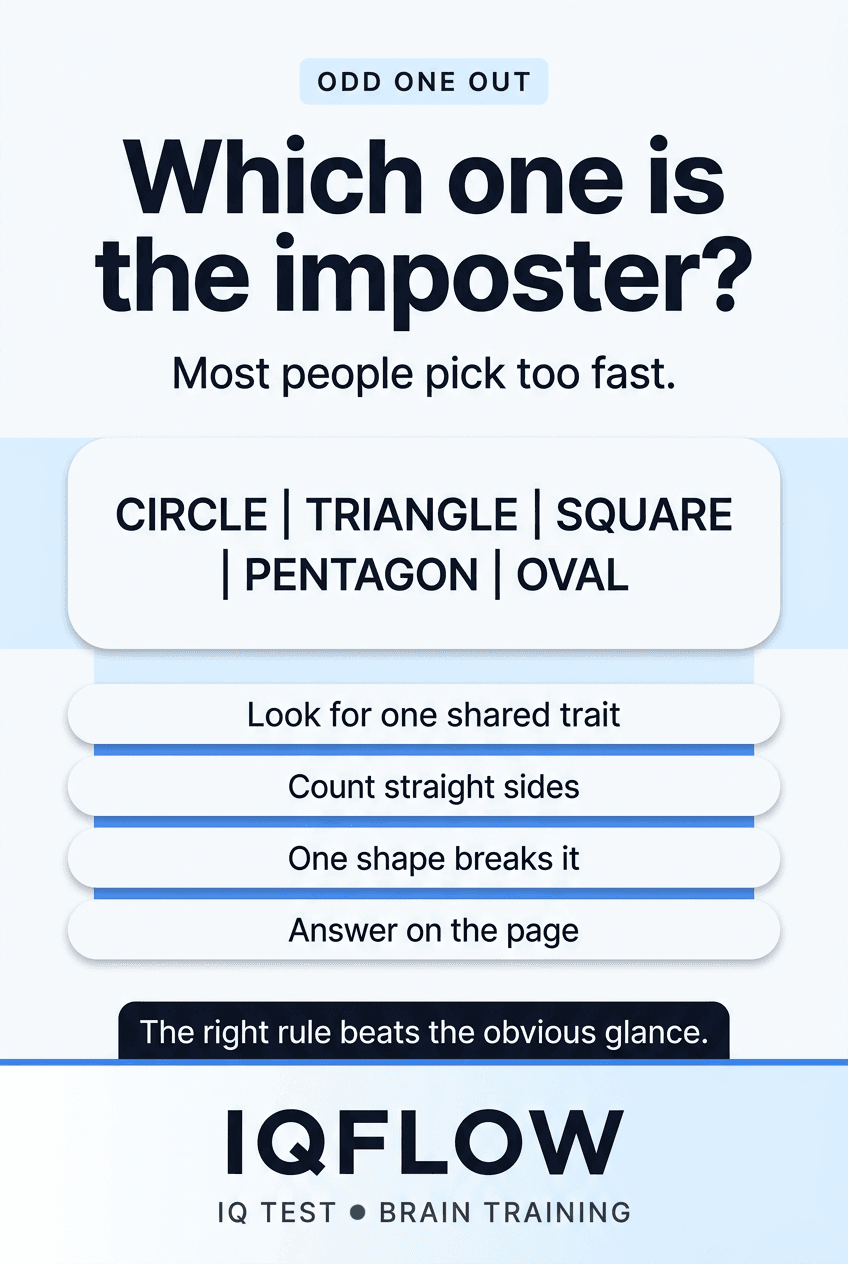
Odd one out
Which one is the imposter
An odd-one-out IQ question about finding the shared feature before picking an answer.
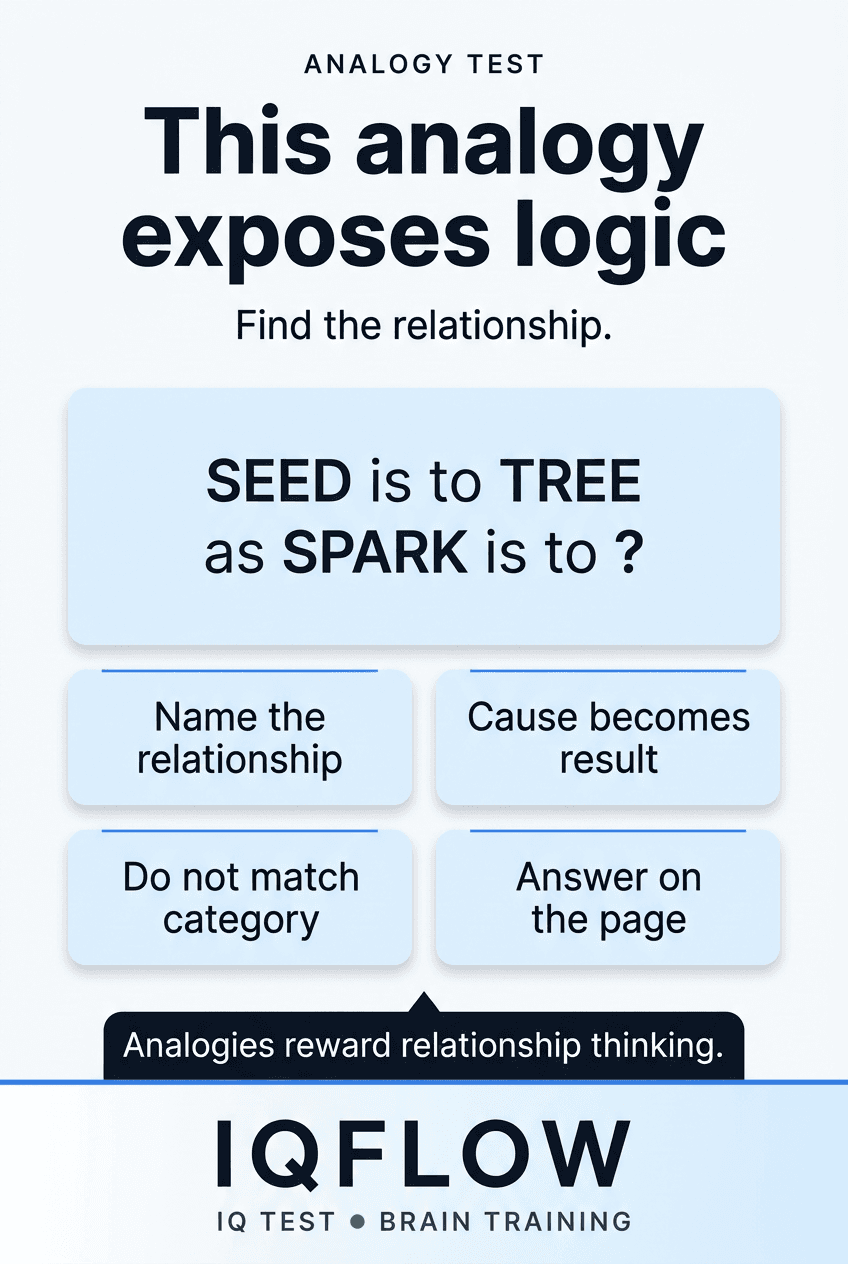
Verbal analogy
This analogy exposes logic
A short analogy question that checks whether you transfer the relationship, not the words.
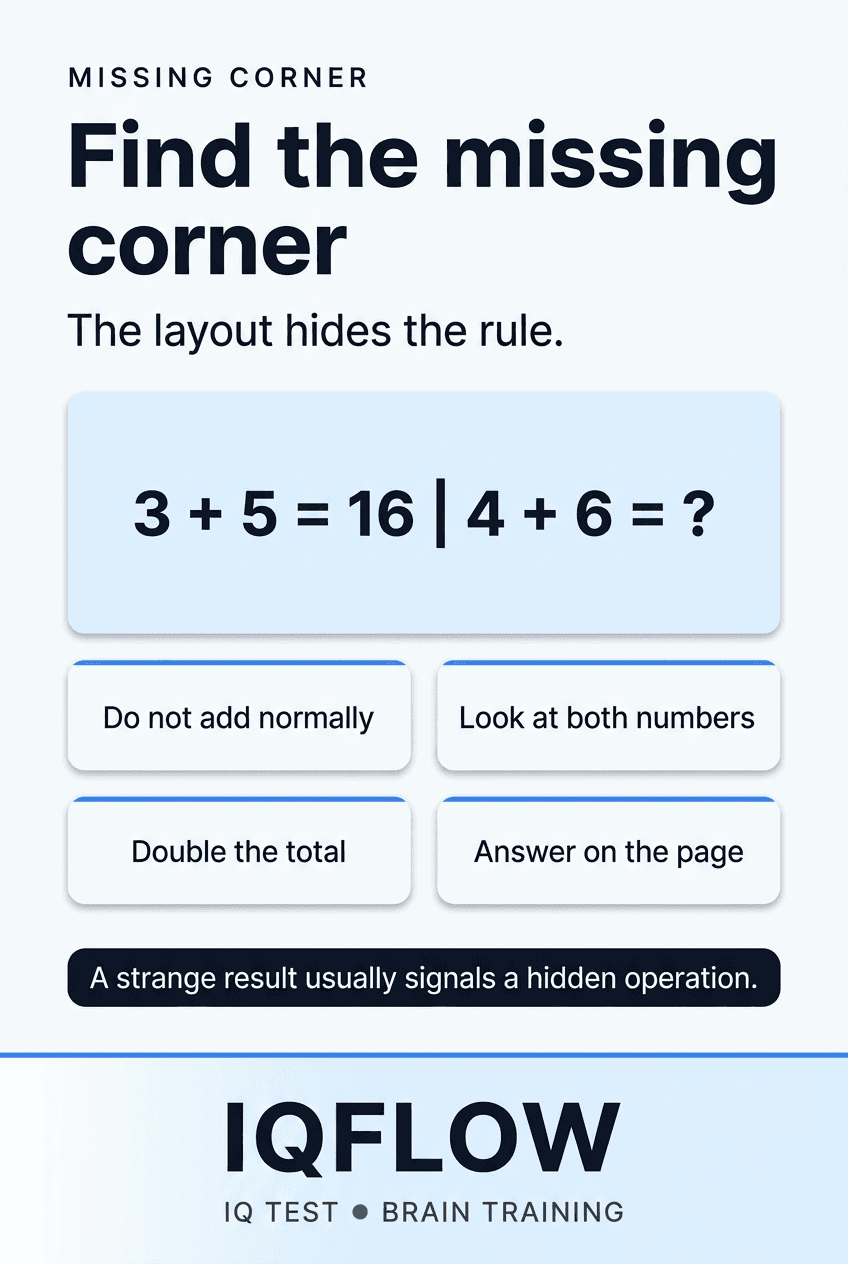
Missing corner puzzle
Find the missing corner
A compact arithmetic logic puzzle where the operation sits behind the layout.
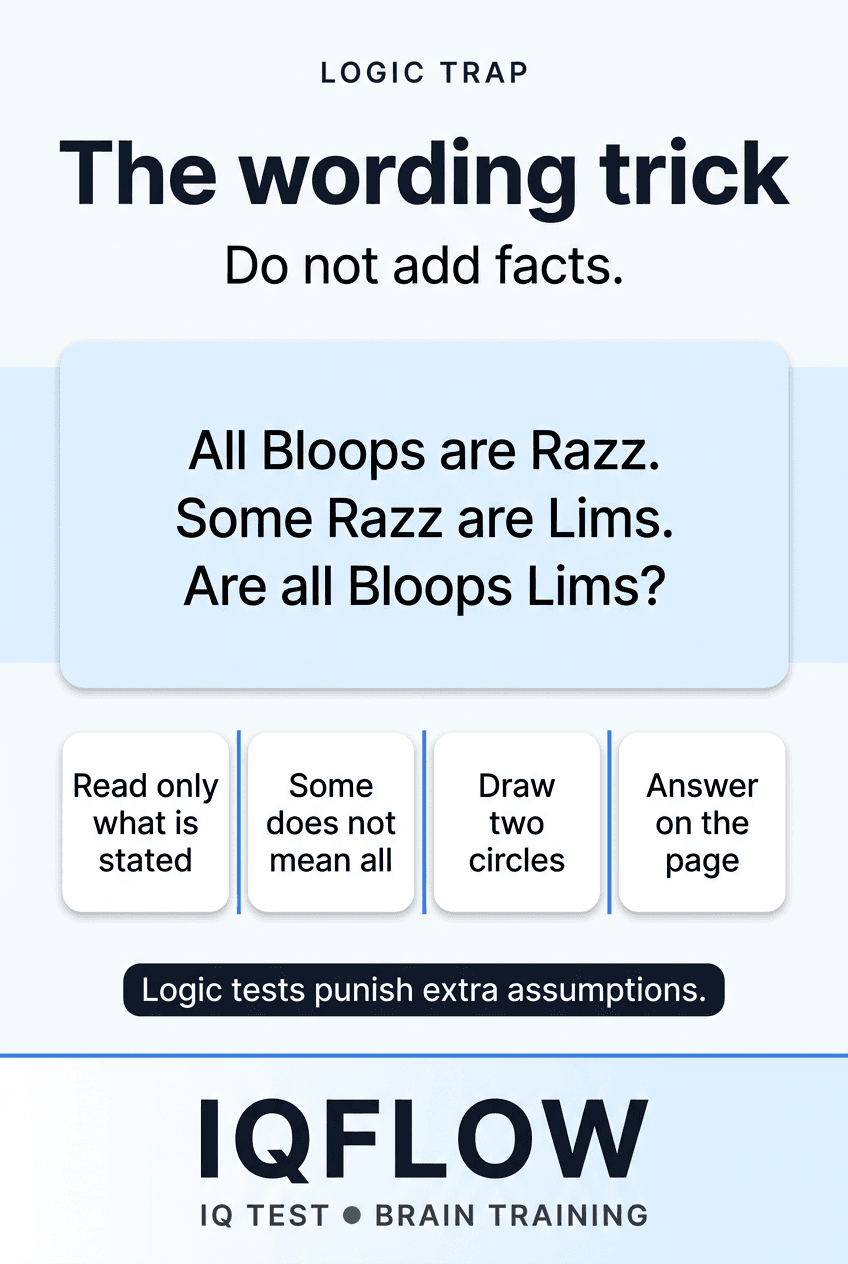
Logic wording trap
The wording trick
A verbal logic trap about not assuming more than the statements actually say.
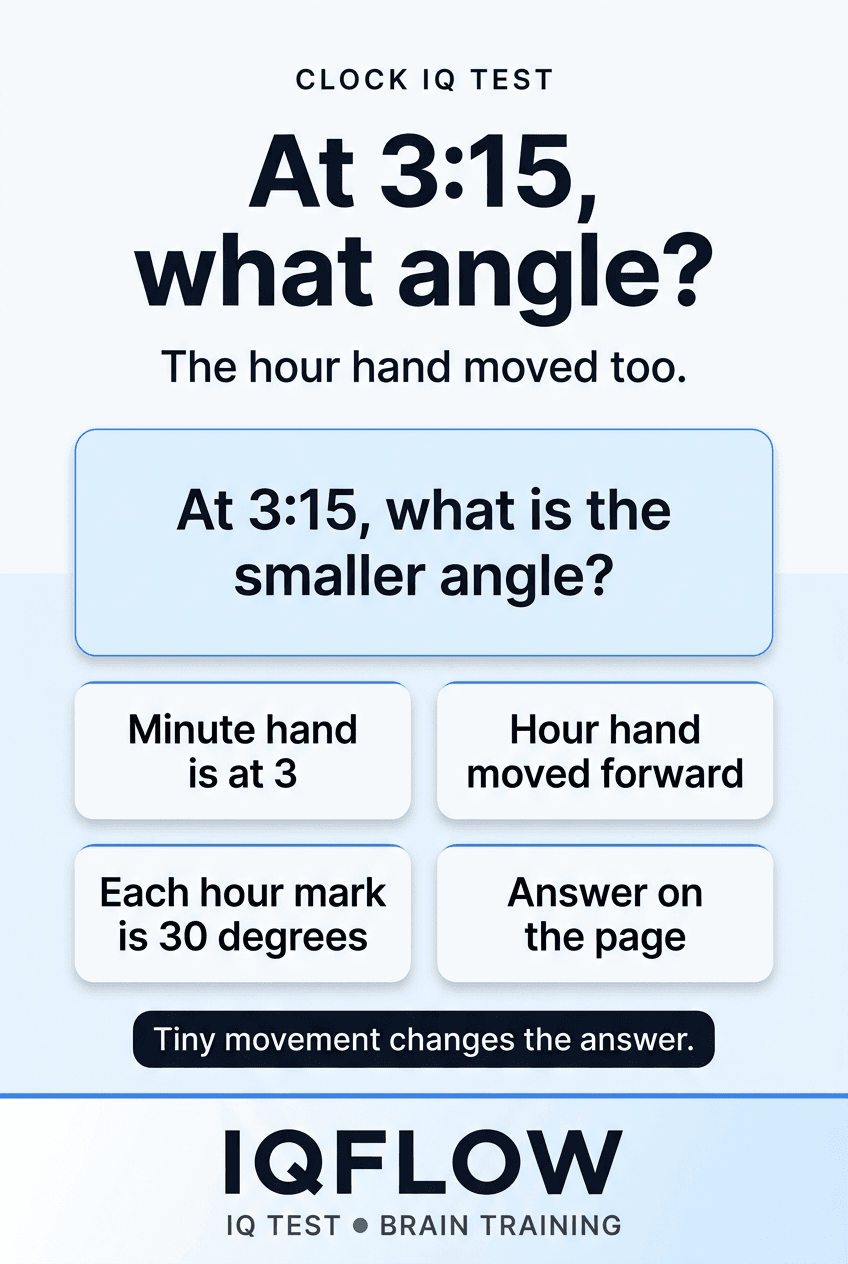
Clock angle
At 3:15, what angle
A classic clock-angle question that catches people who forget the hour hand moves.
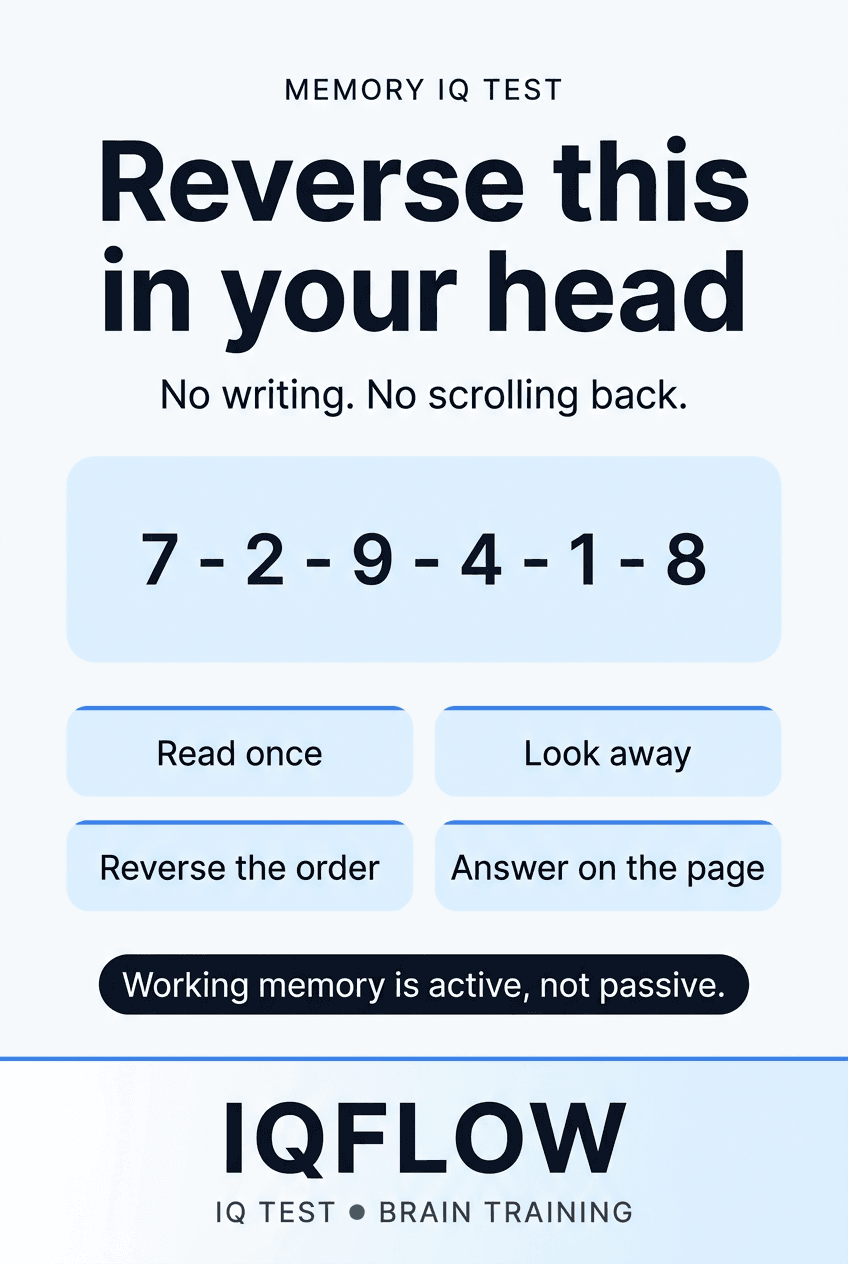
Working memory test
Reverse this in your head
A short working-memory challenge that tests whether you can hold and transform a sequence.
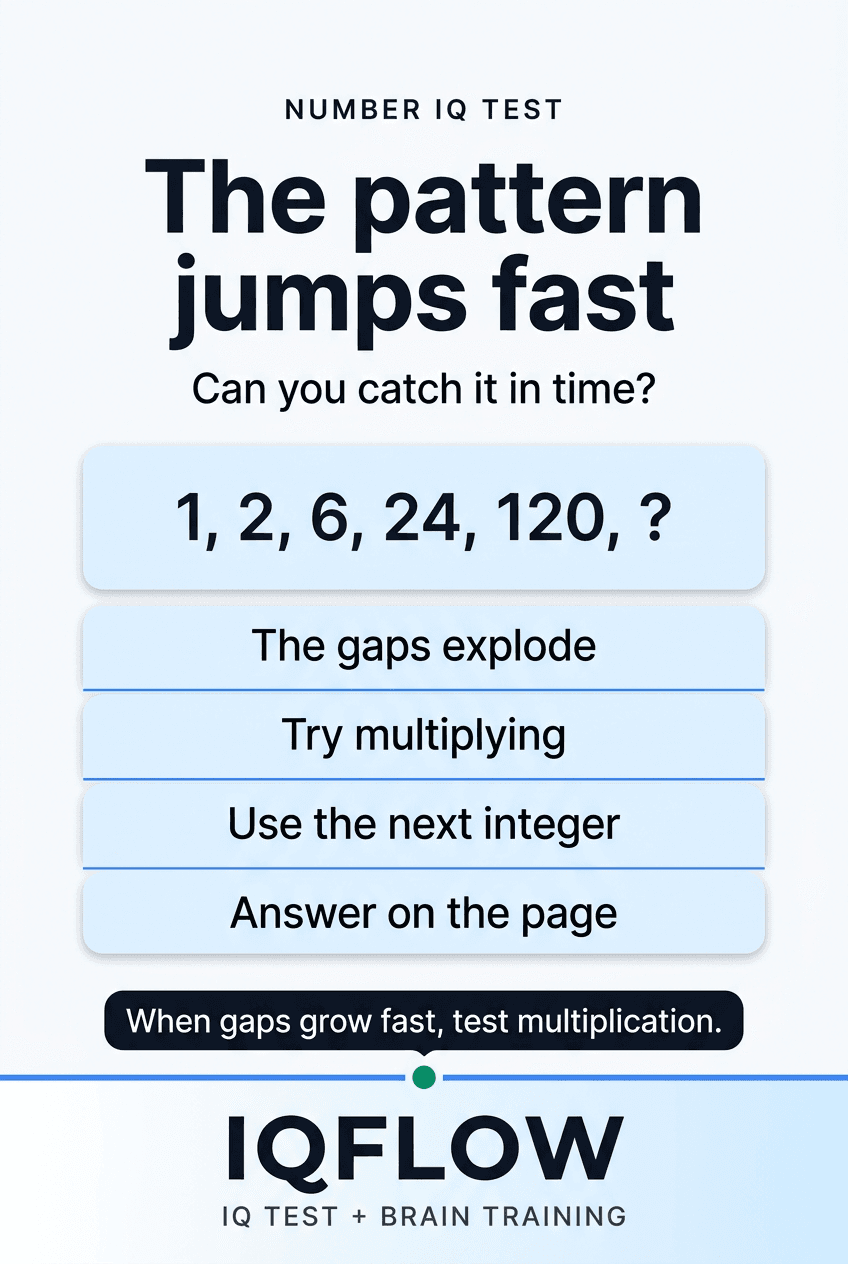
Factorial pattern
The pattern jumps fast
A fast-growing sequence that becomes simple once you notice the multiplication rule.
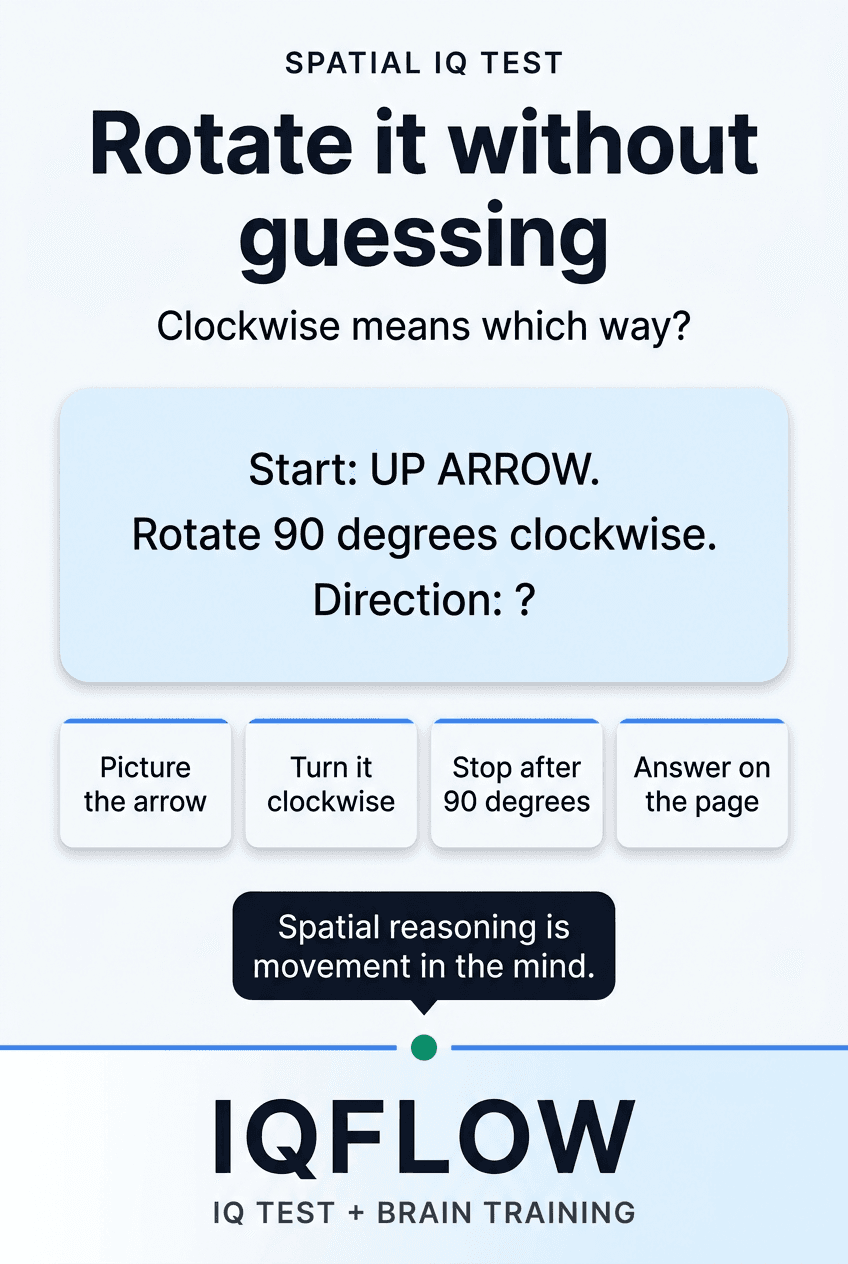
Spatial rotation
Rotate it without guessing
A spatial-reasoning question about mentally rotating direction instead of reacting to the symbol.
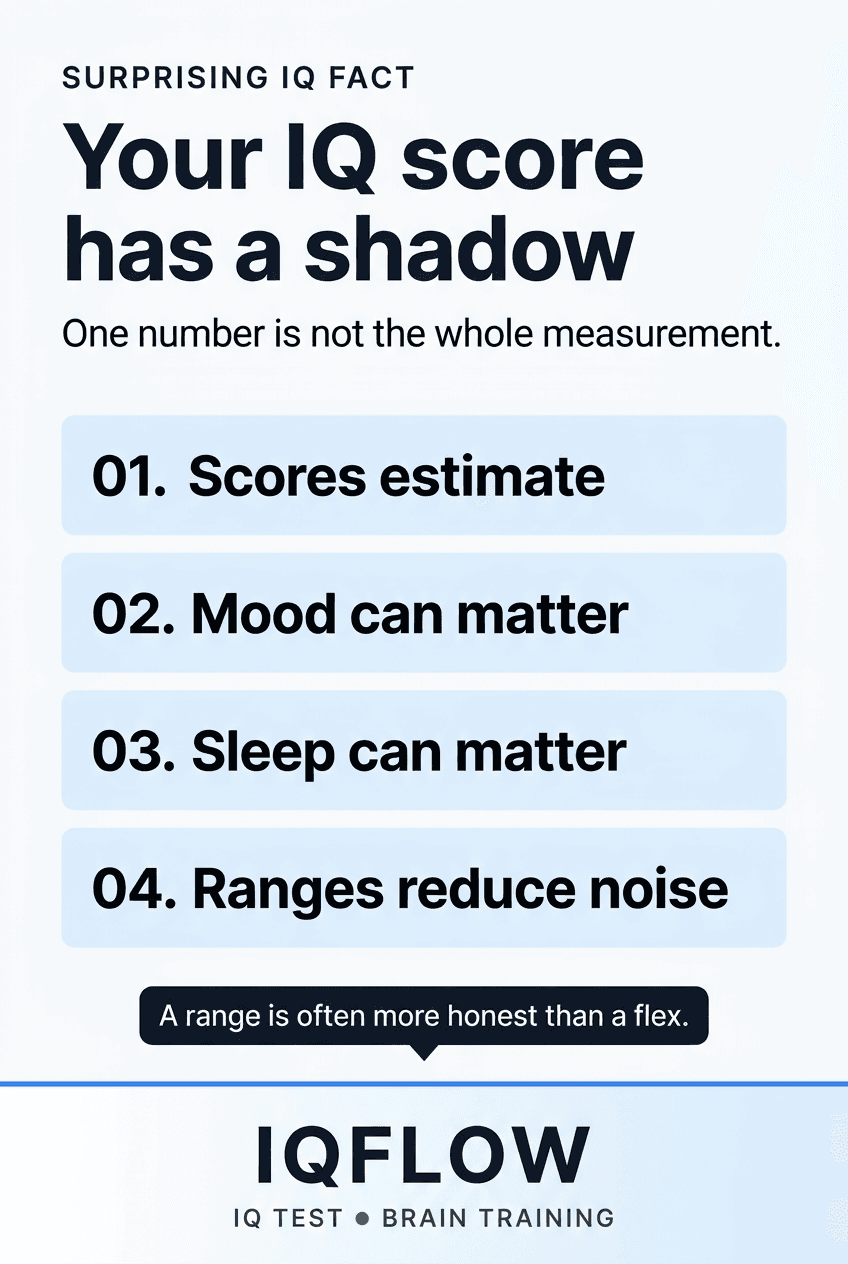
IQ score range
Your IQ score has a shadow
IQ-style scores are estimates, so a range can be more honest than one exact number.
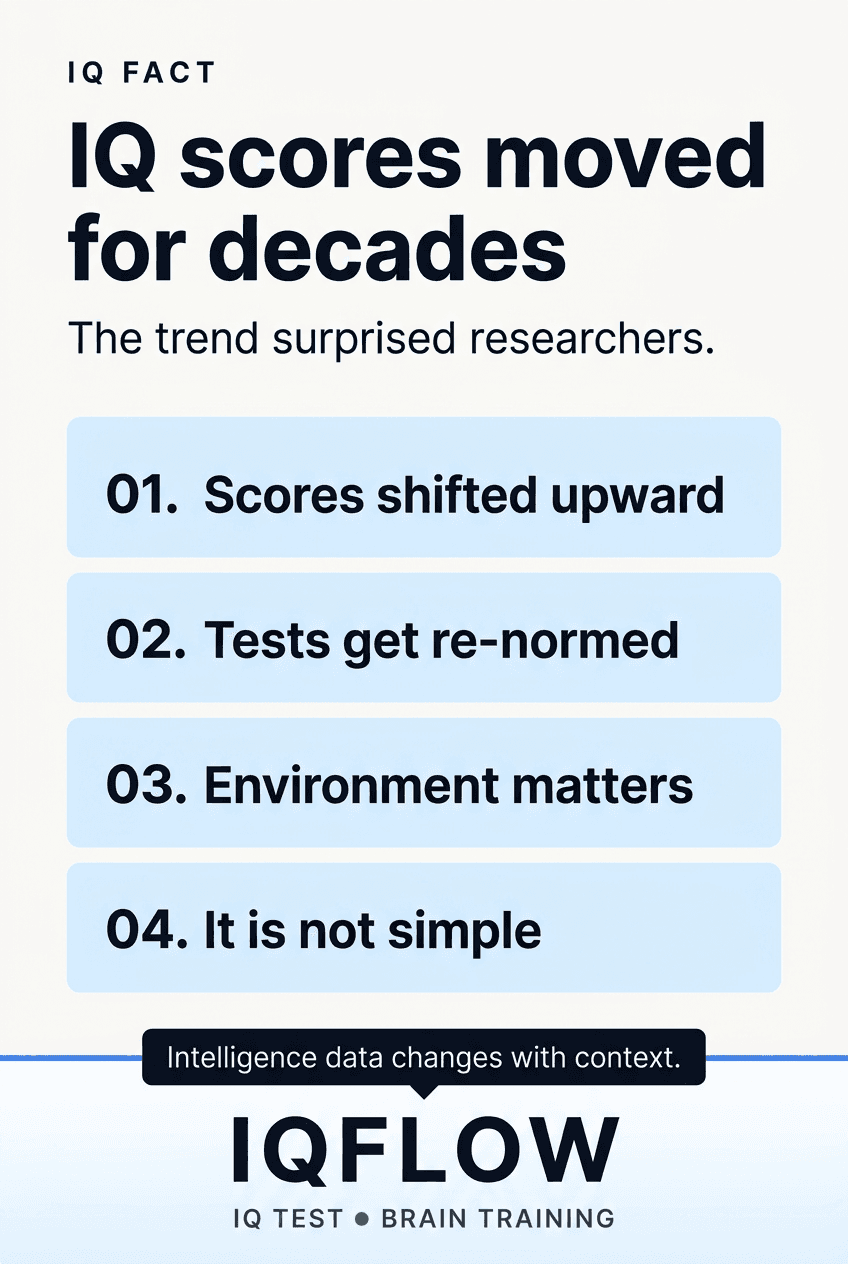
Flynn effect
IQ scores moved for decades
The Flynn effect is one of the strangest IQ facts: test scores rose across many populations over time.
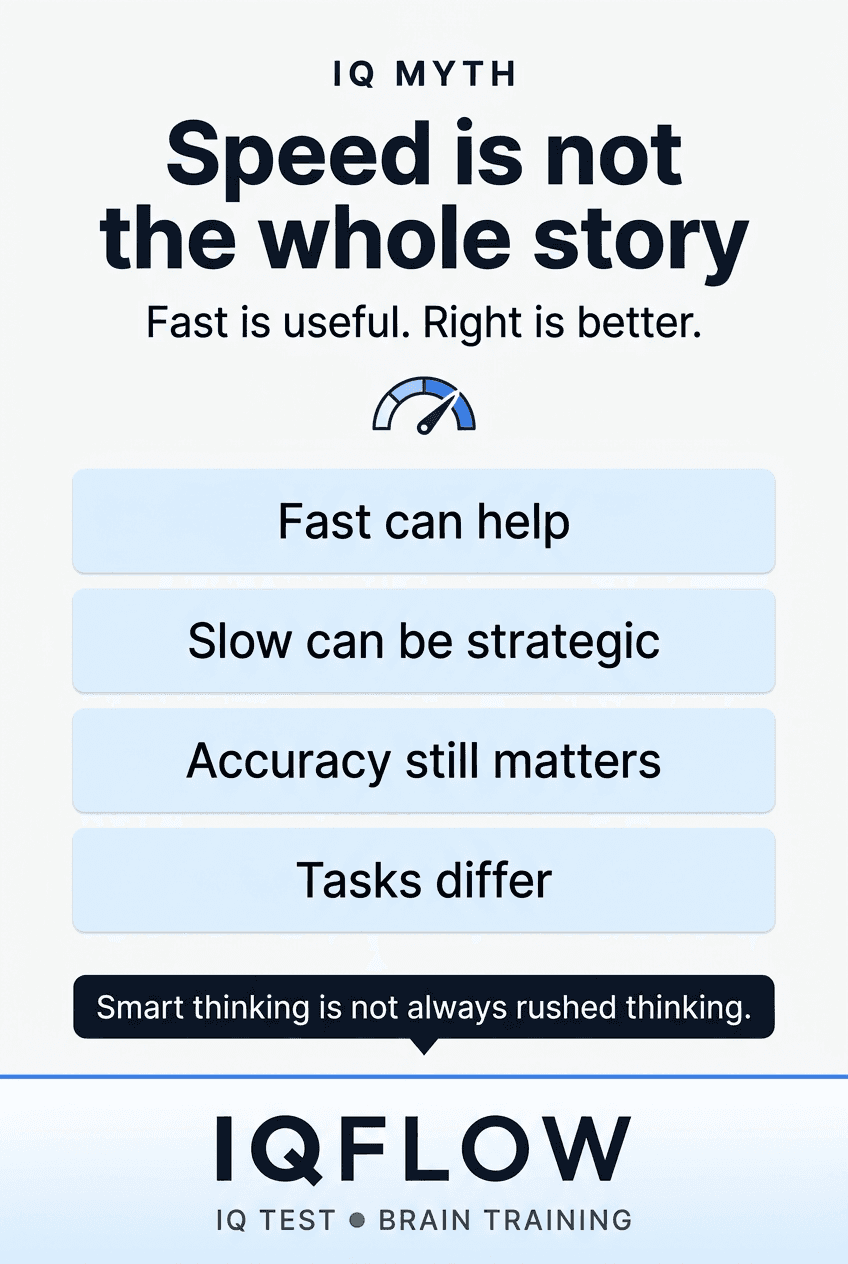
Processing speed
Speed is not the whole story
Processing speed matters, but accuracy and reasoning strategy still change the result.
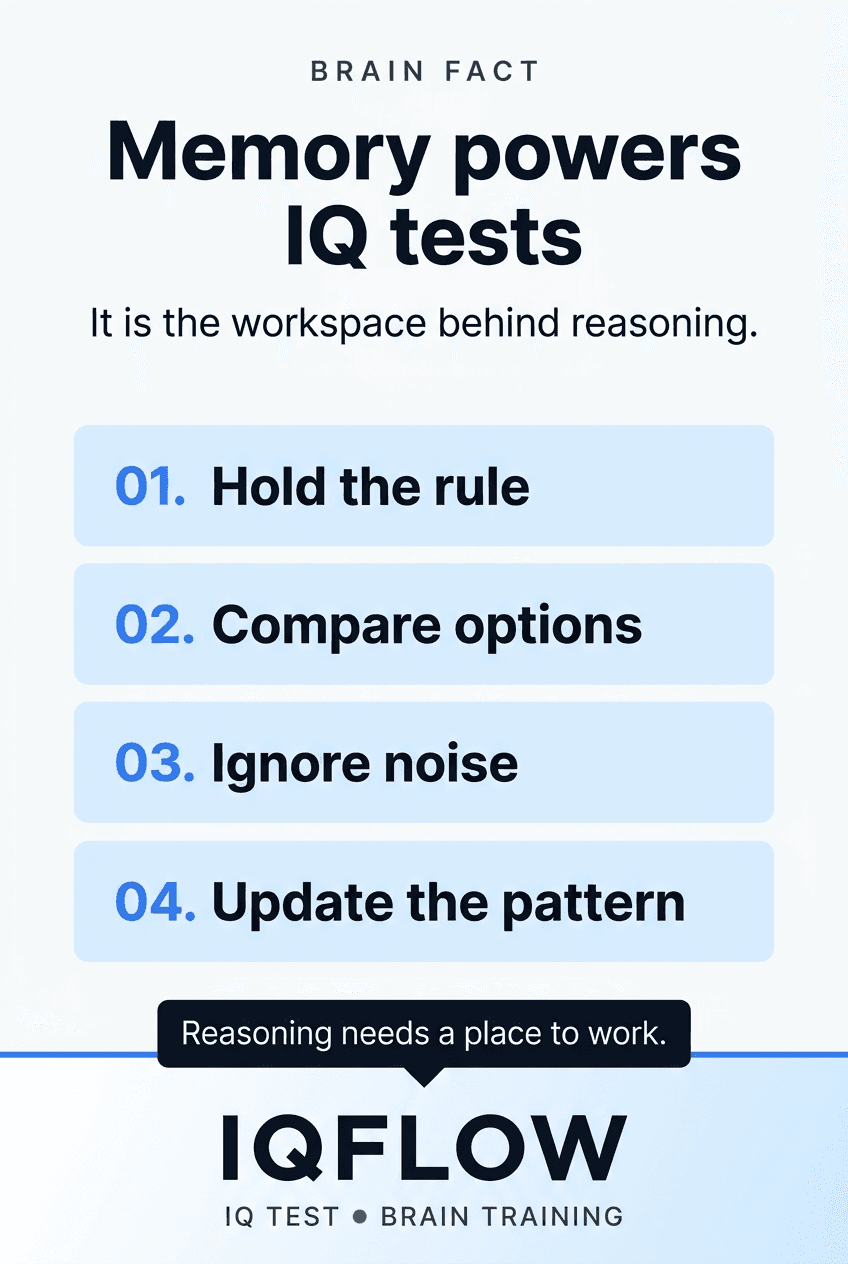
Working memory
Memory powers IQ tests
Working memory helps you hold rules, compare options, and avoid losing the thread.
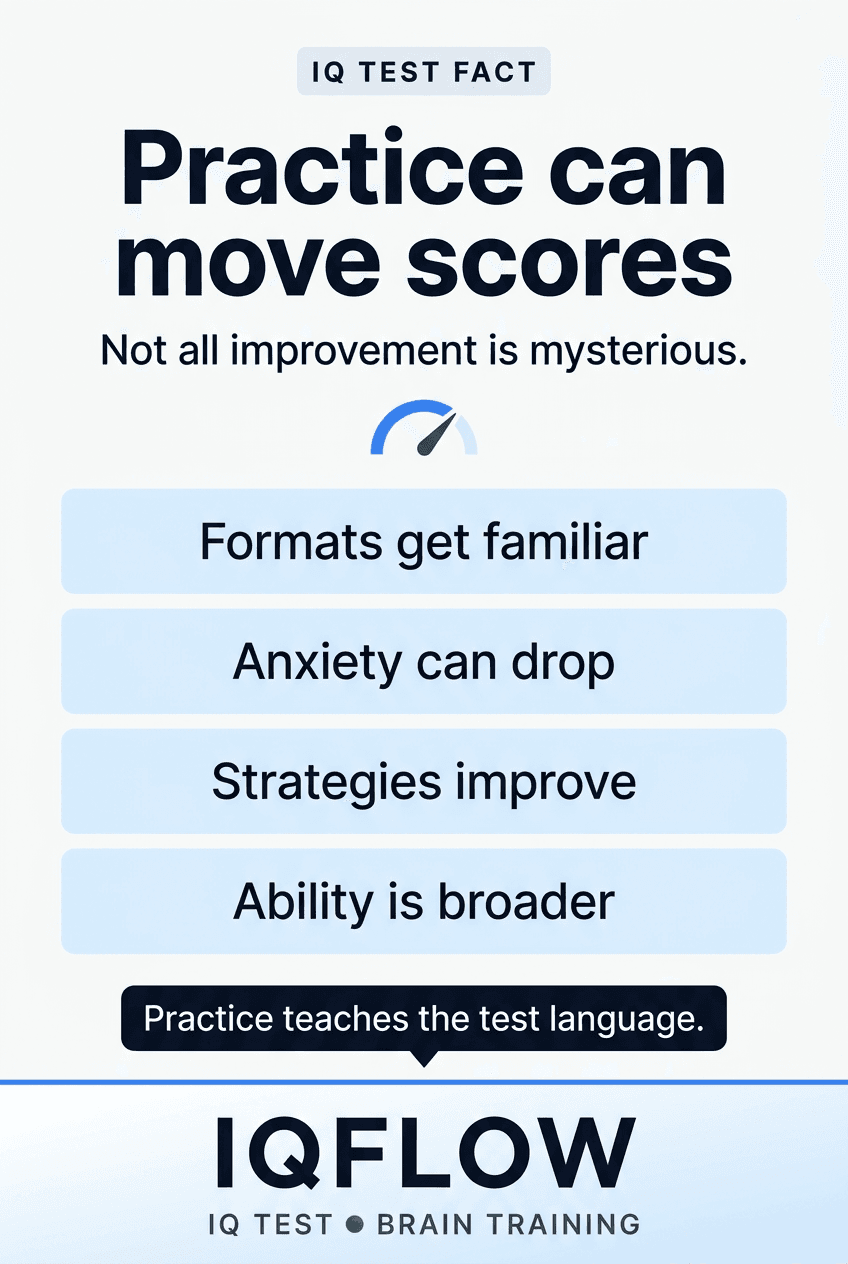
Practice effects
Practice can move scores
Familiarity with question formats can improve performance, which is why one result should not define you.
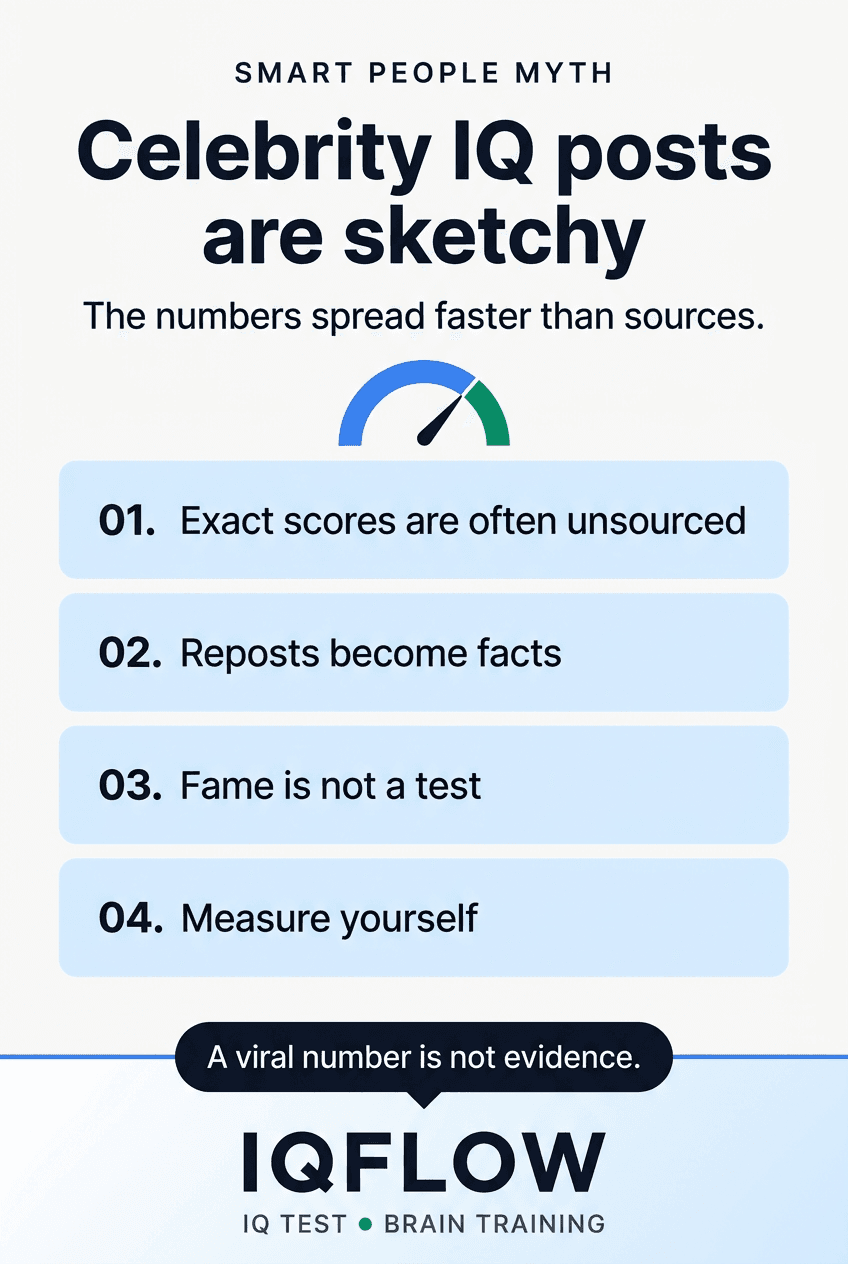
Celebrity IQ myths
Celebrity IQ posts are sketchy
Many viral celebrity IQ numbers are repeated without credible test documentation.
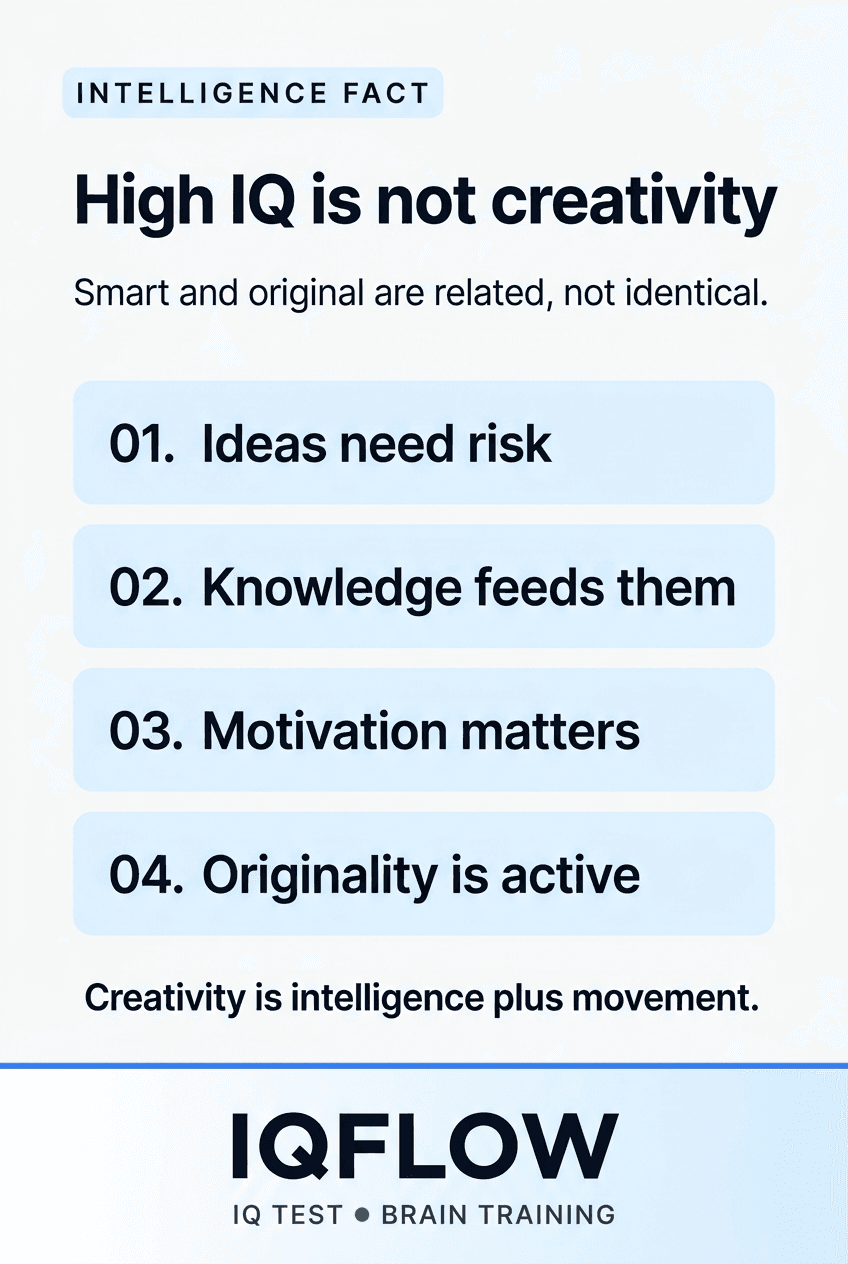
IQ and creativity
High IQ is not creativity
Creativity depends on more than raw problem-solving ability.
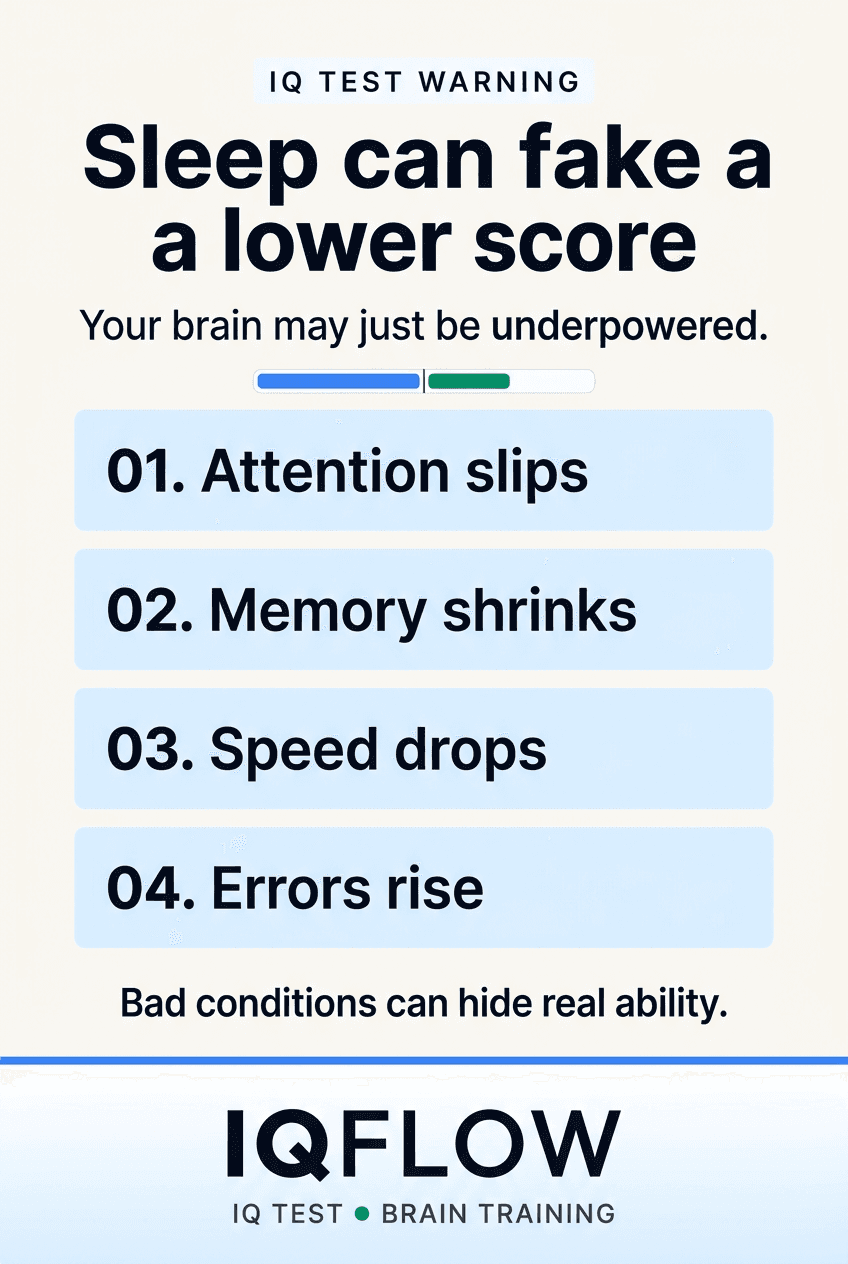
Sleep and testing
Sleep can fake a lower score
A tired brain can make reasoning, memory, and speed look worse for the day.
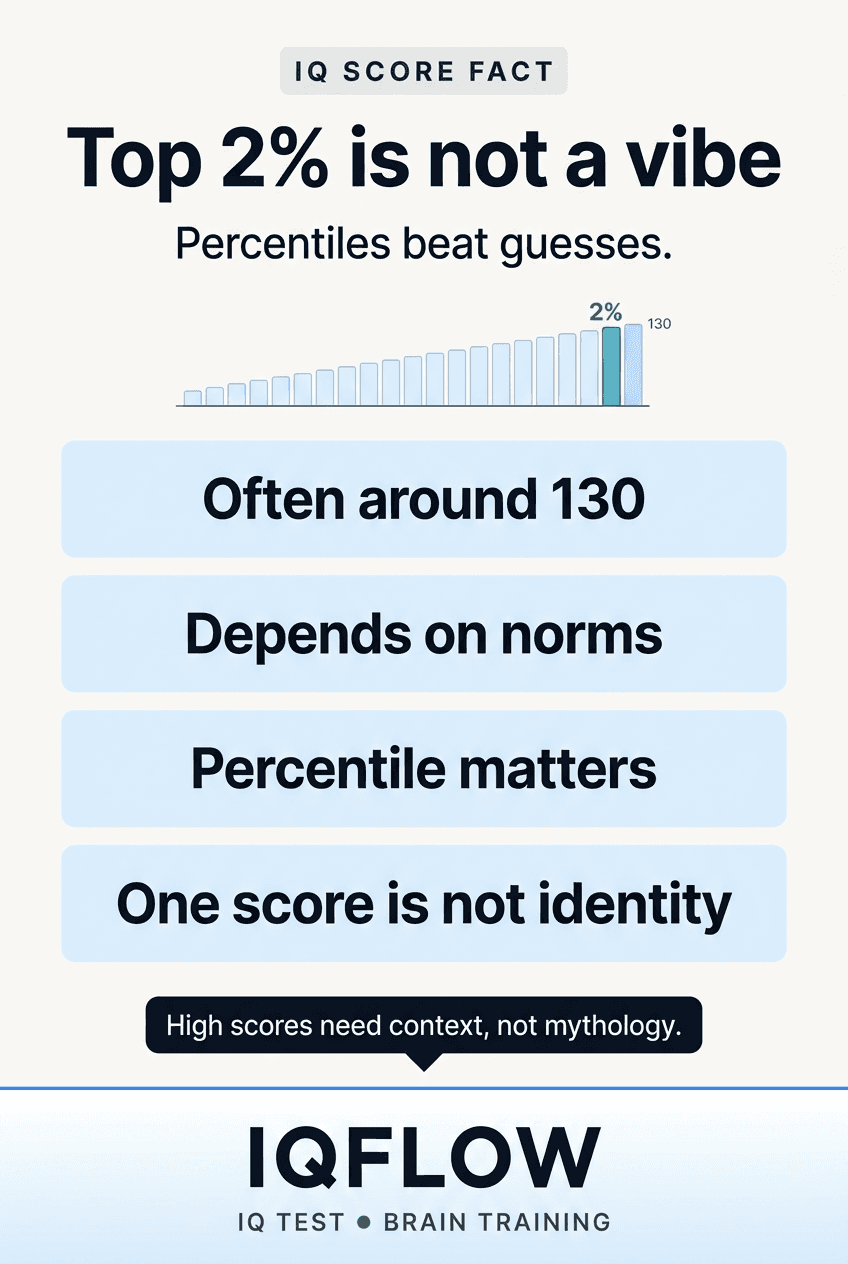
IQ percentiles
Top 2% is not a vibe
High-IQ thresholds are about percentile ranks and test norms, not just feeling smarter than average.
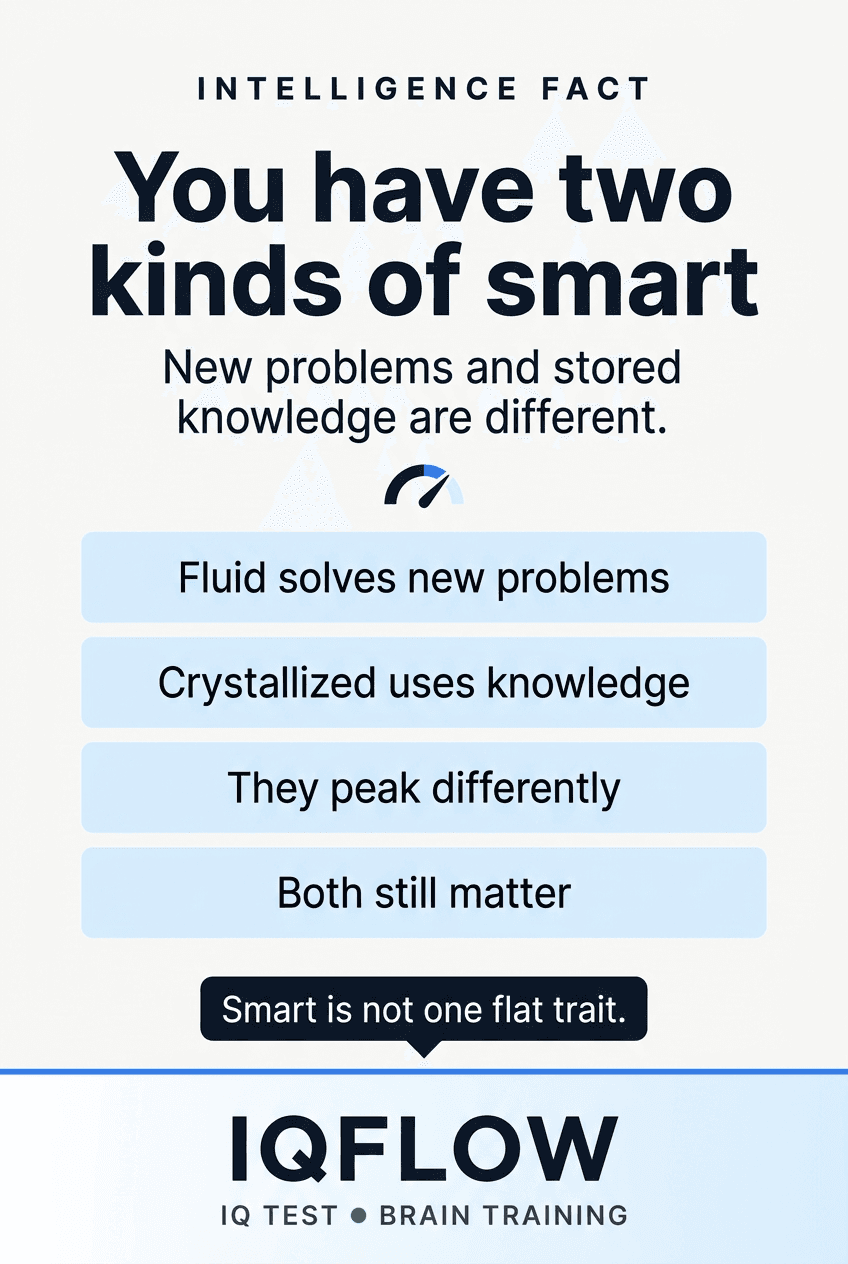
Fluid vs crystallized
You have two kinds of smart
Fluid and crystallized intelligence explain why people can be sharp in different ways.
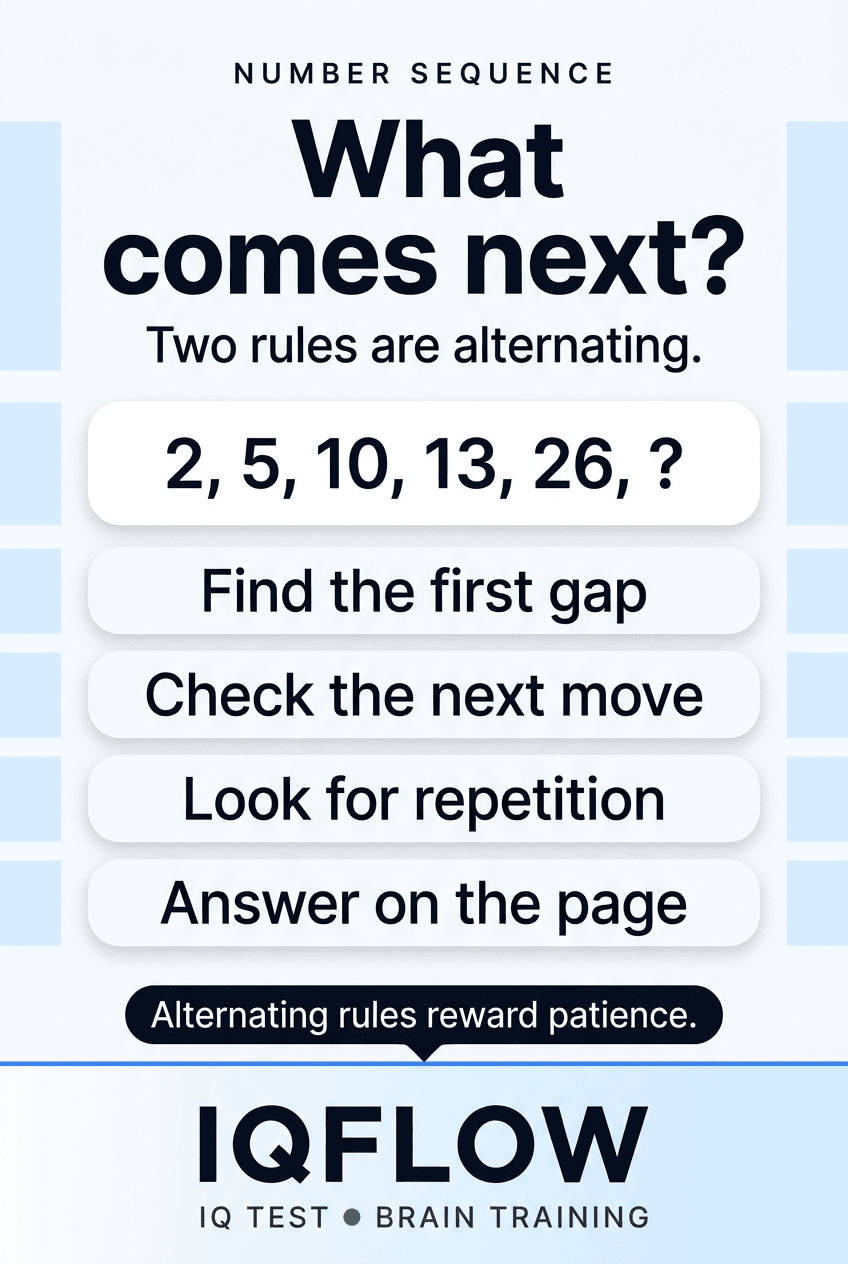
Alternating sequence
What comes next
Try an alternating number sequence and learn why repeating operations matter.
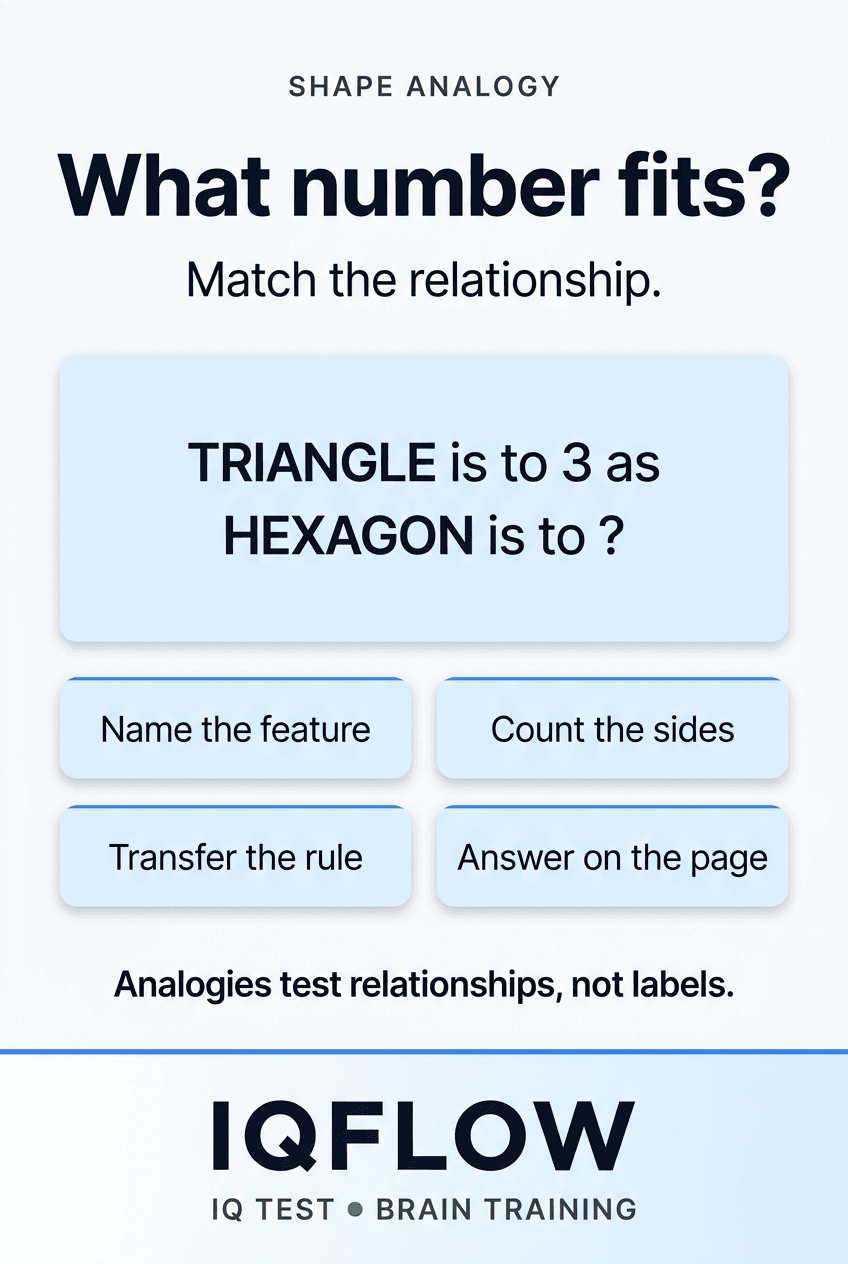
Shape analogy
What number fits
A visual analogy puzzle about matching shapes to their number of sides.
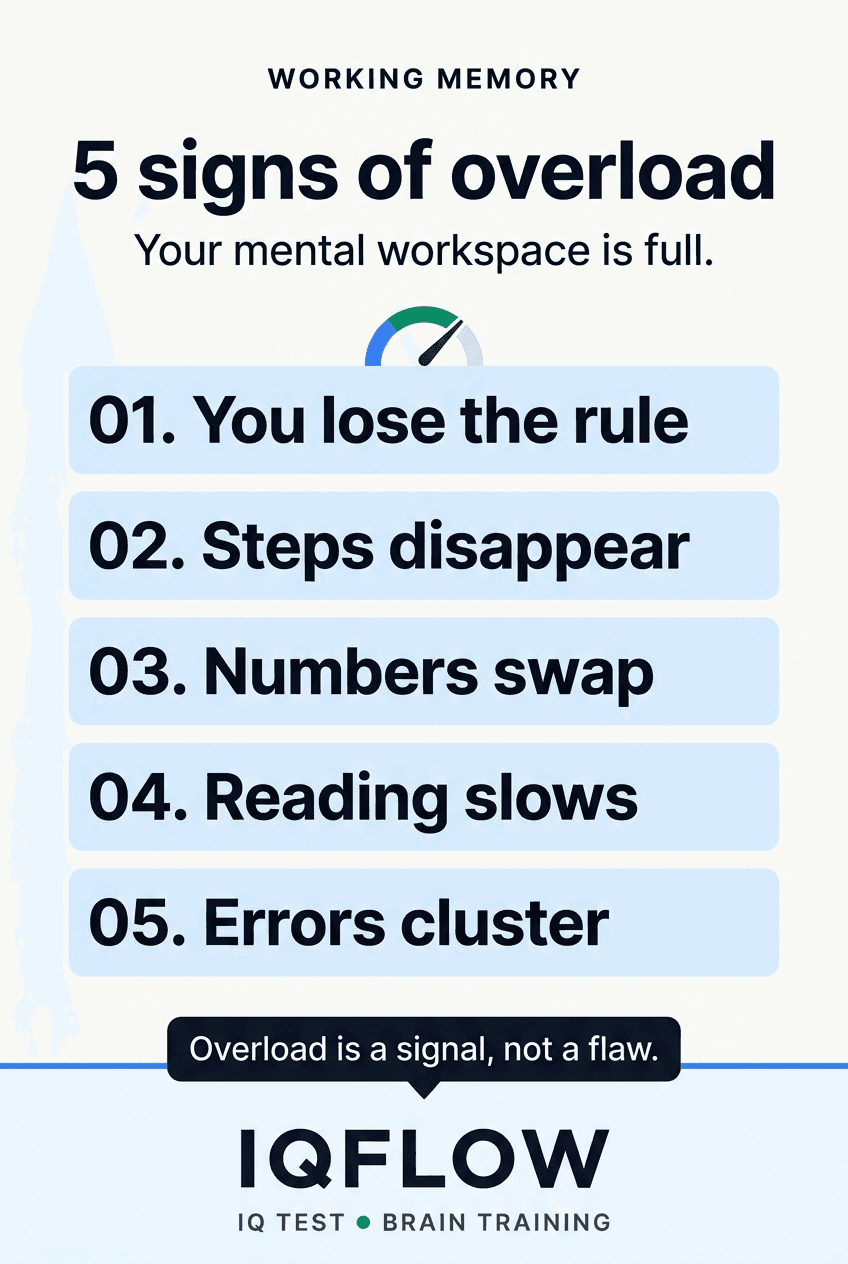
Working memory
5 signs of overload
Working memory overload can make simple tasks feel harder than they should.
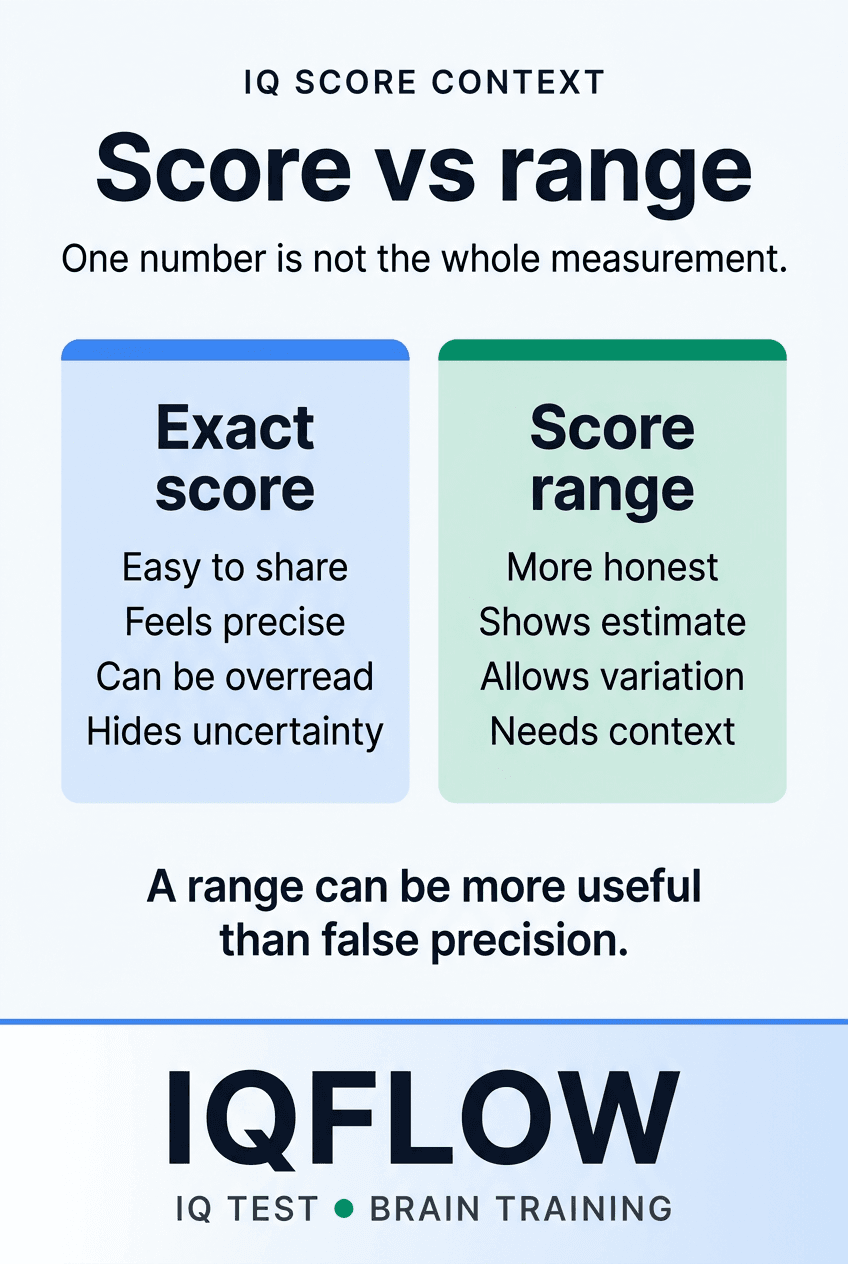
Score ranges
Why IQ scores have ranges
IQ-style scores are estimates, so a range can be more honest than one exact number.
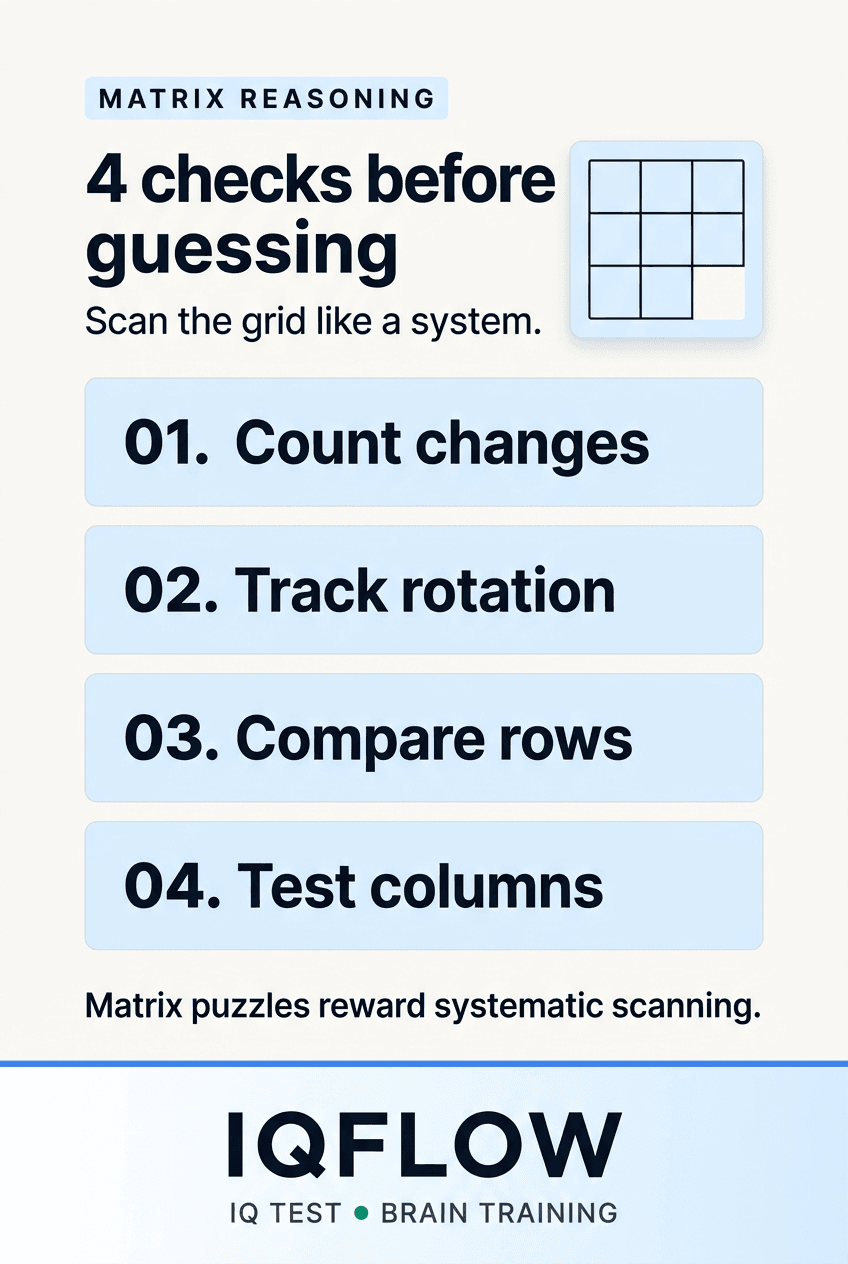
Matrix reasoning
4 checks before guessing
Matrix reasoning gets easier when you scan rows and columns systematically.
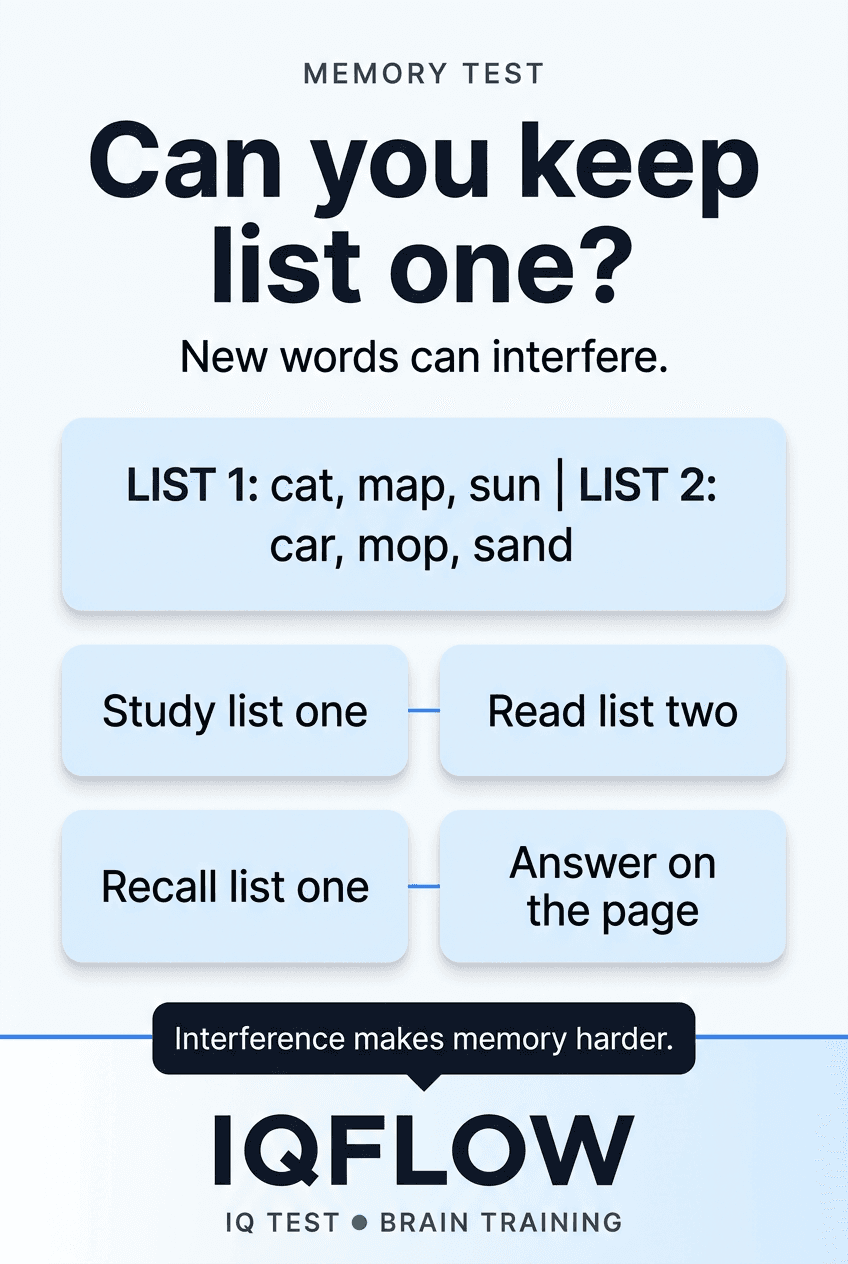
Memory interference
Can you keep list one
Interference tasks show how new information can crowd out what you just learned.
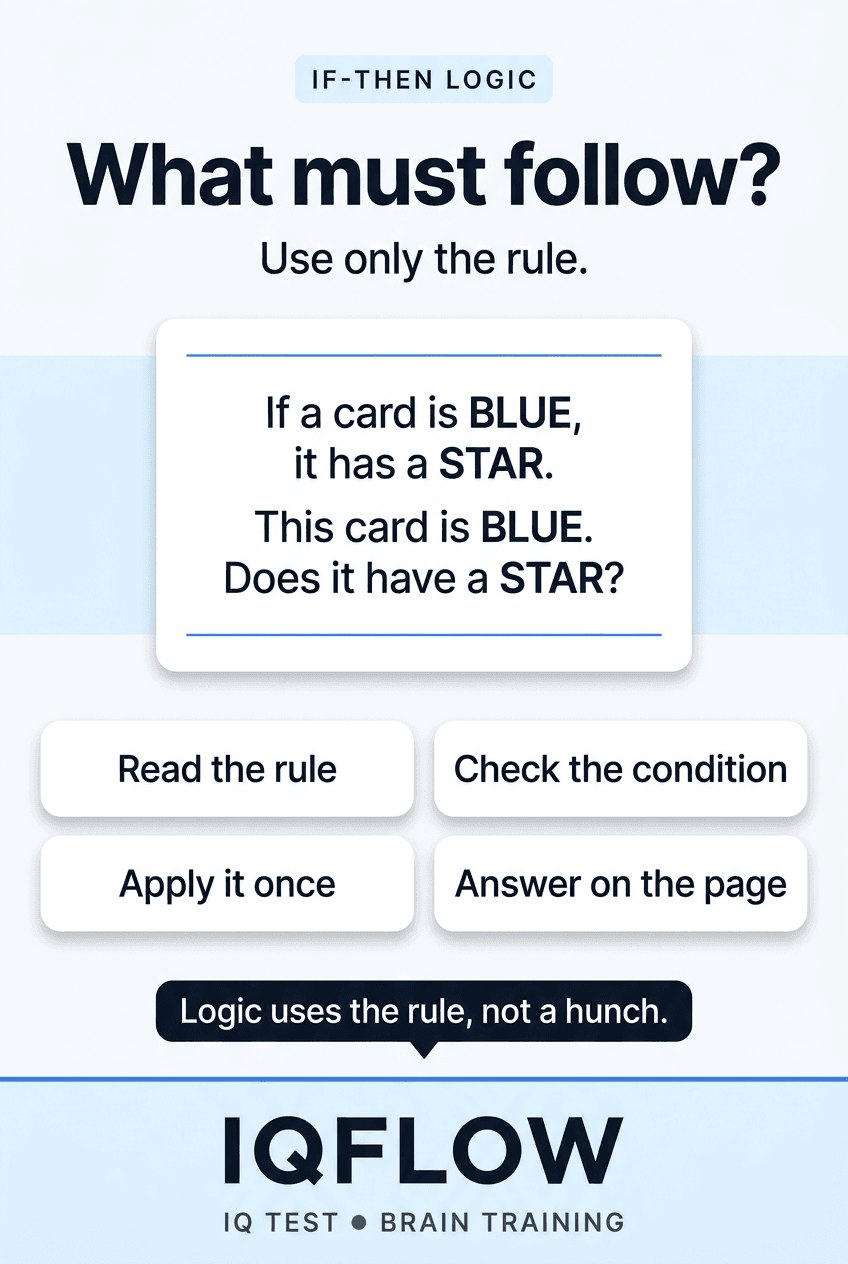
If-then logic
What must follow
A short if-then logic question for practicing careful conclusions.
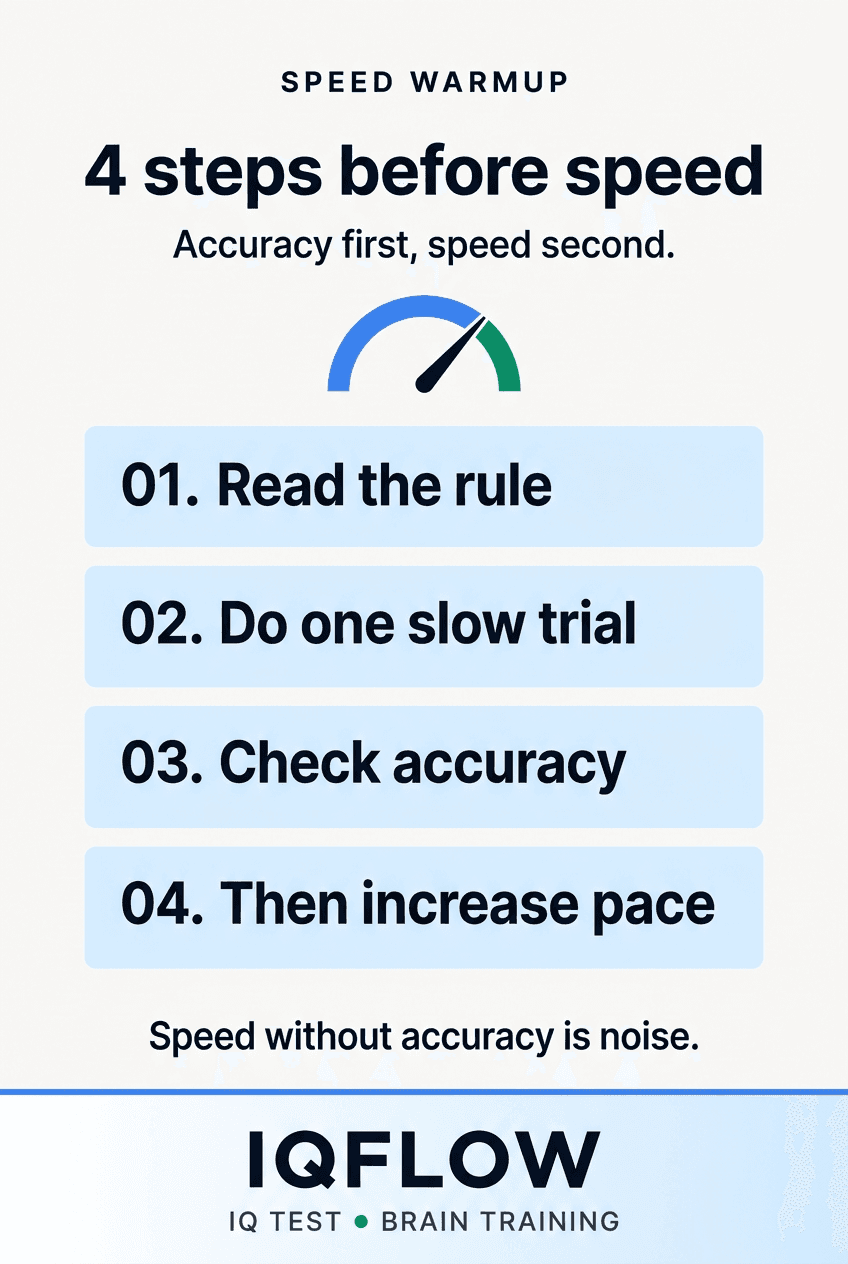
Processing speed
4 steps before speed
A short warmup can make timed cognitive tasks feel less chaotic.
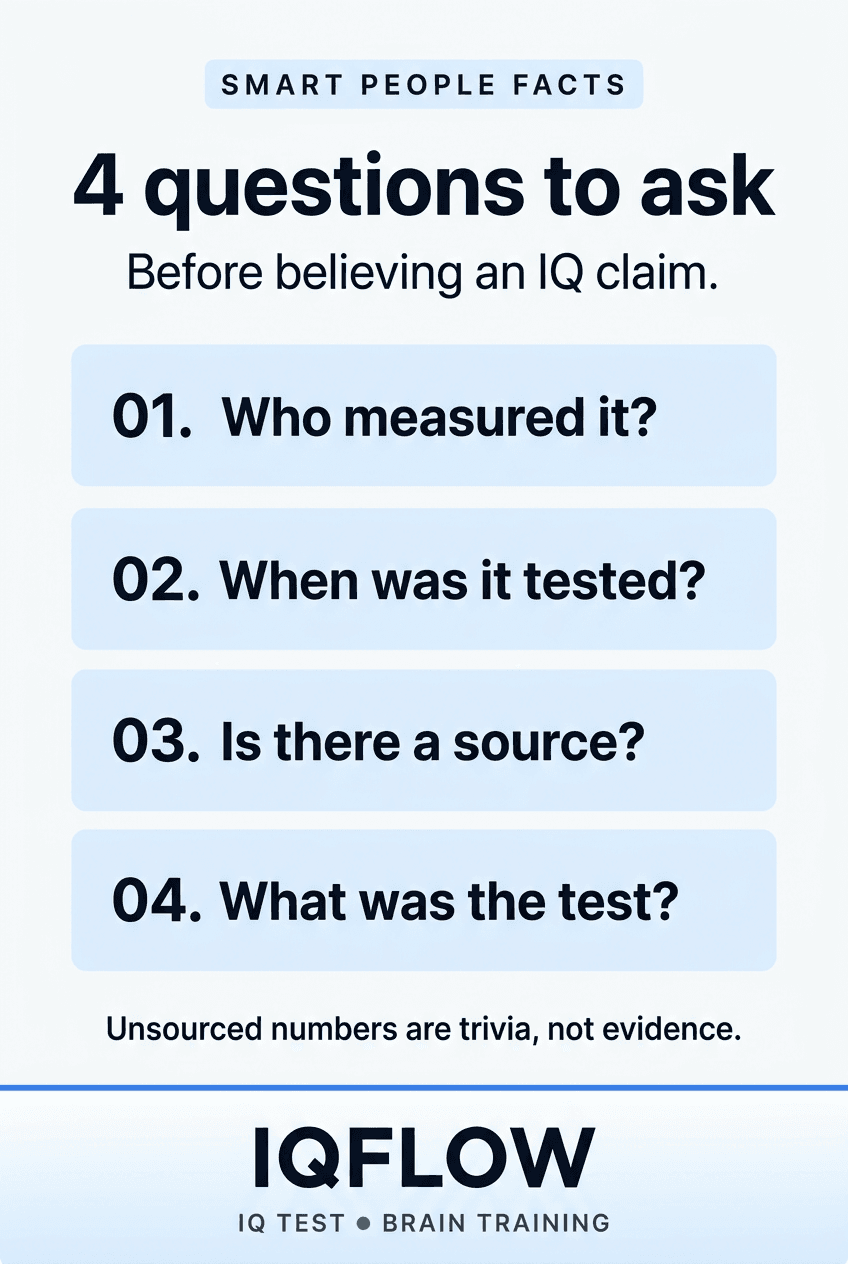
Celebrity IQ claims
4 questions to ask
Exact celebrity IQ claims often spread without reliable sourcing.
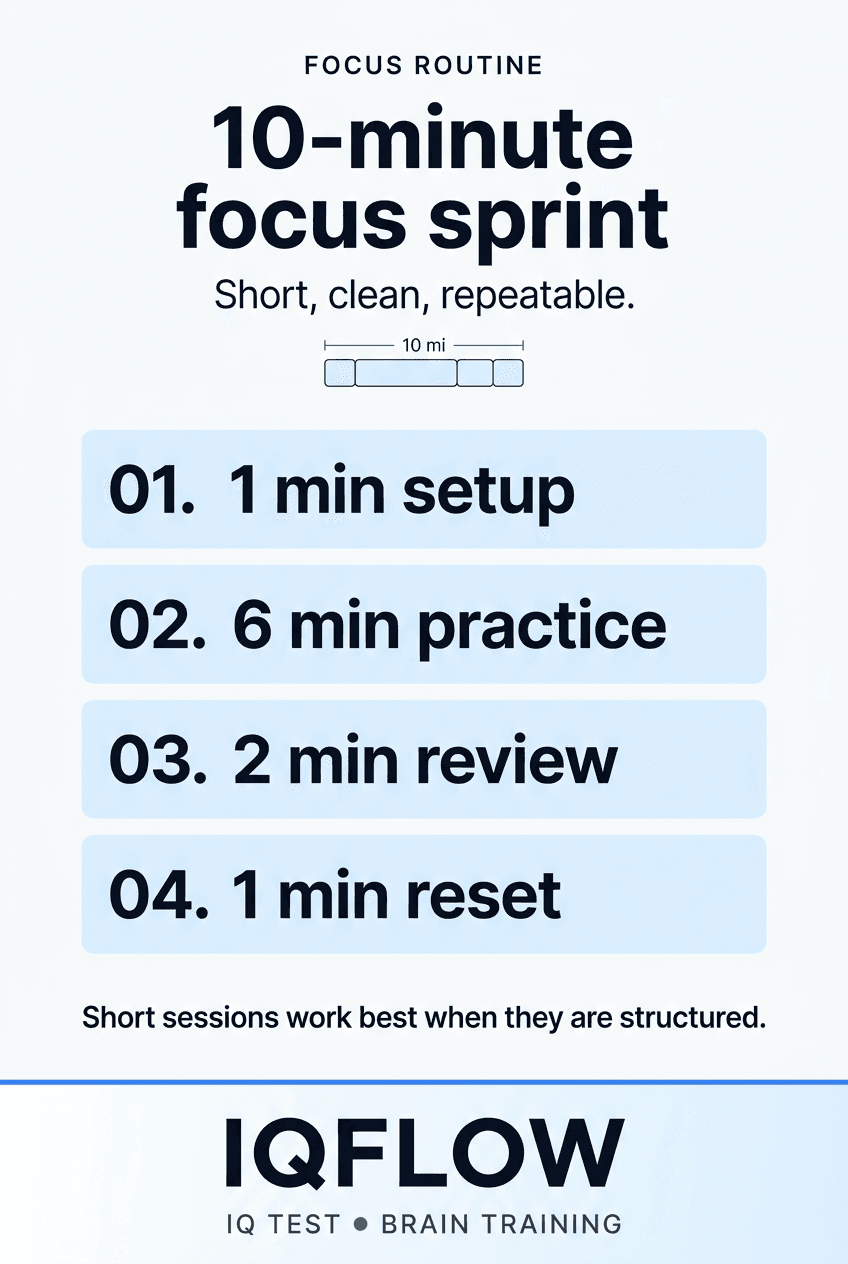
Focus routine
10-minute focus sprint
A 10-minute focus sprint gives short cognitive practice a clear structure.
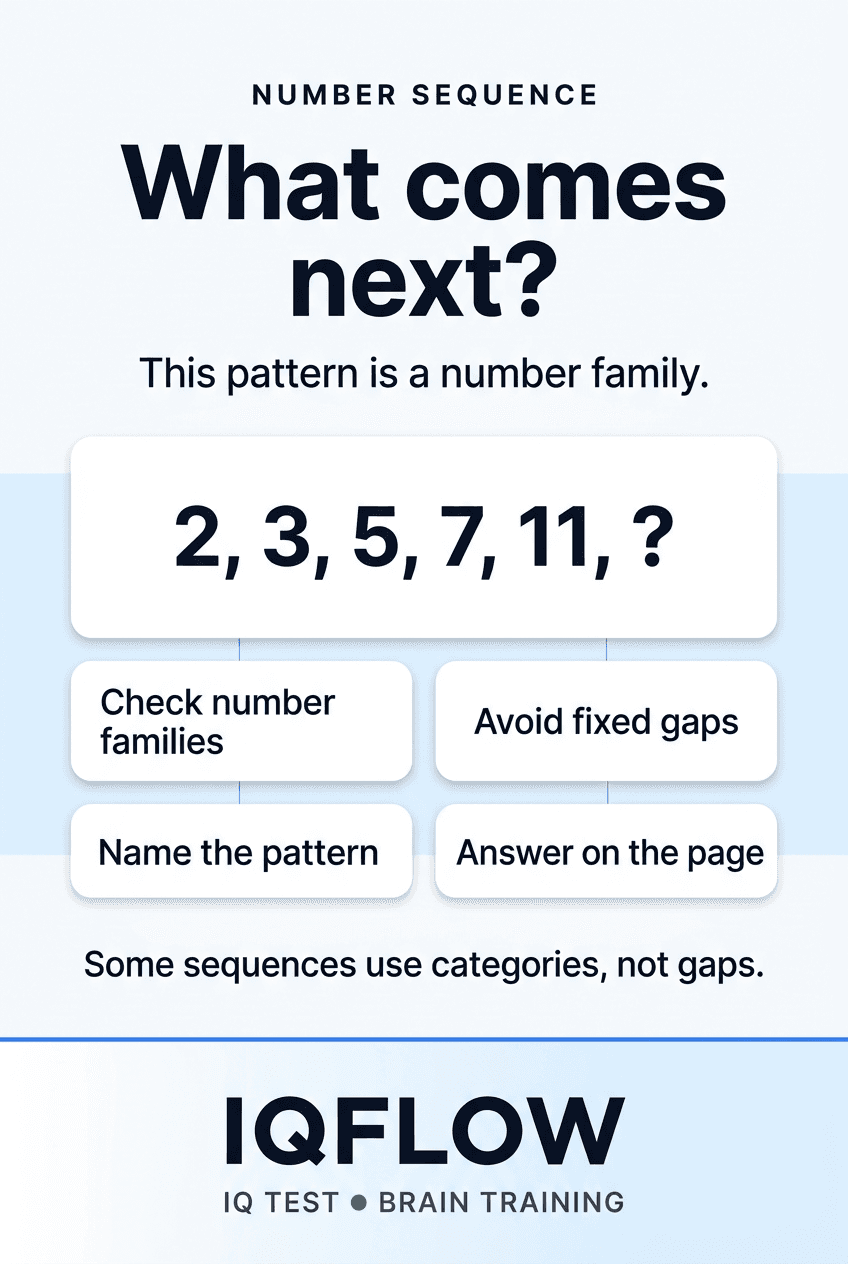
Prime sequence
What comes next
A simple number sequence puzzle that tests whether you recognize prime numbers.
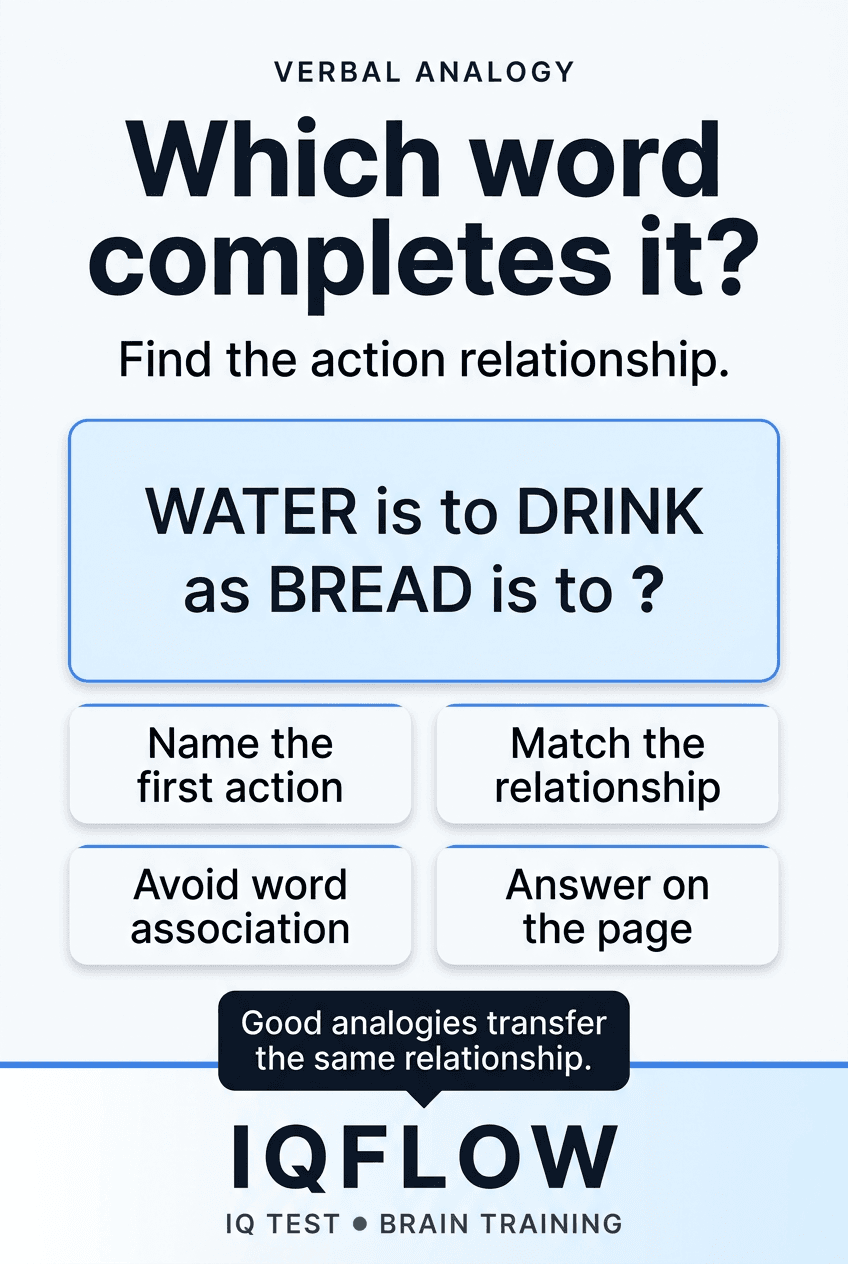
Verbal analogy
Which word completes it
A quick verbal analogy for practicing relationship mapping.
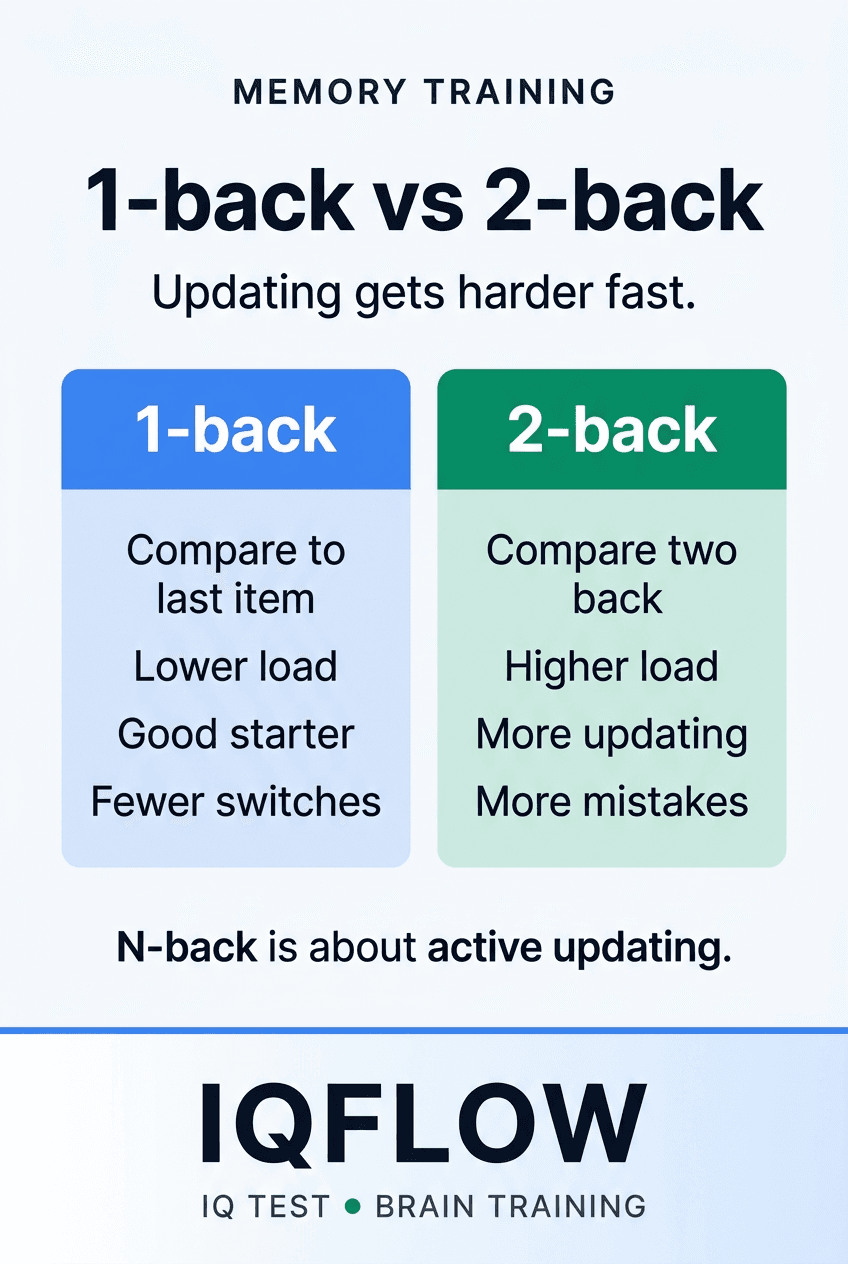
N-back memory
1-back vs 2-back
N-back tasks train active updating, not just simple recall.
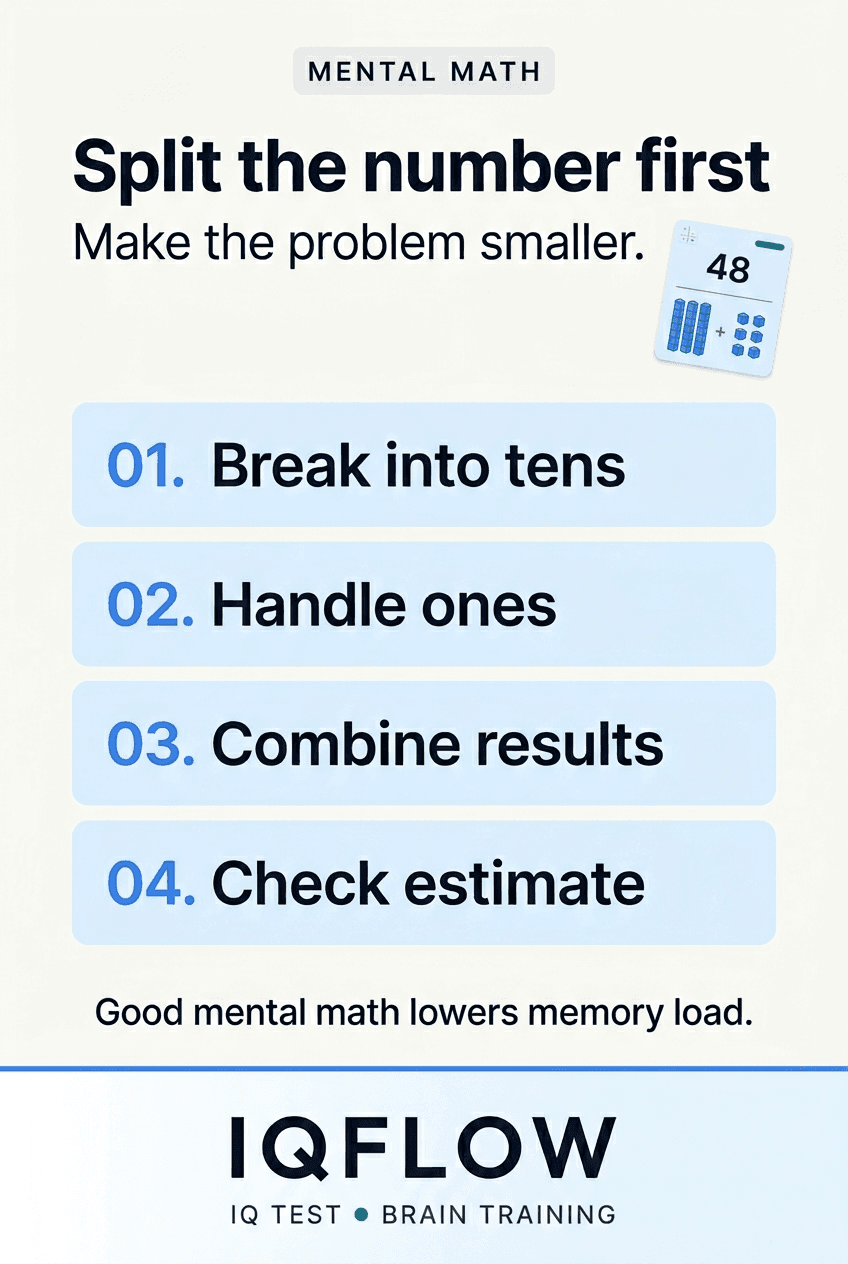
Mental math
Split the number first
A beginner mental math habit that reduces working-memory load.
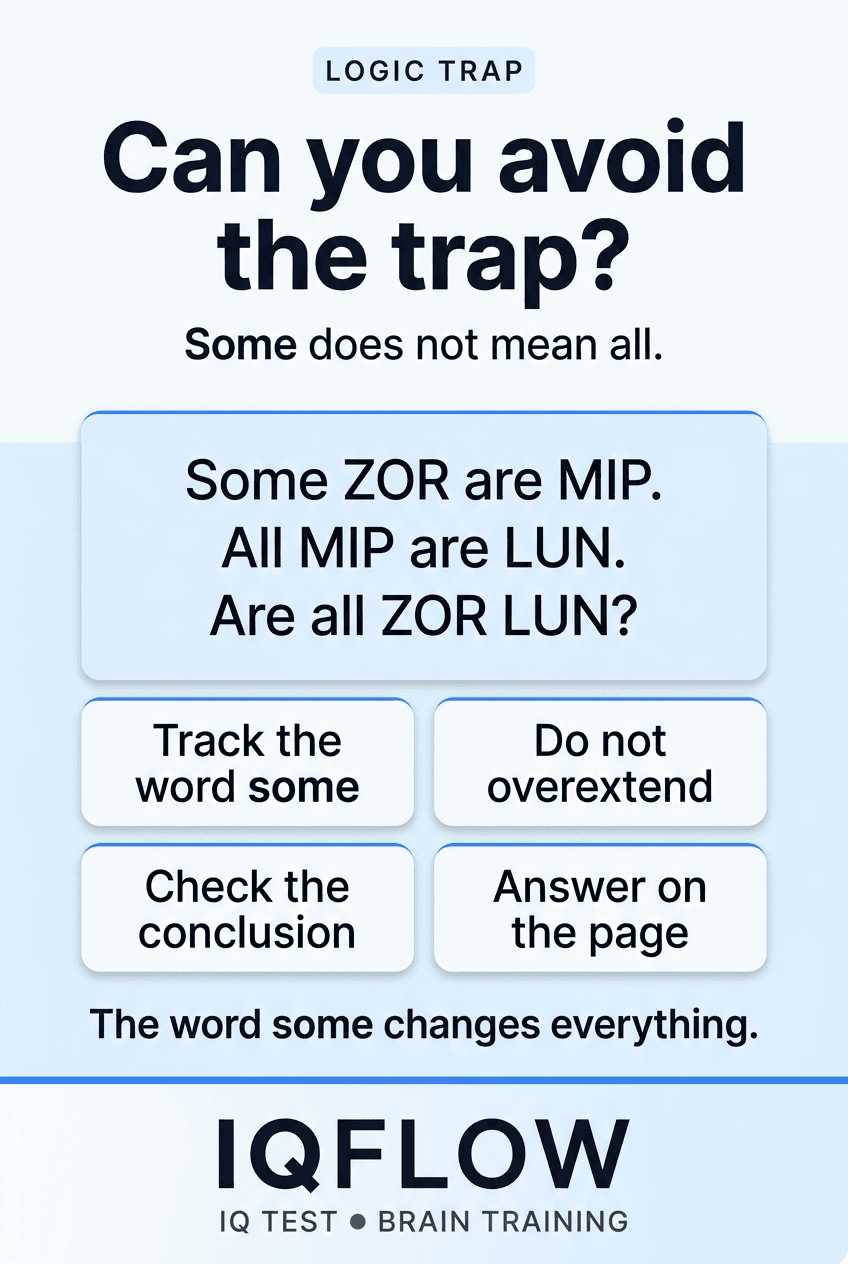
Logic trap
Can you avoid the trap
Some/all statements are a common trap in logic questions.
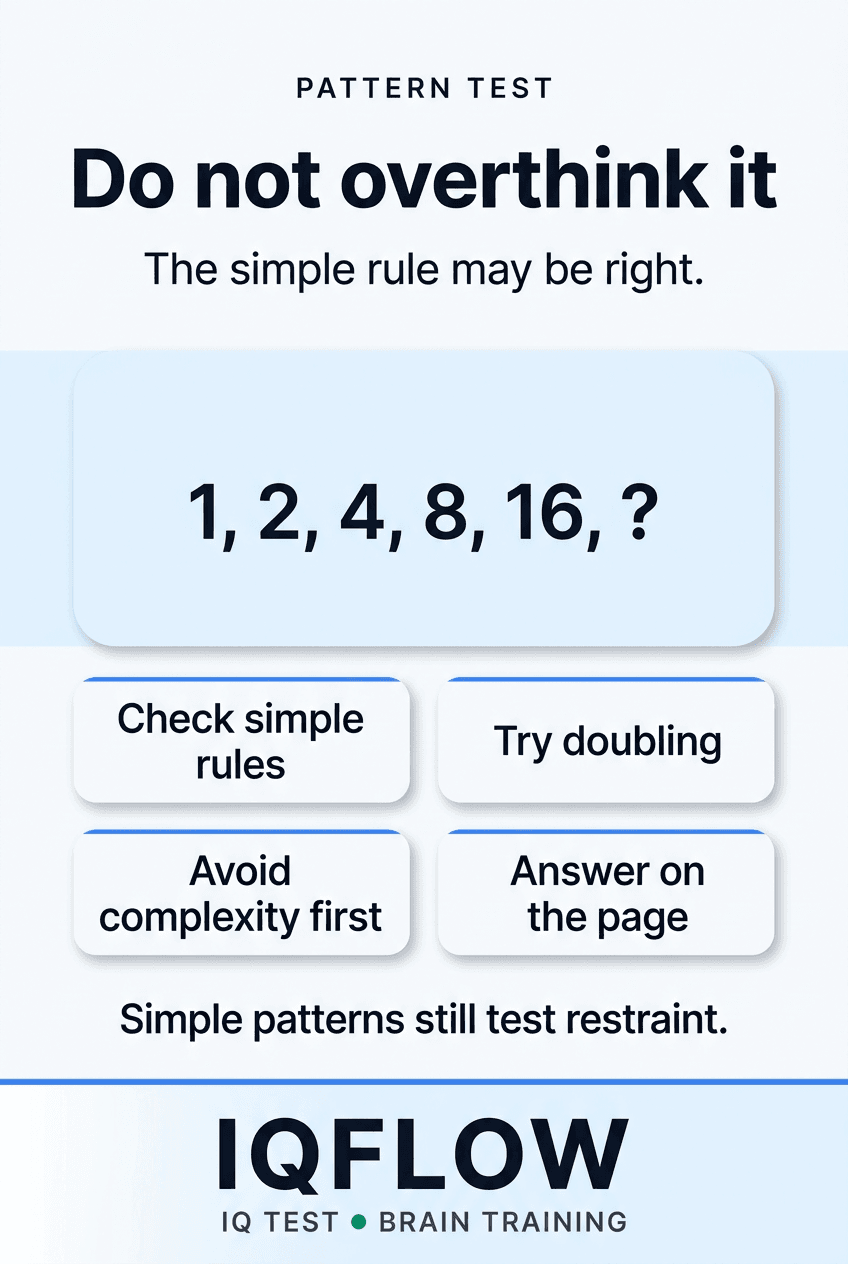
Pattern trap
Do not overthink it
Some IQ-style patterns are simple, but people miss them by searching for something too complex.
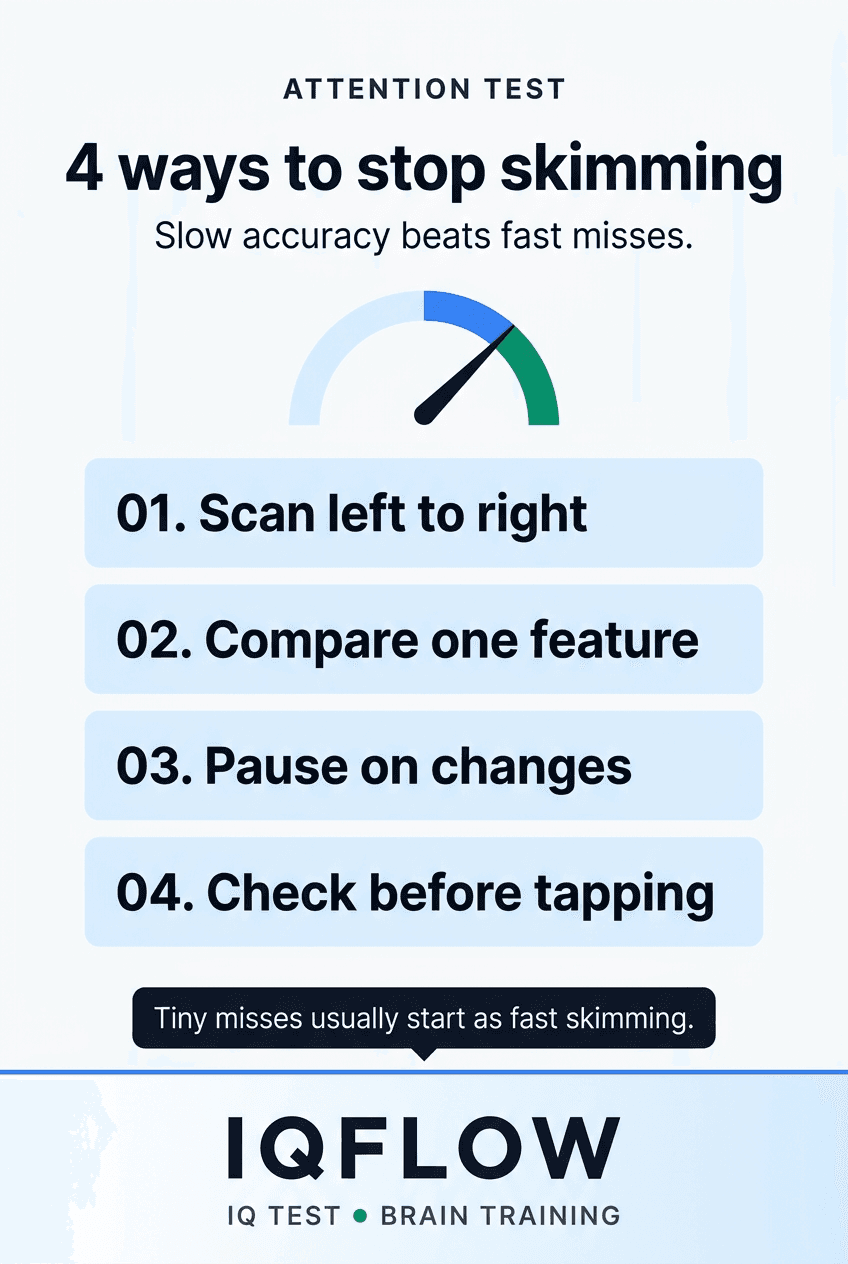
Attention test
4 ways to stop skimming
A quick attention checklist for slowing down before tiny mistakes slip through.
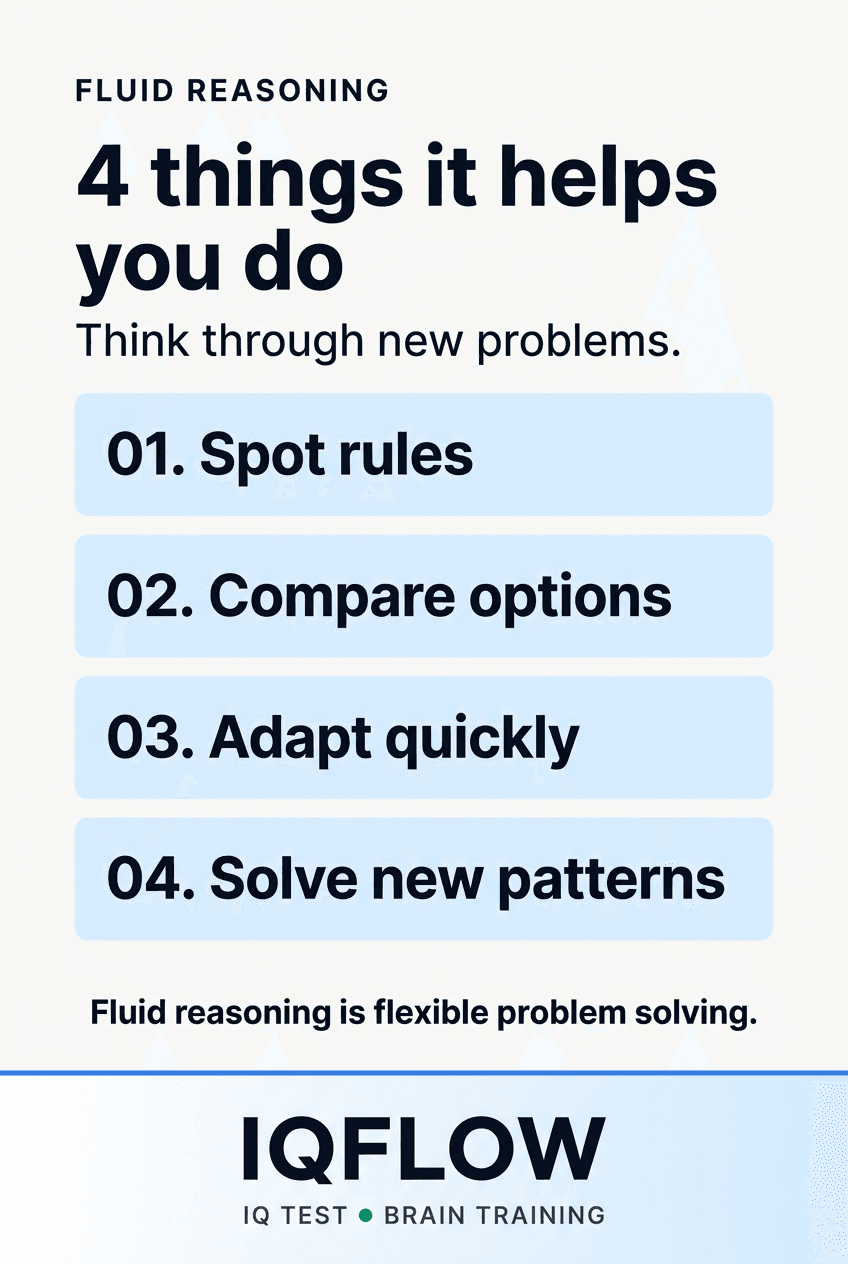
Fluid reasoning
4 things it helps you do
Fluid reasoning is the ability to solve new problems without relying only on memorized facts.
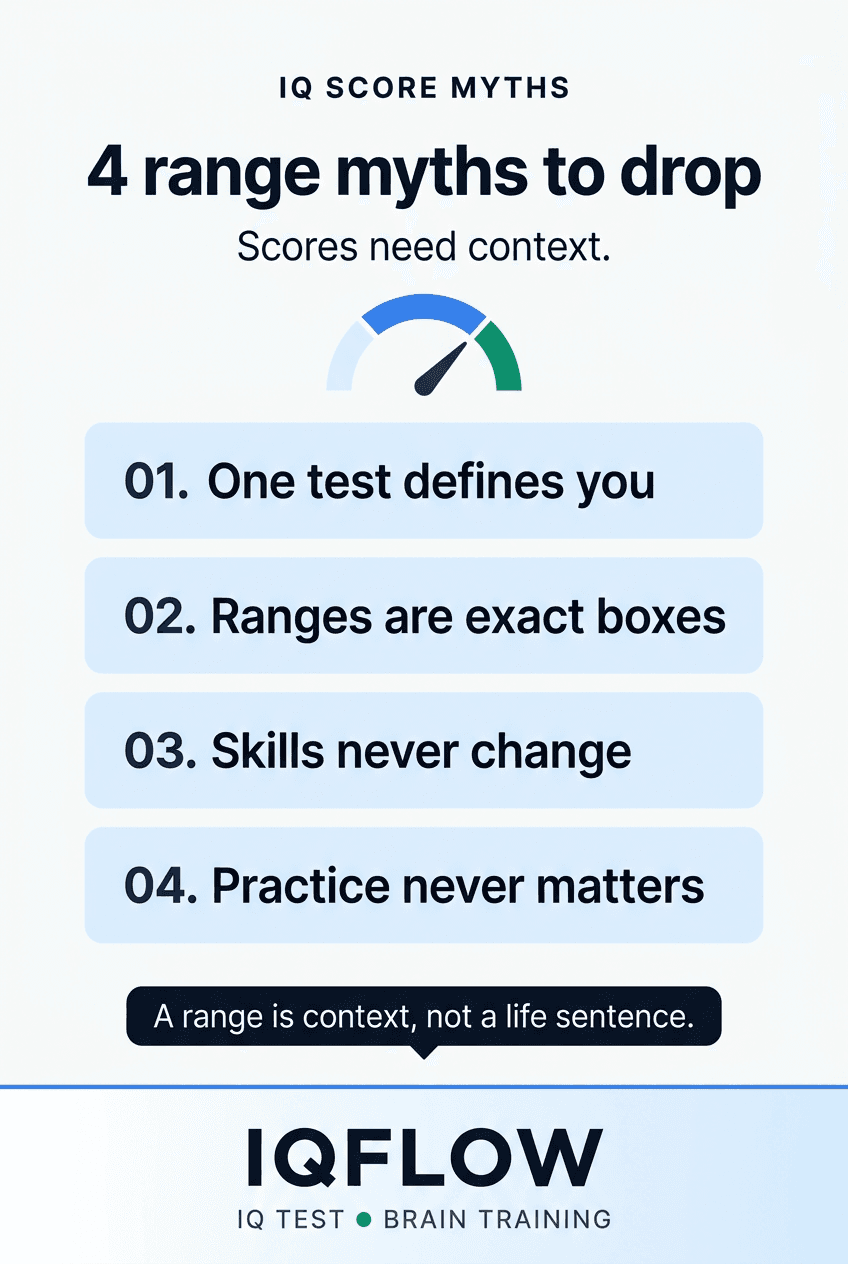
IQ range myths
4 range myths to drop
IQ score ranges are often misunderstood as fixed identity labels.
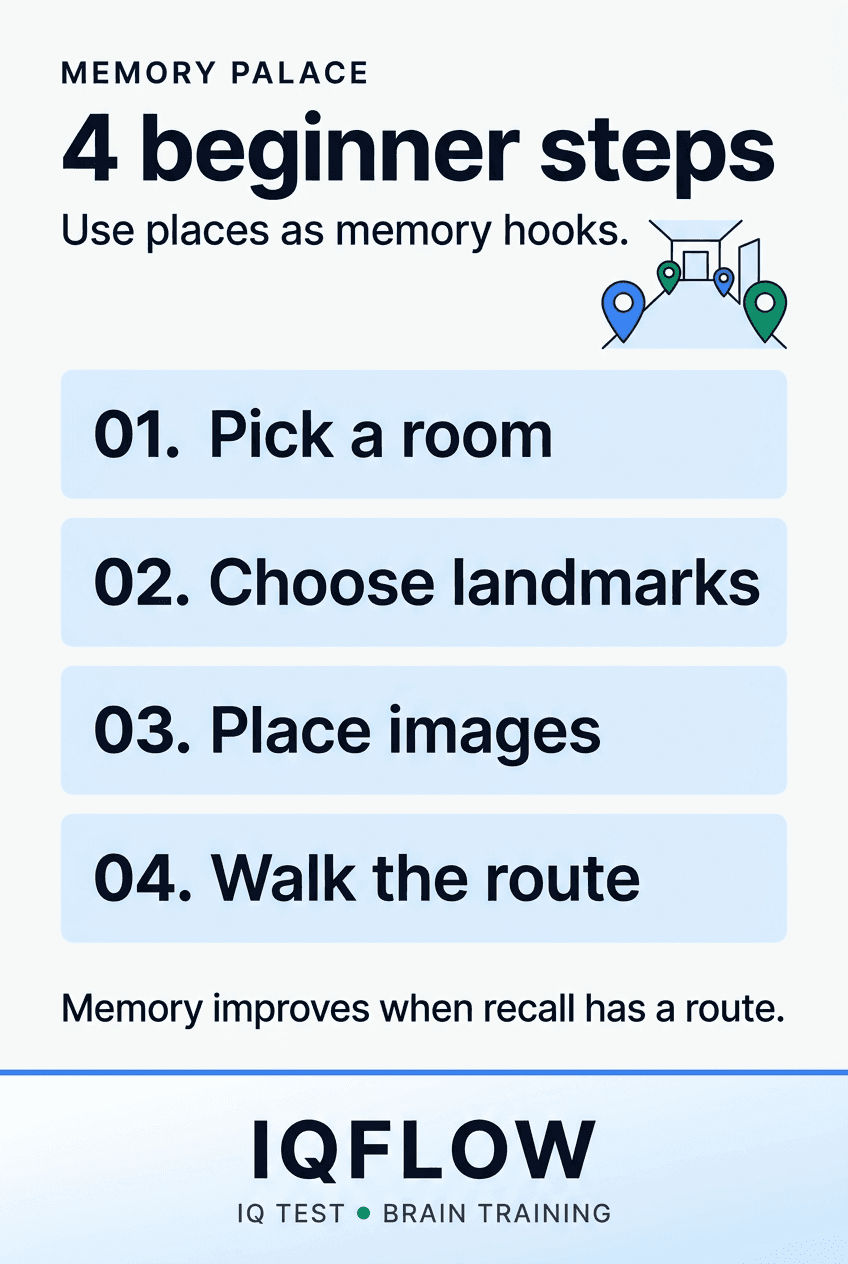
Memory palace
4 beginner steps
A simple memory palace can make recall easier by connecting information to familiar places.
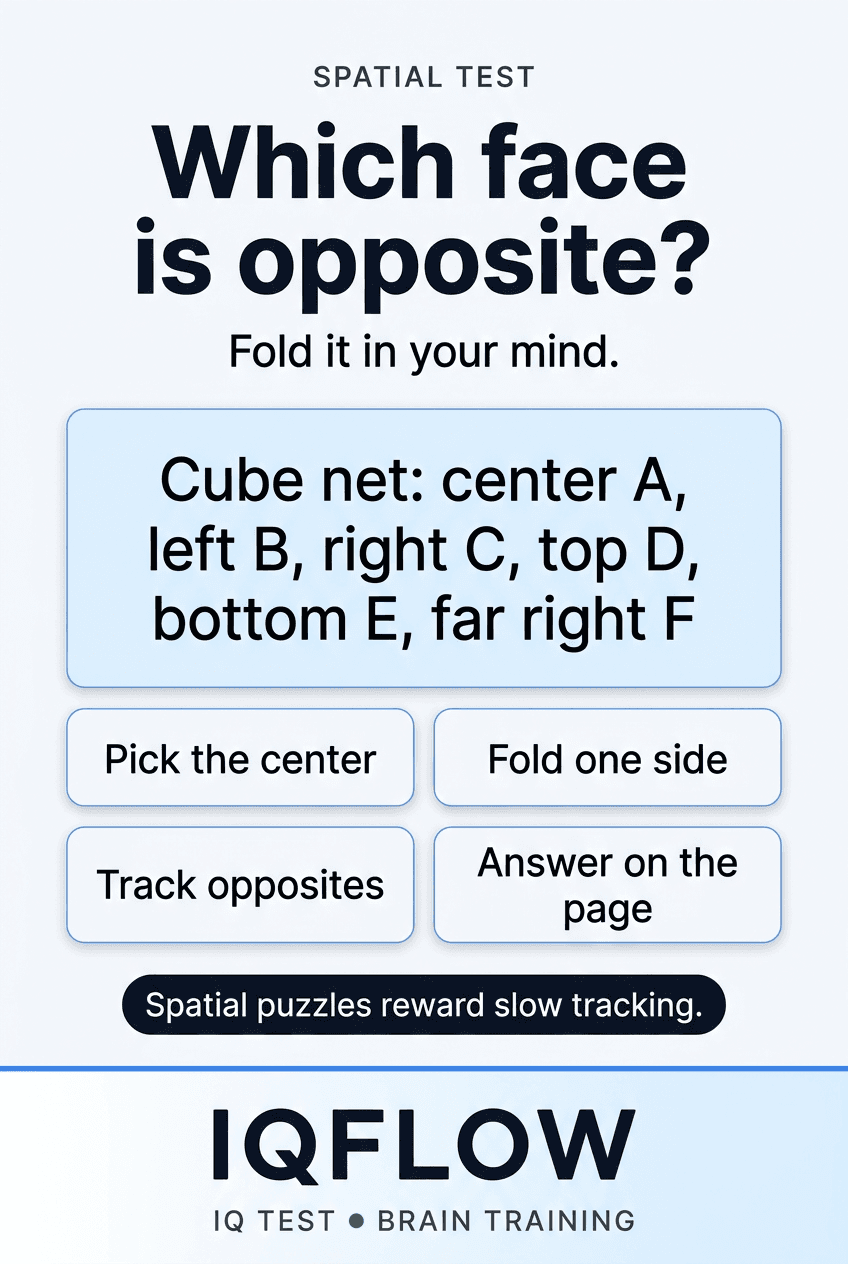
Cube net reasoning
Which face is opposite
Cube-net questions train spatial visualization and careful face tracking.
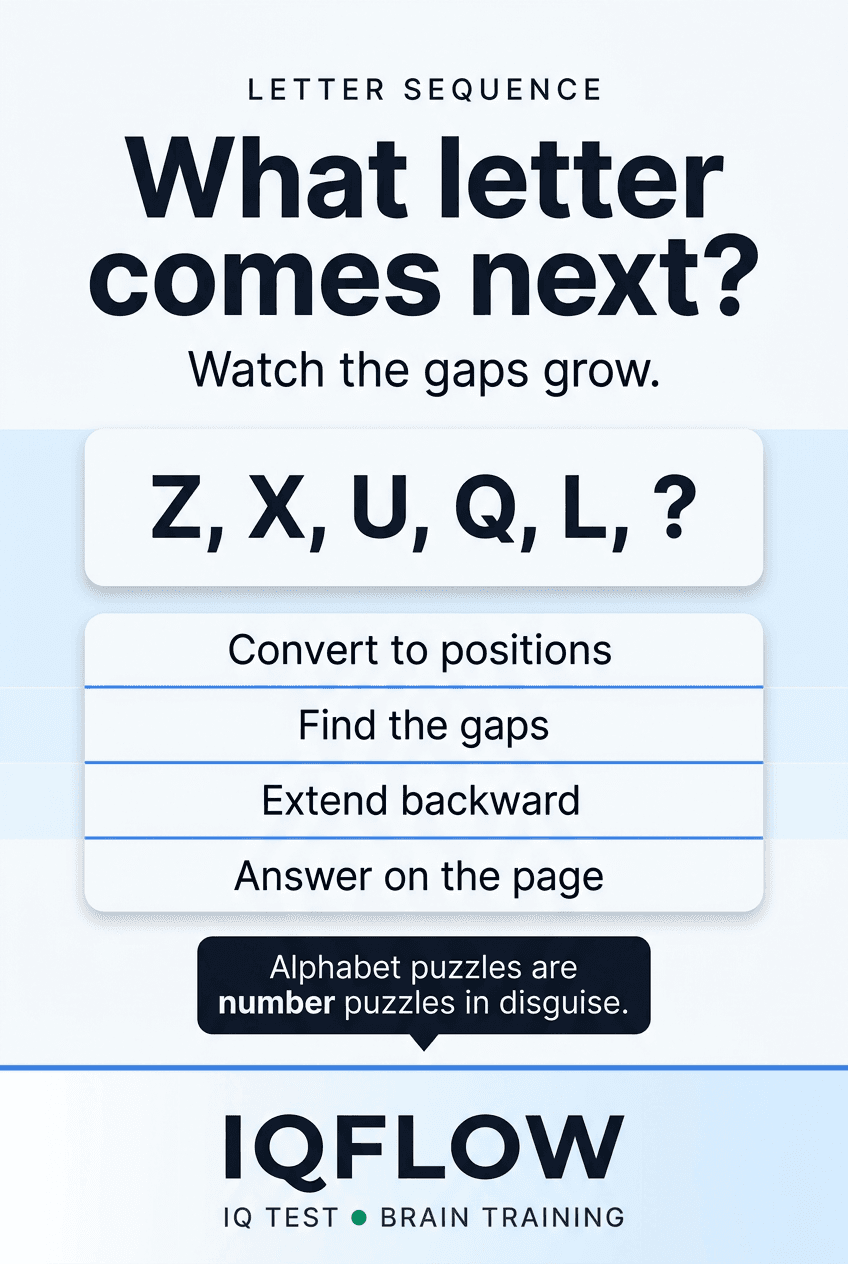
Letter sequence
What letter comes next
This alphabet puzzle uses growing backward gaps.
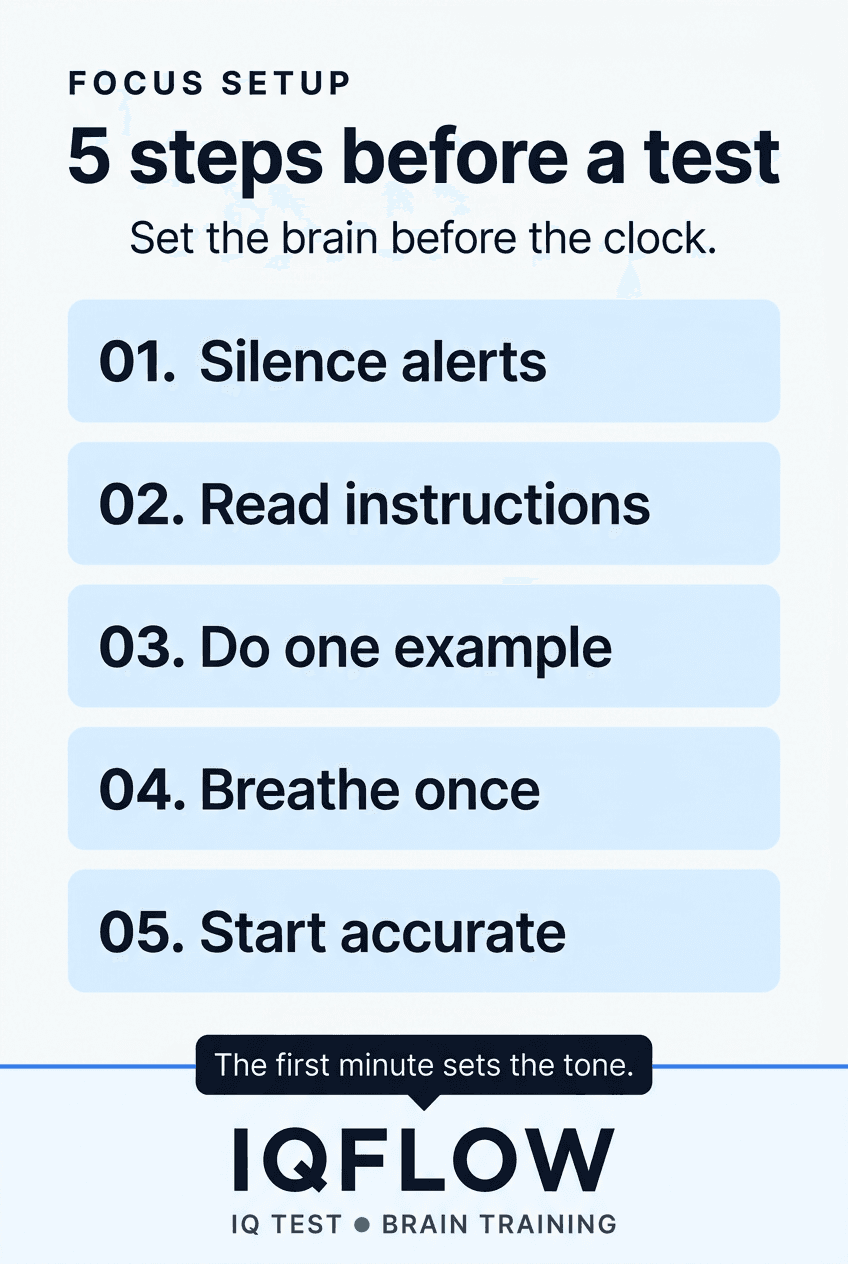
Pre-test focus
5 steps before a test
A short pre-test routine can reduce careless starts and improve consistency.
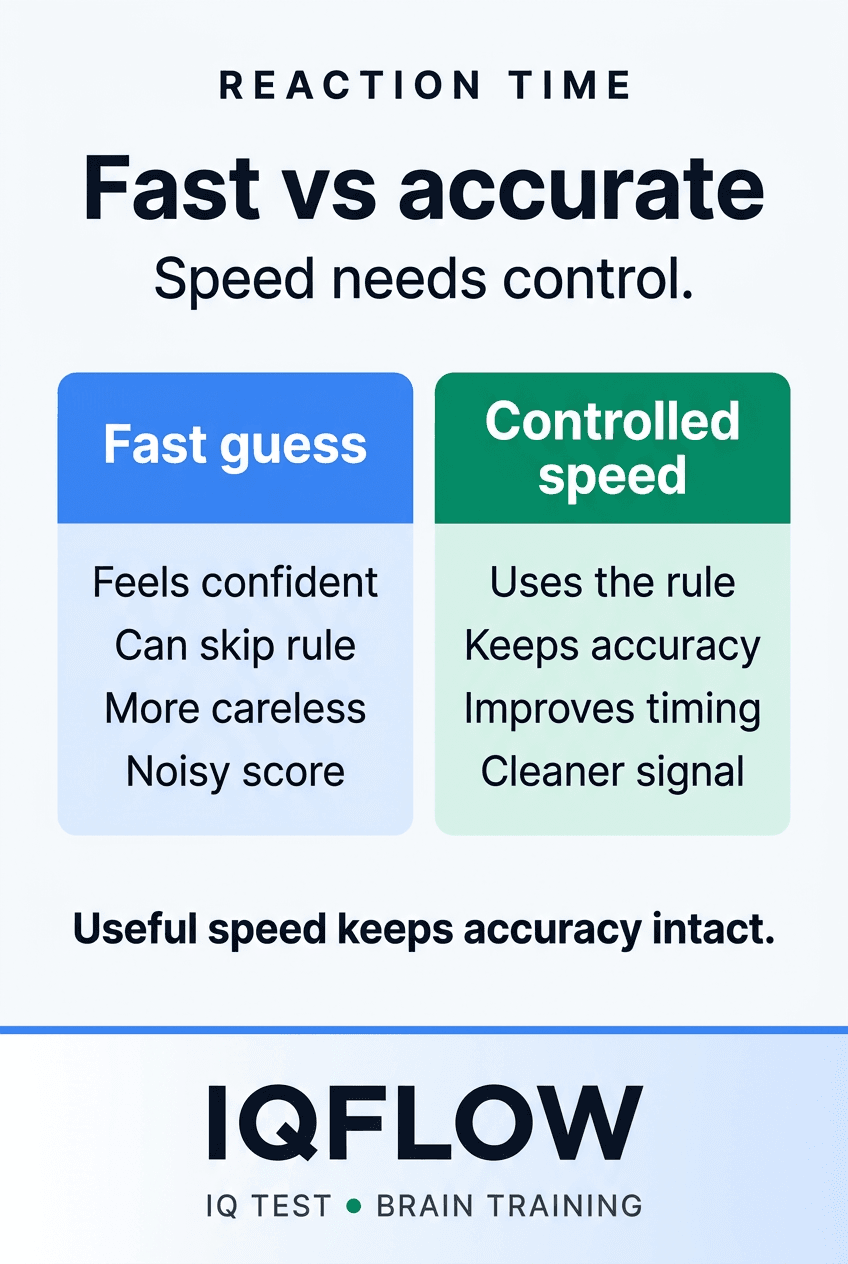
Reaction time
Fast vs accurate
Reaction time matters, but fast guesses can hurt cognitive test performance.
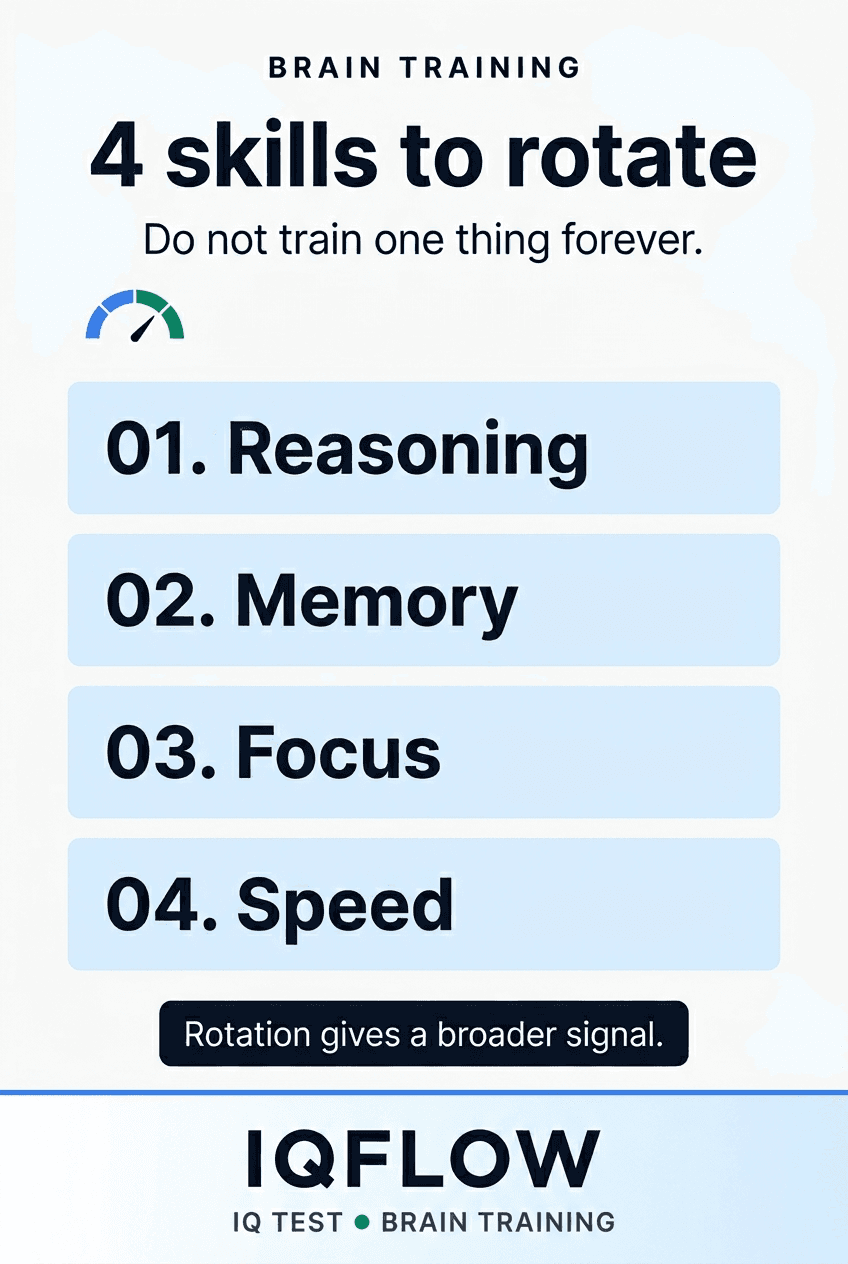
Adult brain training
4 skills to rotate
A simple adult brain training plan works best when it rotates different cognitive skills.
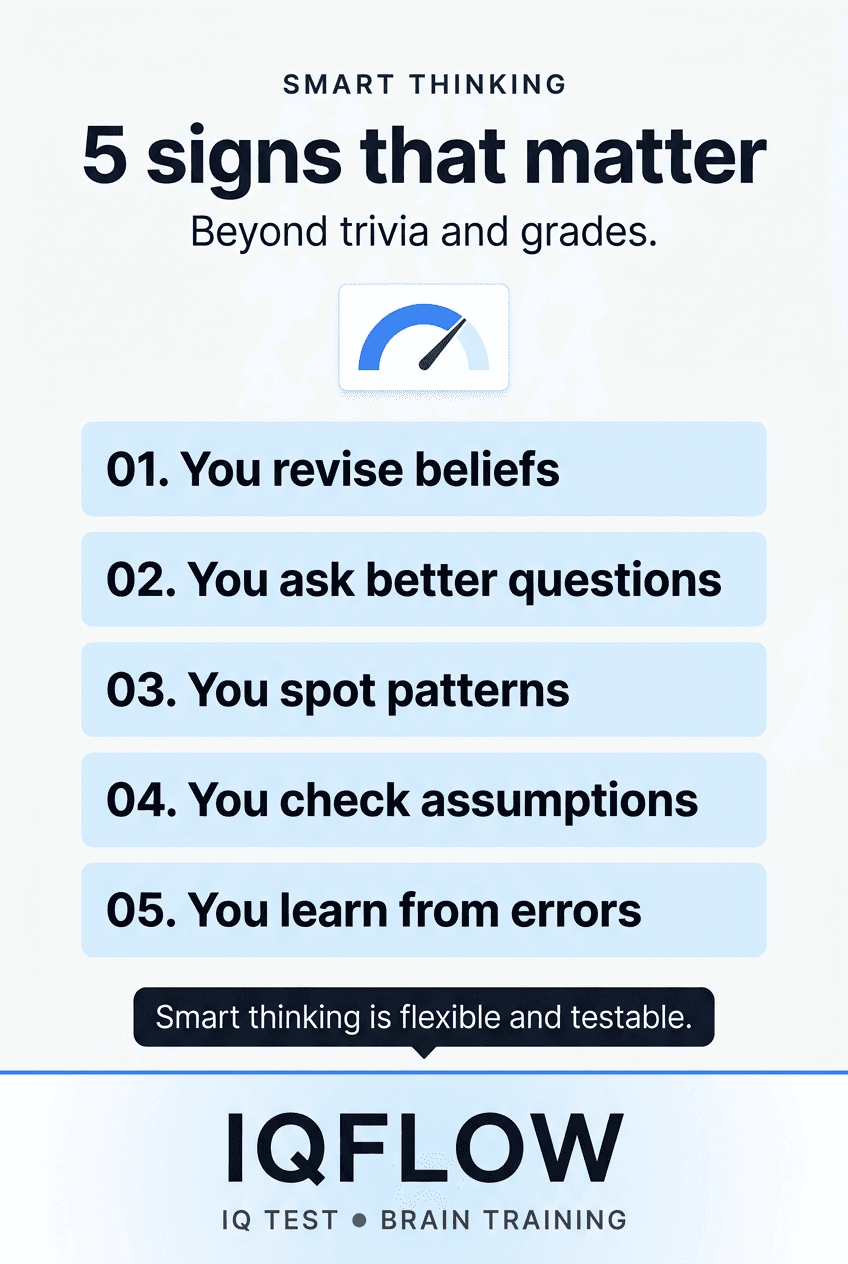
Smart thinking
5 signs that matter
Useful intelligence often shows up as flexible thinking, not memorized trivia.
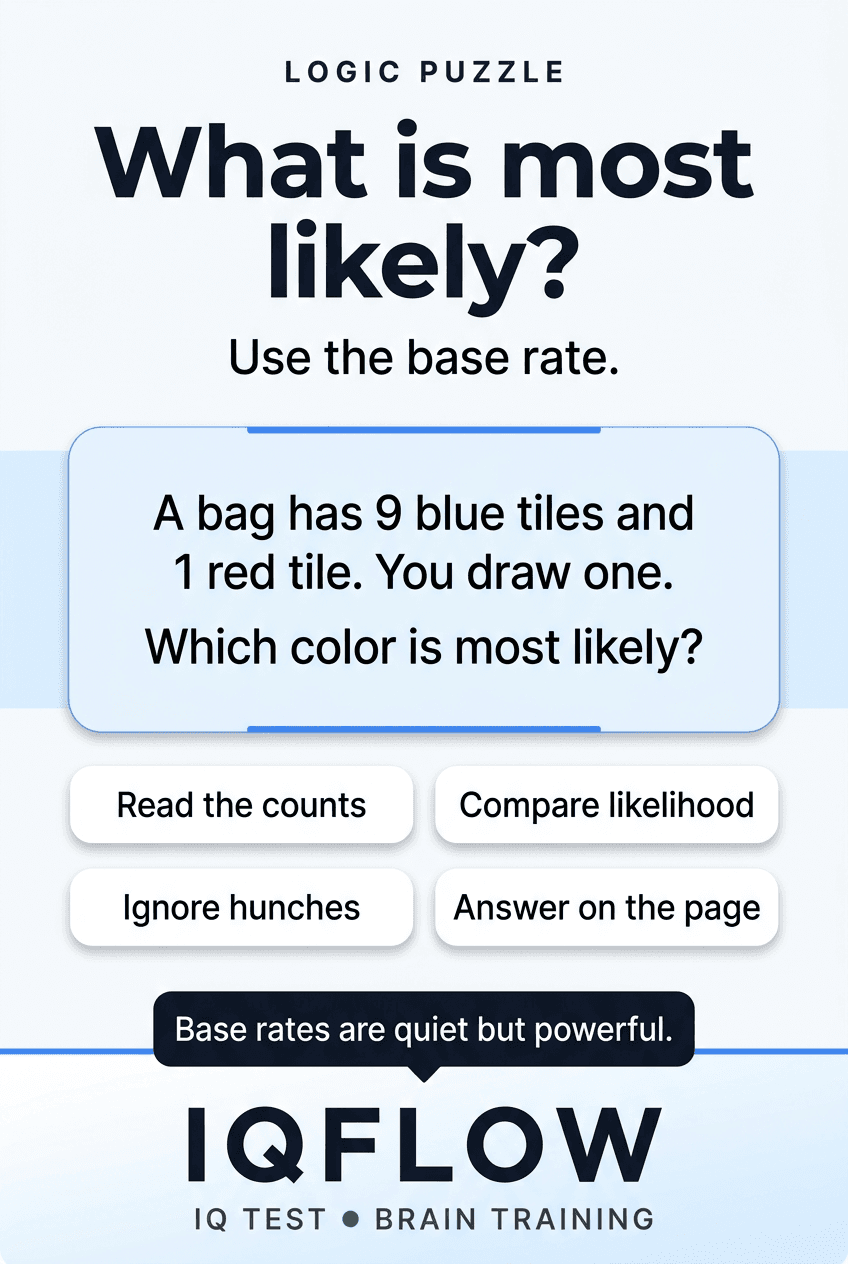
Base-rate logic
What is most likely
Base-rate puzzles test whether you use the background numbers before guessing.
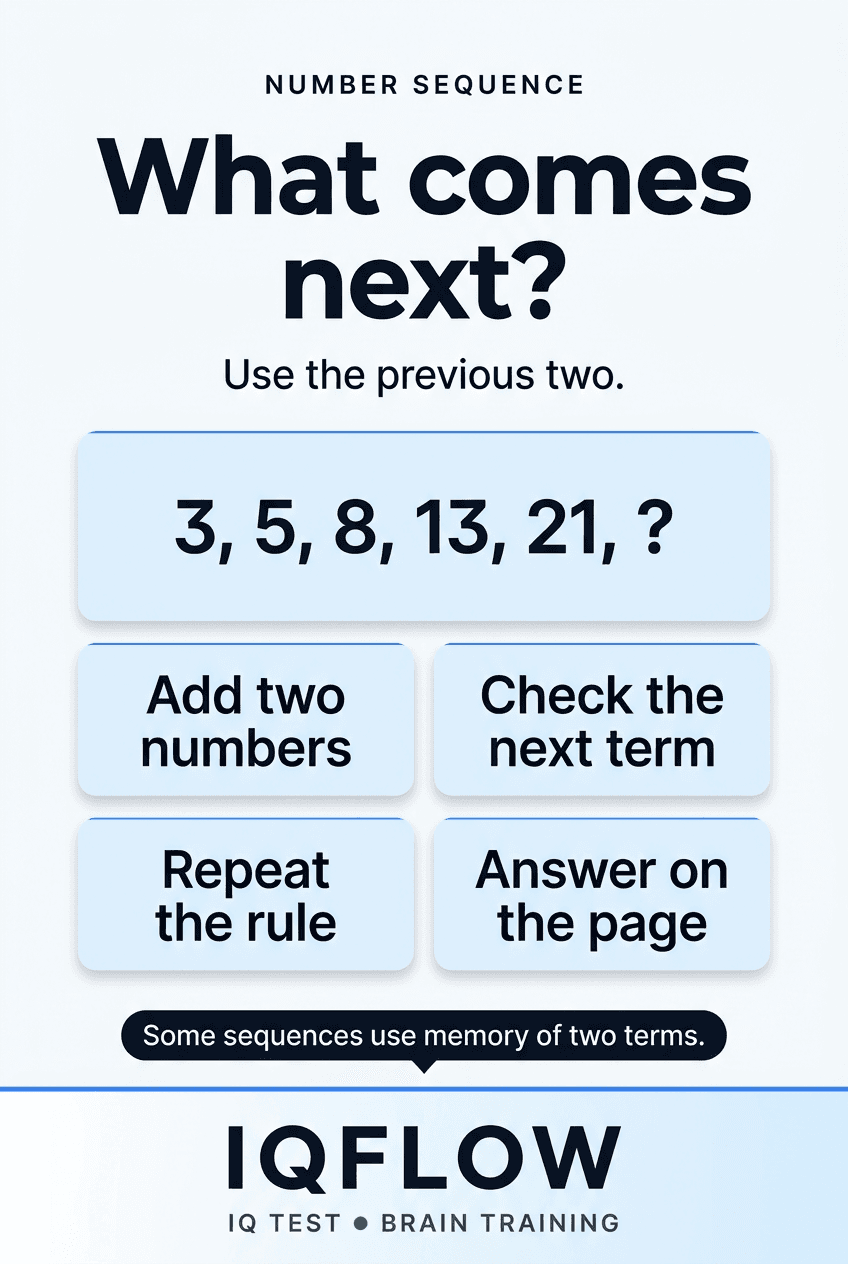
Fibonacci-style puzzle
What comes next
This sequence uses the previous two numbers to create the next one.
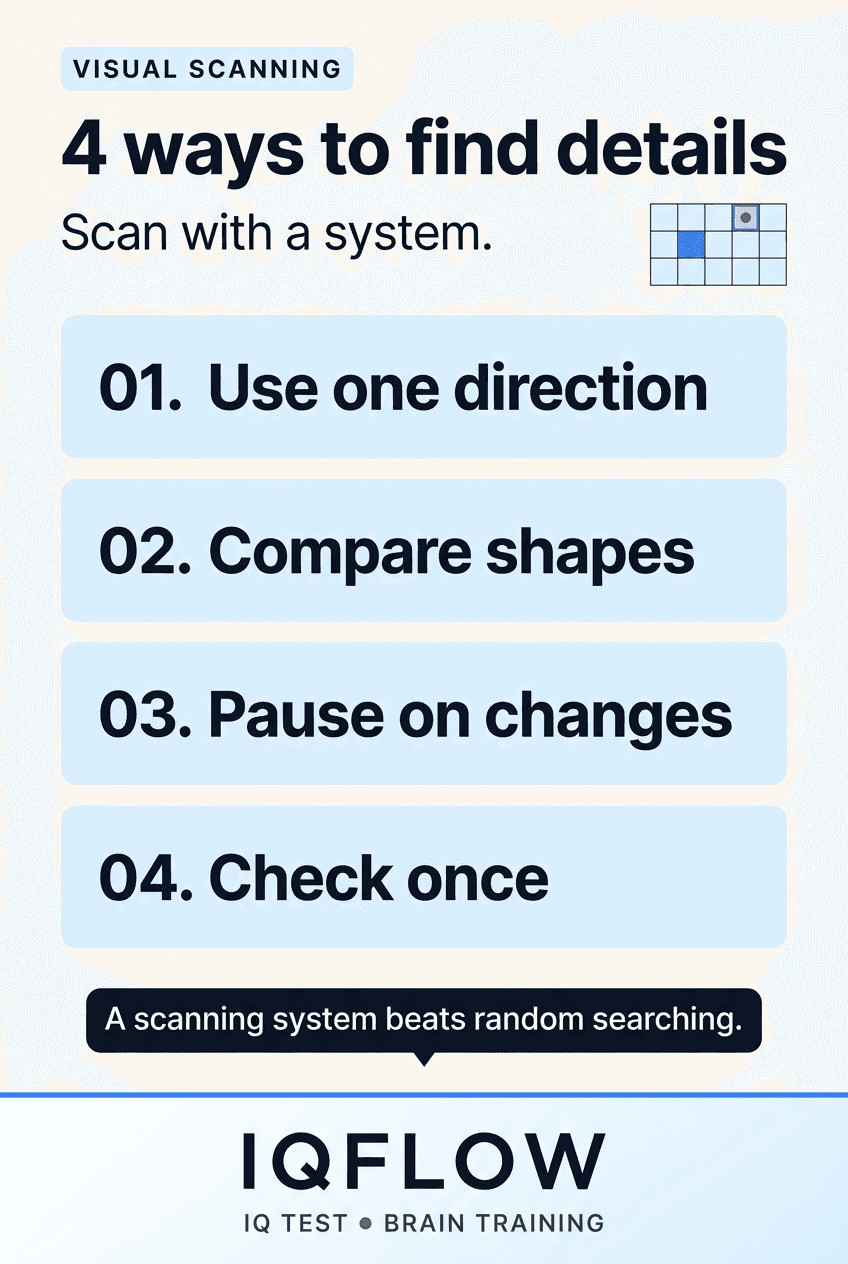
Visual scanning
4 ways to find details
A quick visual scanning checklist for improving focus without careless misses.
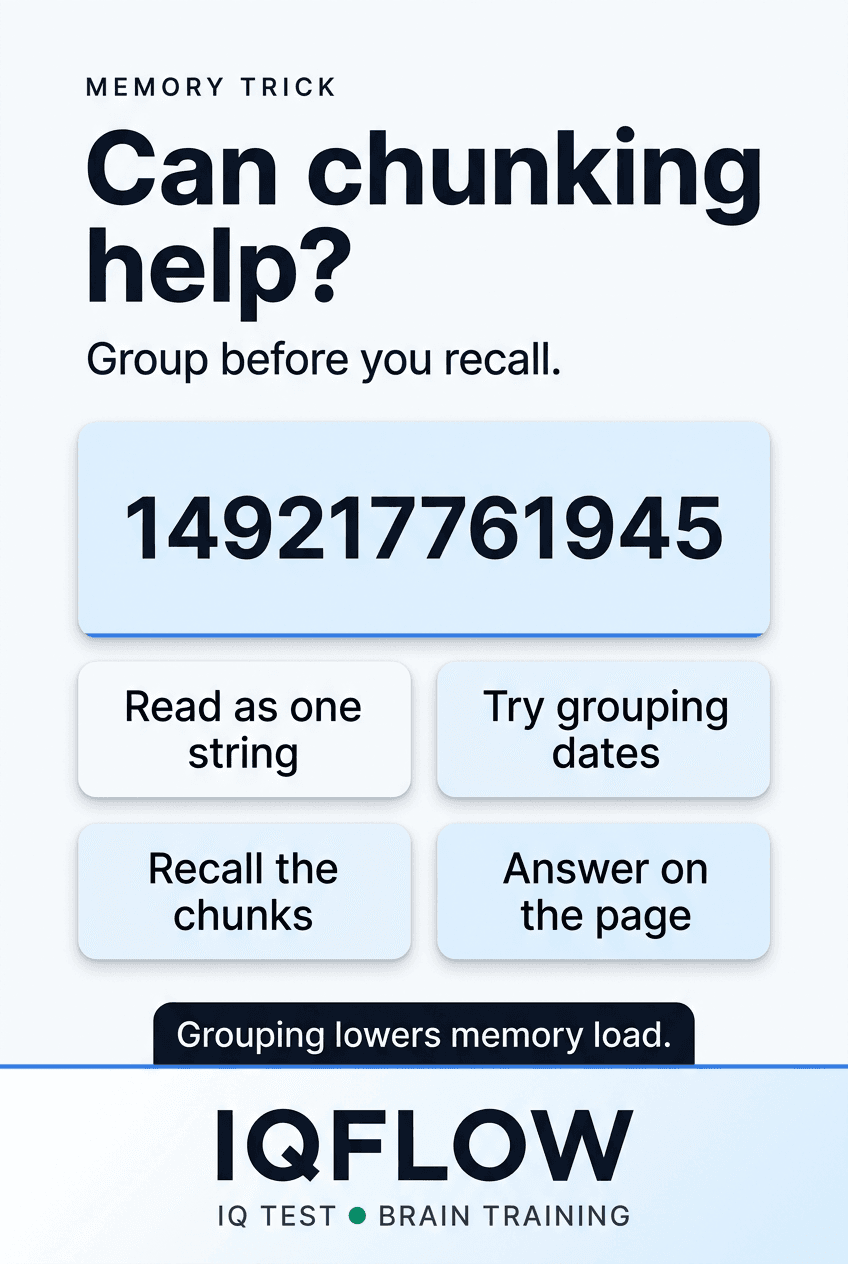
Chunking memory
Can chunking help
Chunking can make a long string easier to remember by grouping it into meaningful pieces.
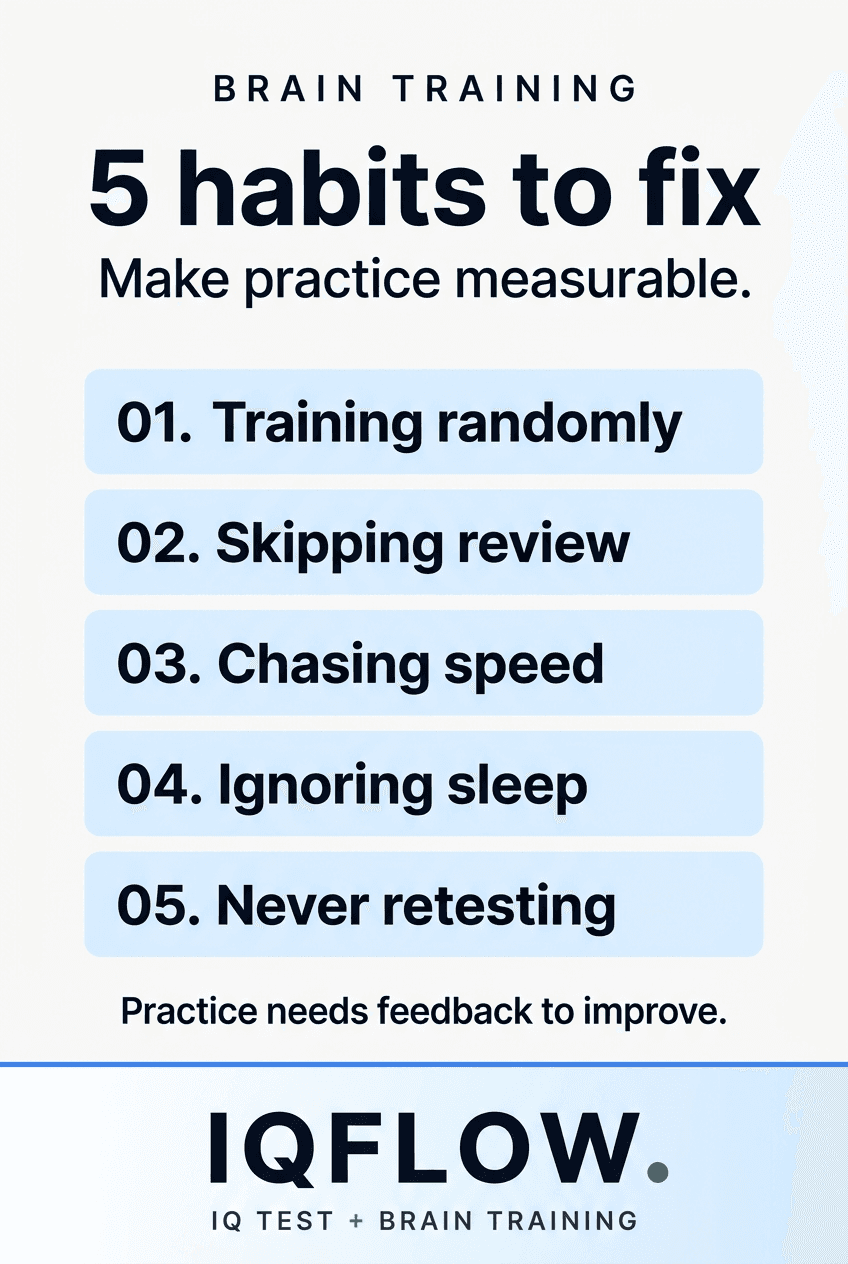
Training mistakes
5 habits to fix
Brain training works better when practice is structured and measurable.
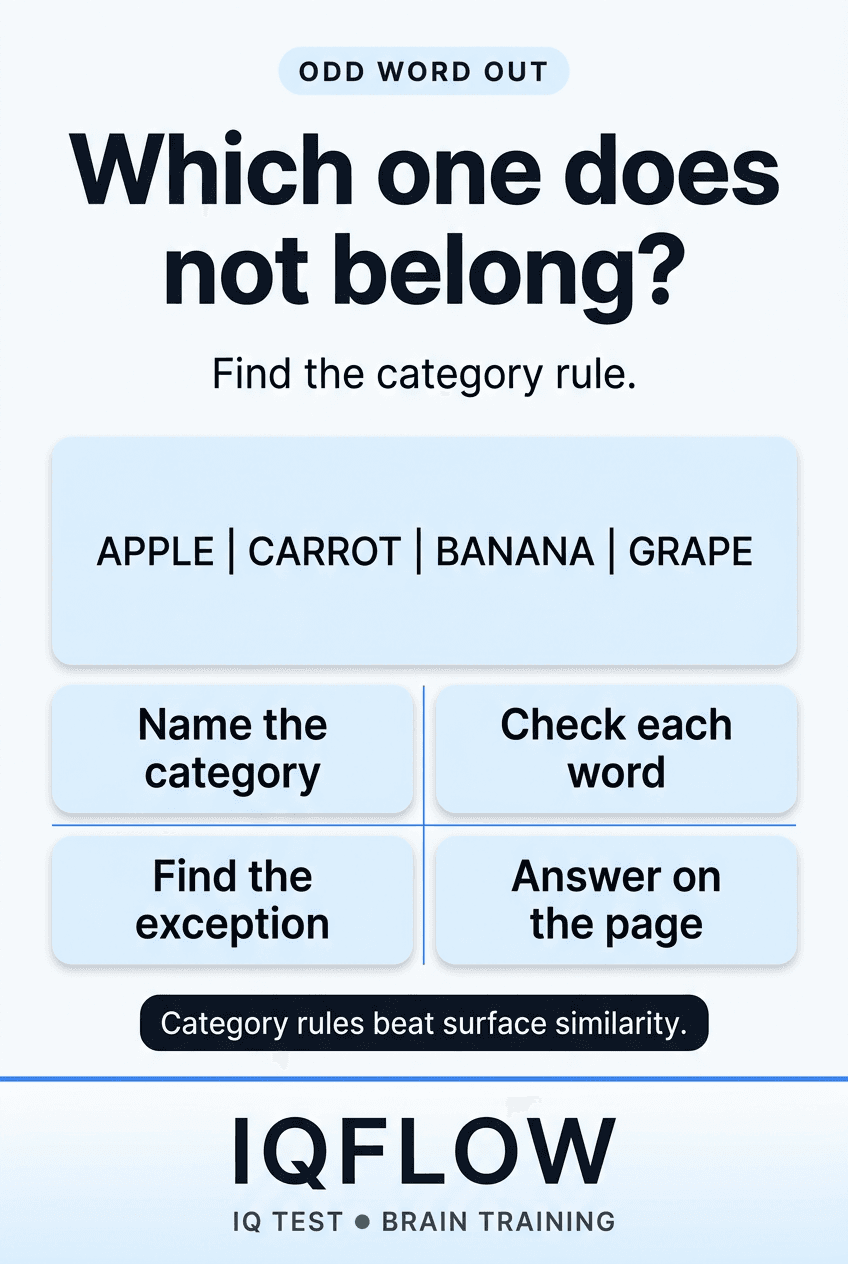
Odd word out
Which one does not belong
A quick category reasoning question for practicing careful grouping.
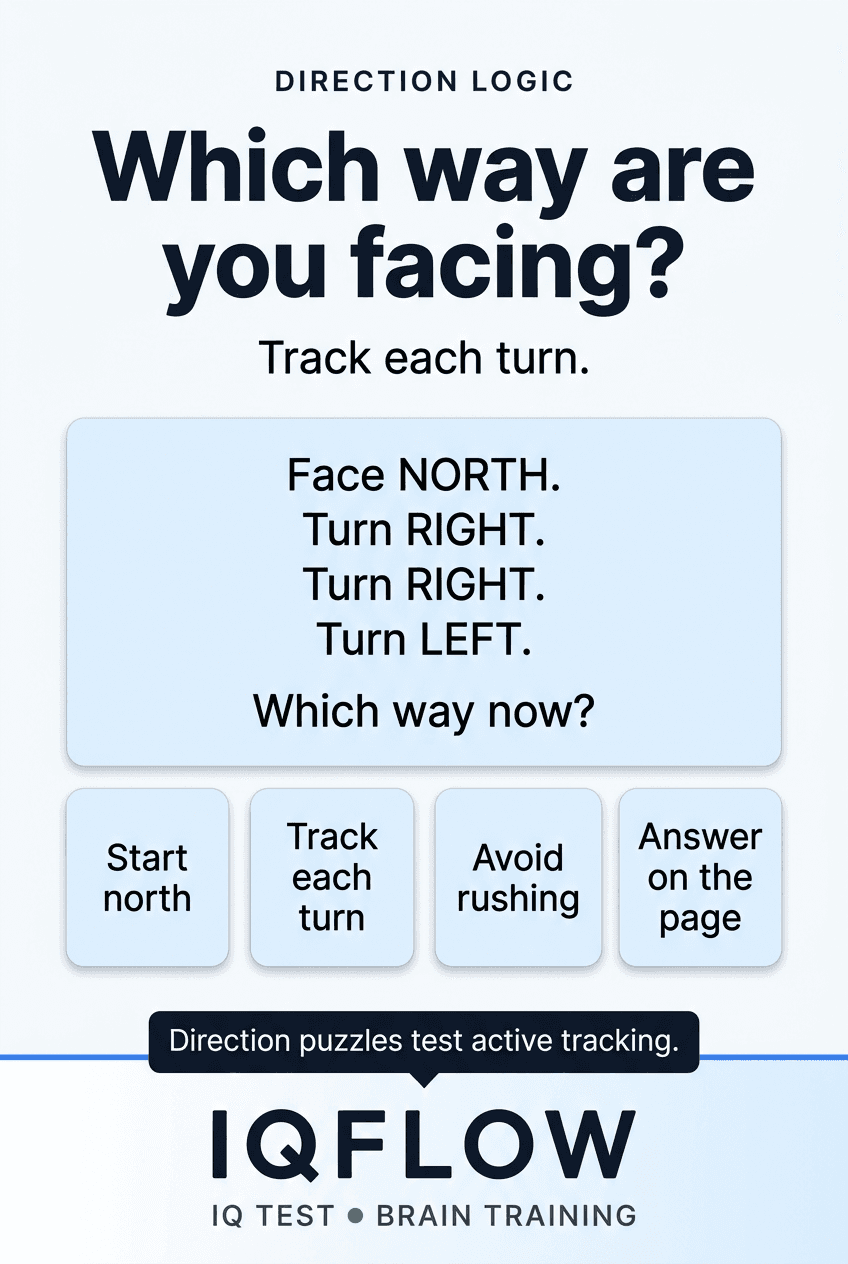
Direction logic
Which way are you facing
A simple direction puzzle for practicing mental tracking.
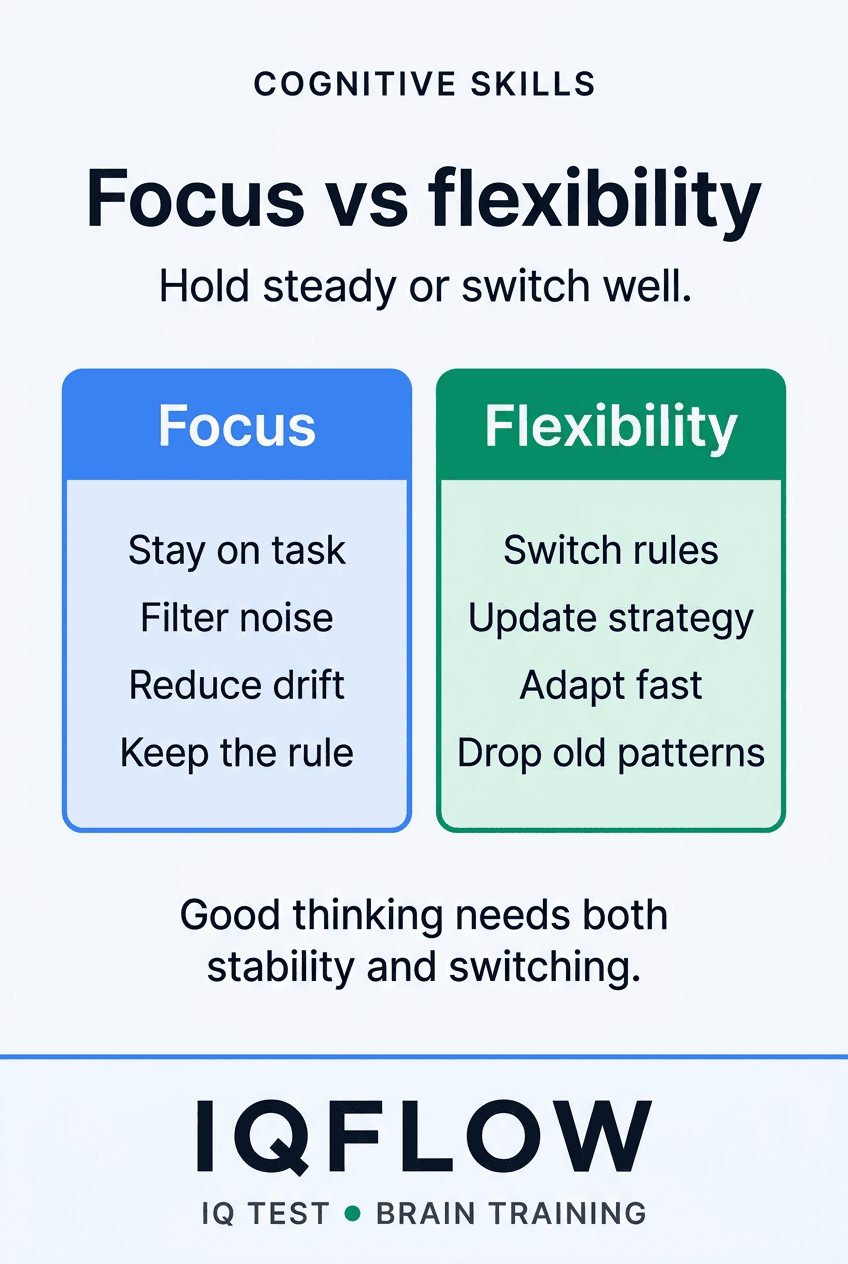
Cognitive skills
Focus vs flexibility
Focus holds the task steady. Flexibility helps you switch when the rule changes.
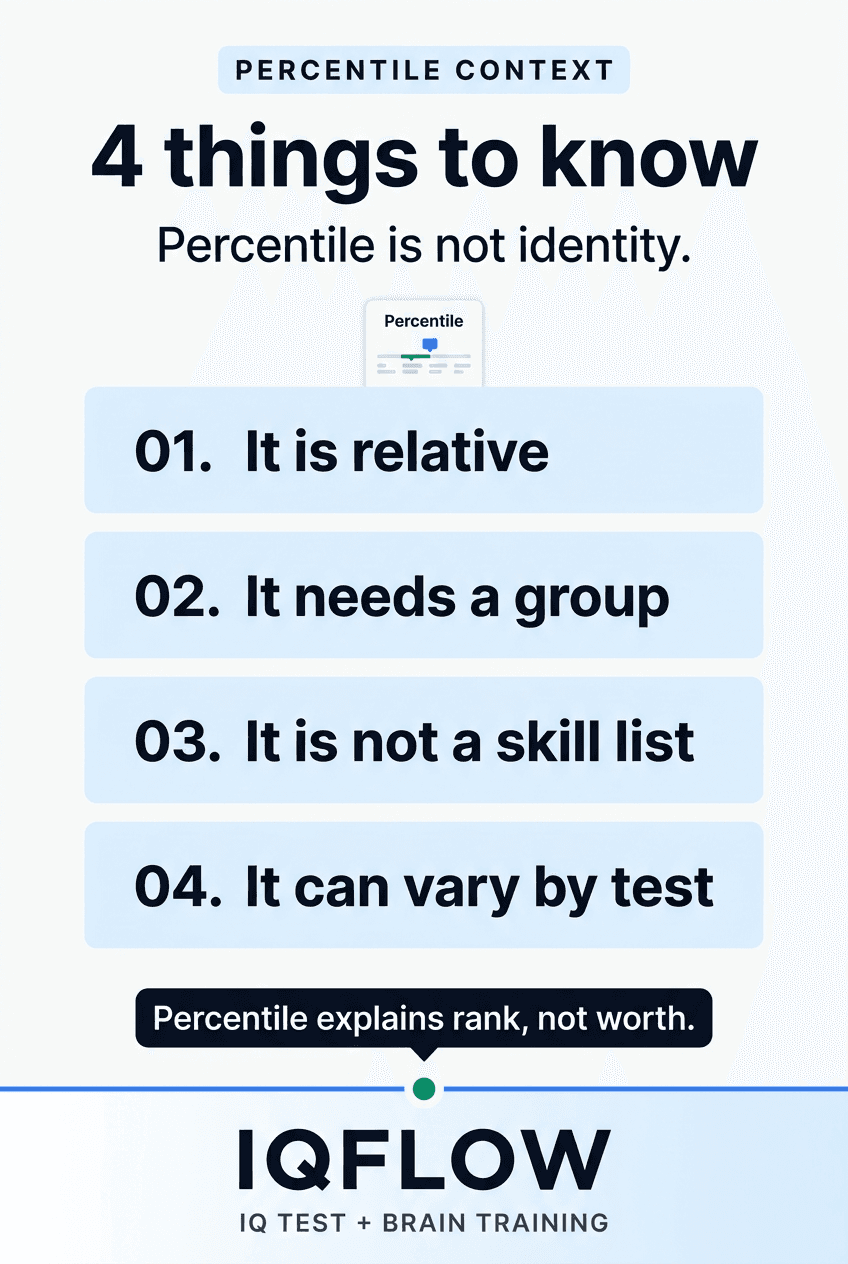
Percentile context
4 things to know
Percentiles are useful, but they are easy to misread without context.
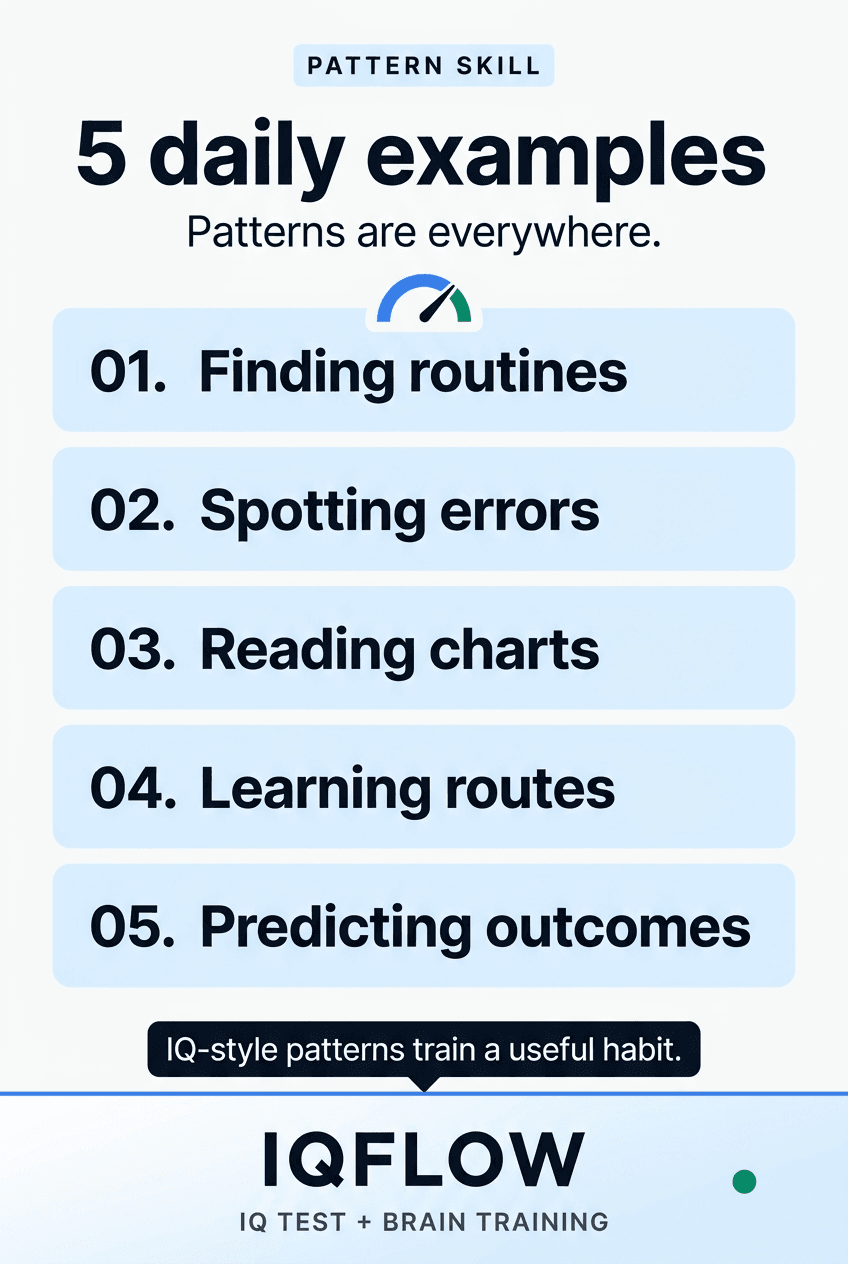
Pattern recognition
5 daily examples
Pattern recognition is not only for IQ puzzles. It shows up in everyday decisions.
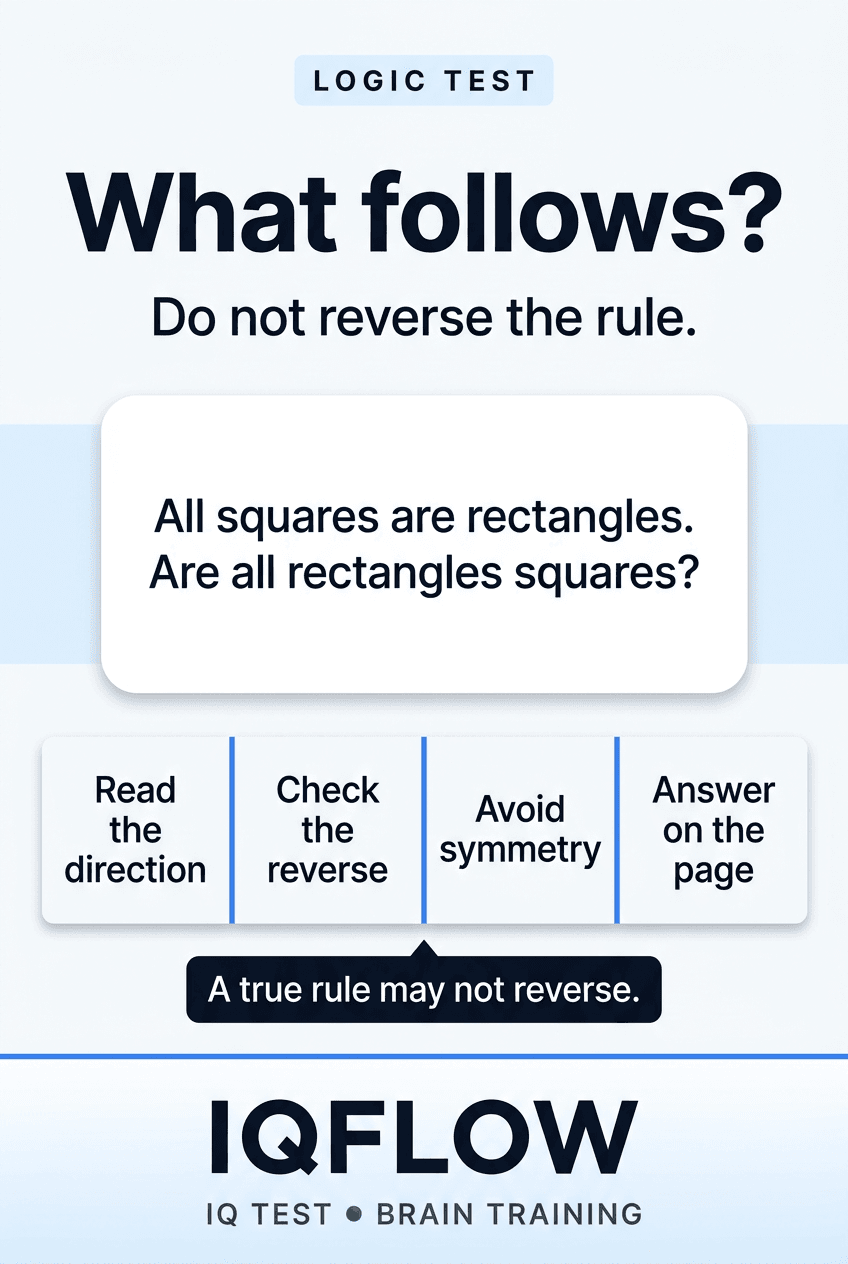
Category logic
What follows
A classic category logic question about reversing a true statement.
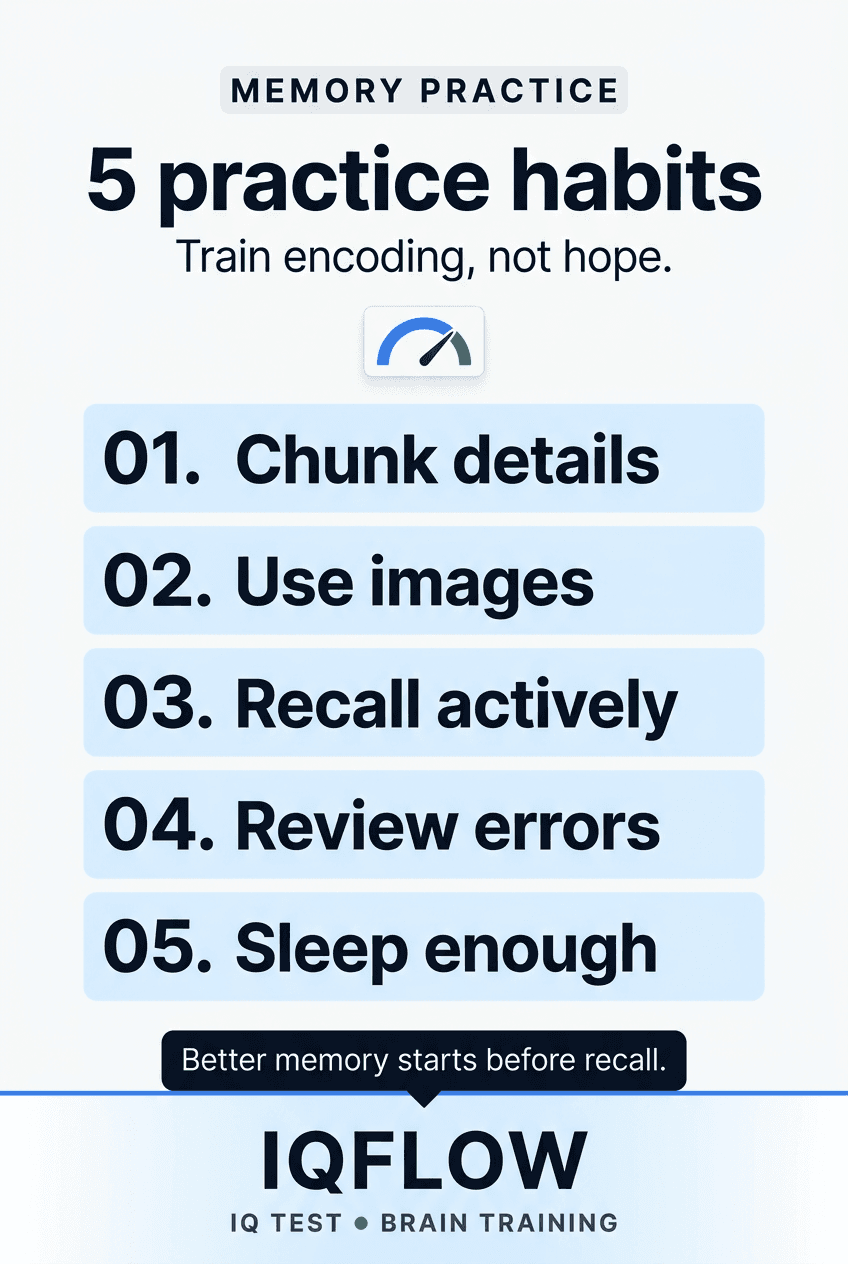
Memory practice
5 practice habits
Memory scores can improve when you train encoding strategy, attention, and review.
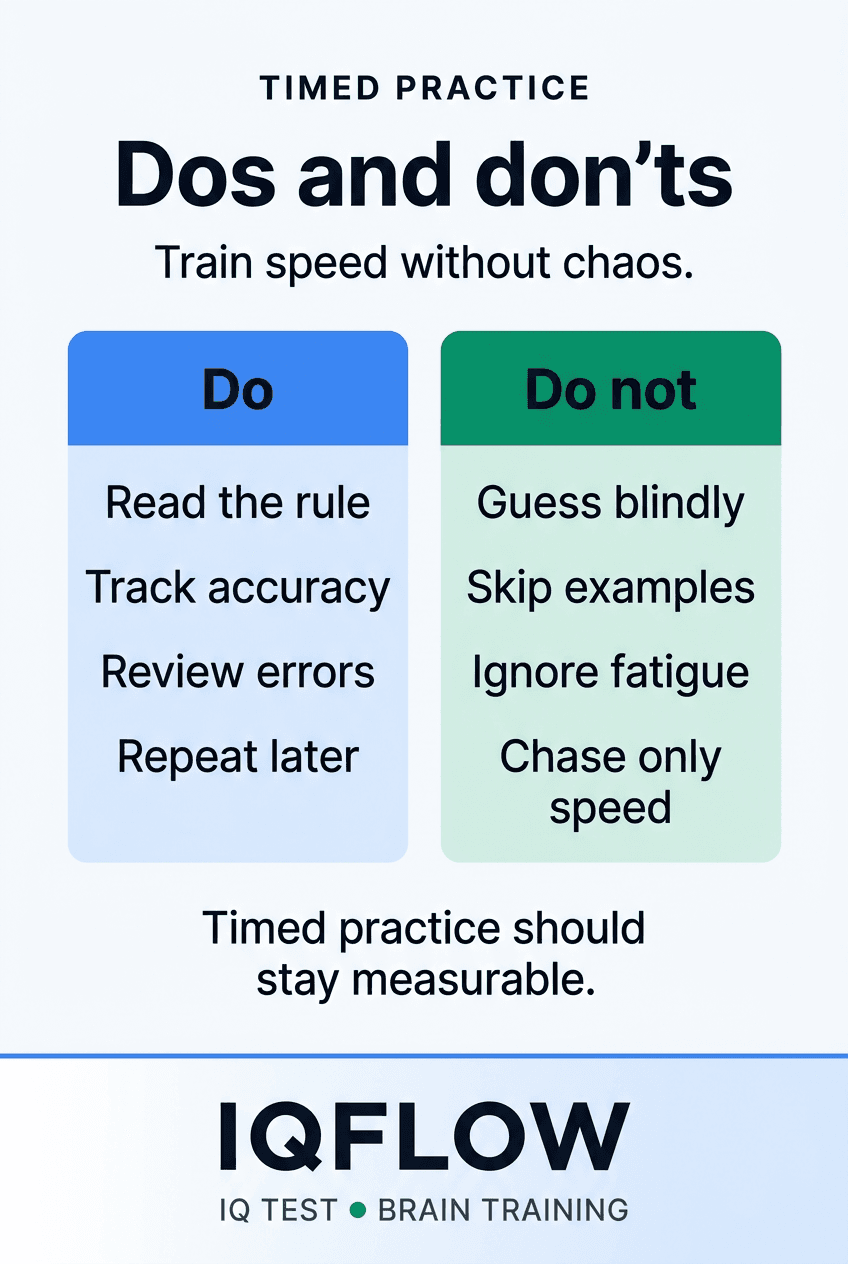
Timed IQ practice
Dos and don'ts
Timed practice should improve speed without training careless guessing.
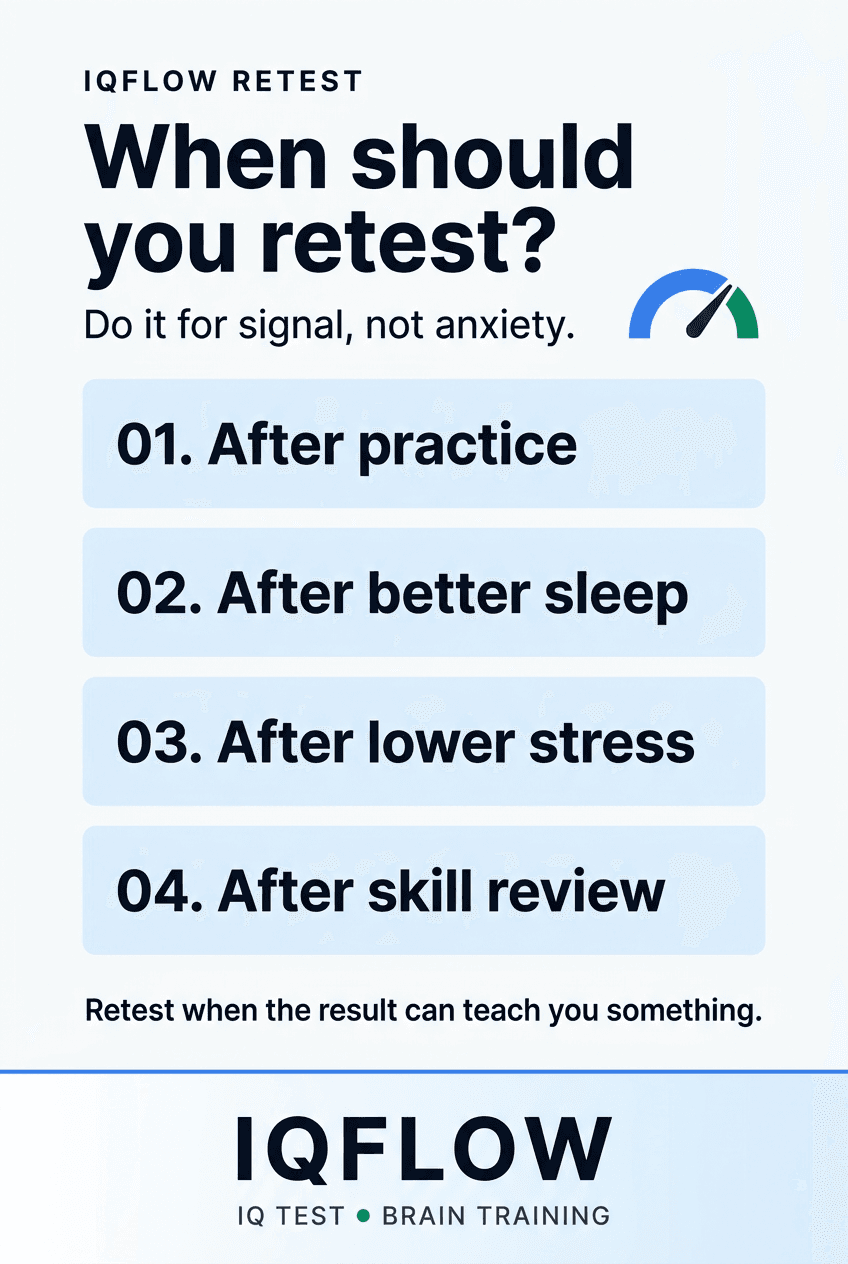
IQFlow retest
When should you retest
Retesting works best after enough practice or a meaningful change in conditions.
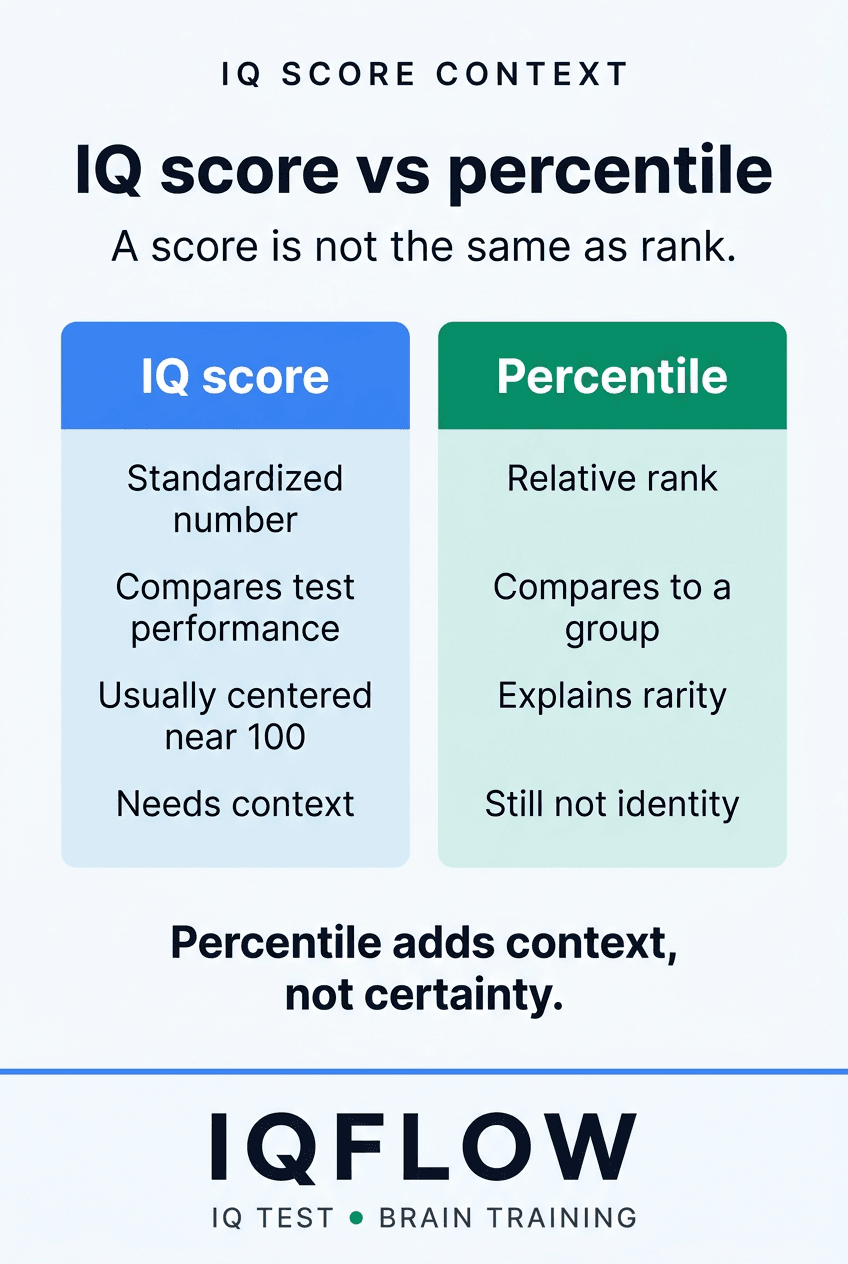
IQ score context
IQ score vs percentile
A percentile tells you where a score falls relative to a comparison group. It is useful context, but it still does not describe the whole person.
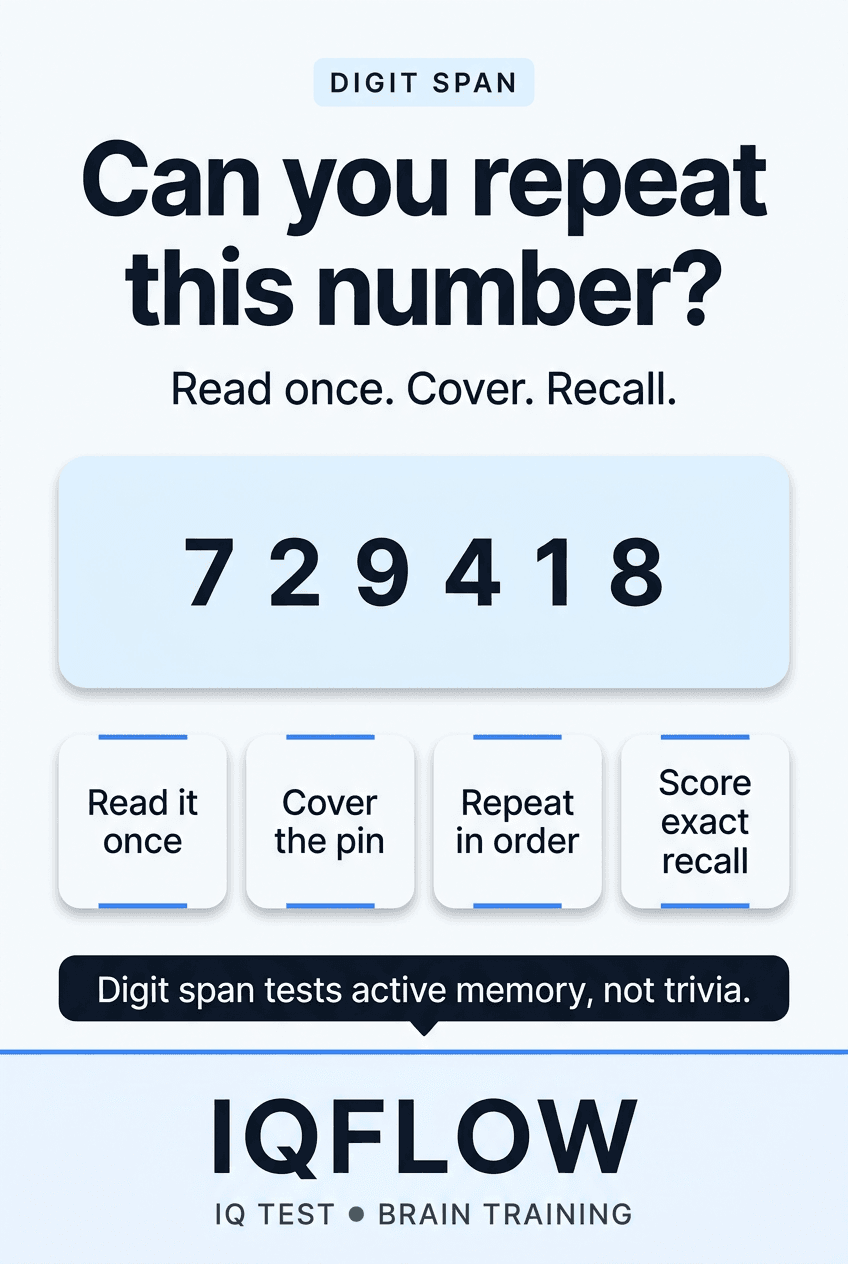
Digit span memory test
Can you repeat this number?
Digit span tasks test how much information you can hold briefly while keeping the order intact.
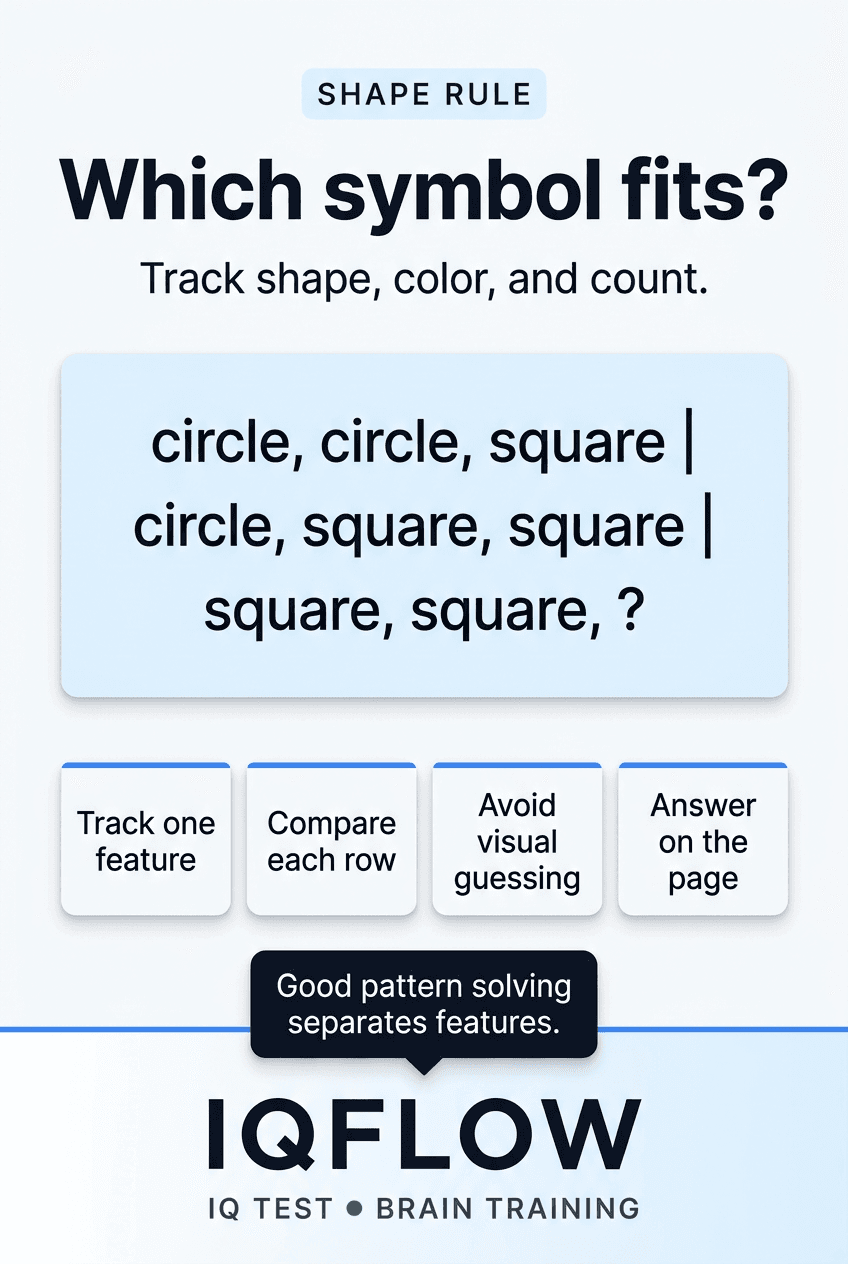
Shape rule IQ test
Which symbol fits?
Shape-rule puzzles are easier when you track one changing feature at a time instead of relying on a quick visual guess.
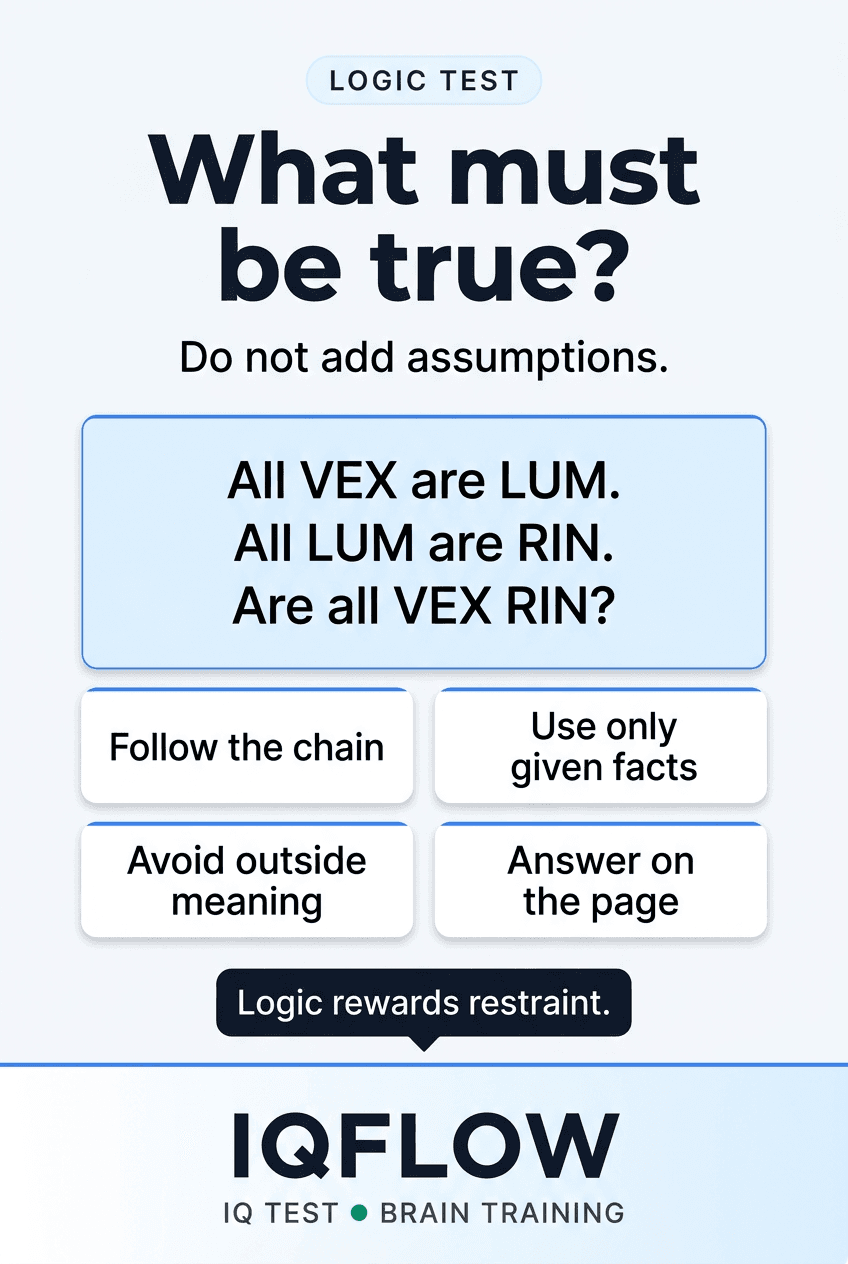
Syllogism logic test
What must be true?
This short syllogism tests whether you can follow a chain of statements without adding extra assumptions.
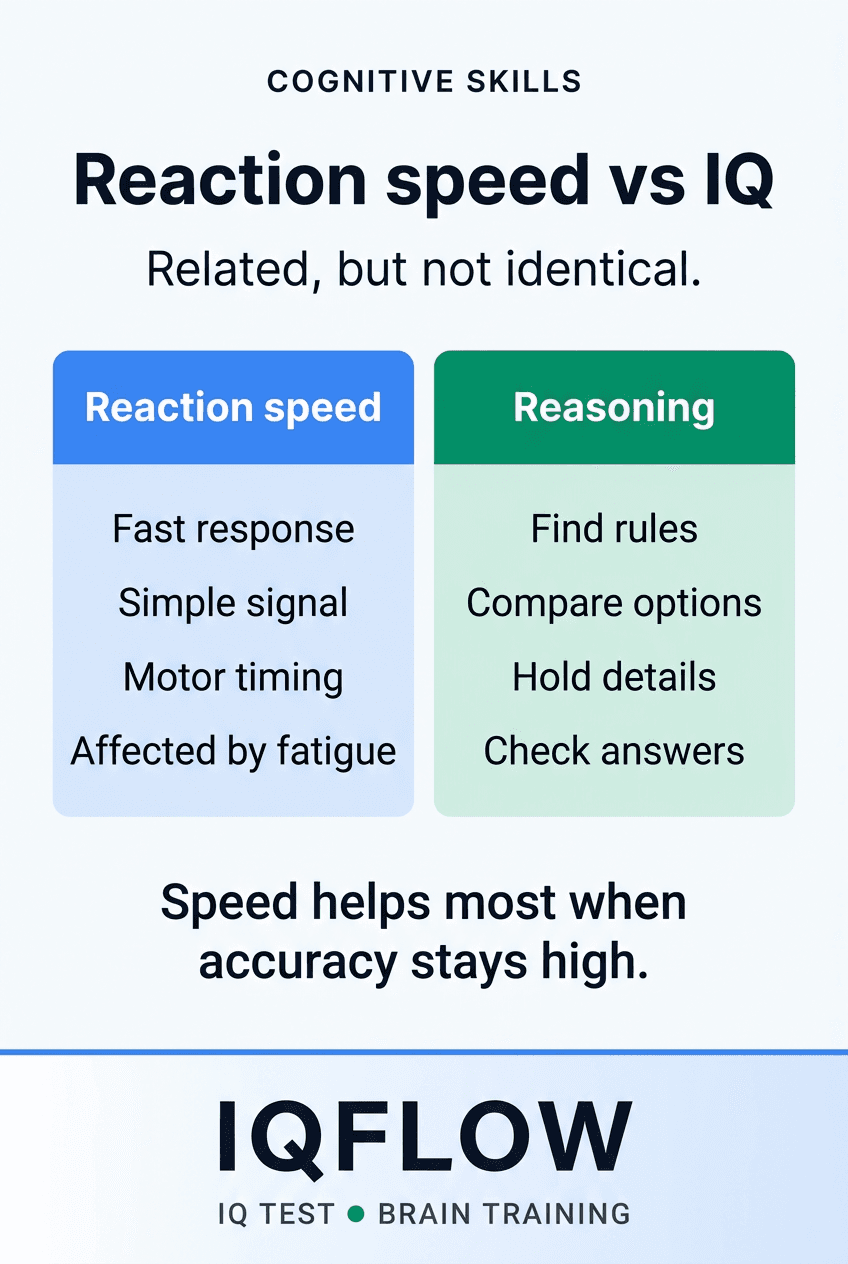
Cognitive skills
Reaction speed vs IQ
Reaction speed can matter in timed tasks, but reasoning also depends on rule finding, memory, and accuracy.
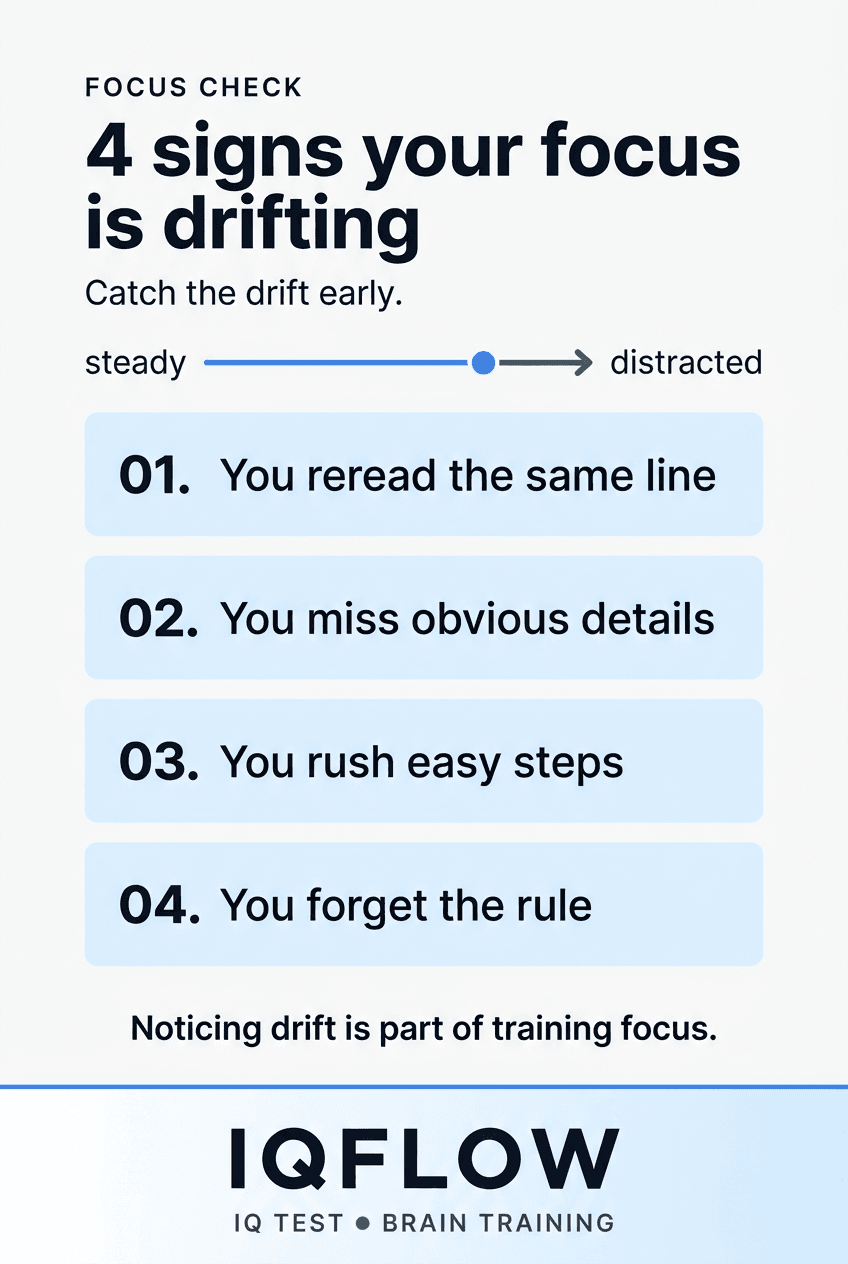
Focus check
4 signs your focus is drifting
Attention drift often shows up before you fully notice it. These signs help you pause and reset before accuracy drops.
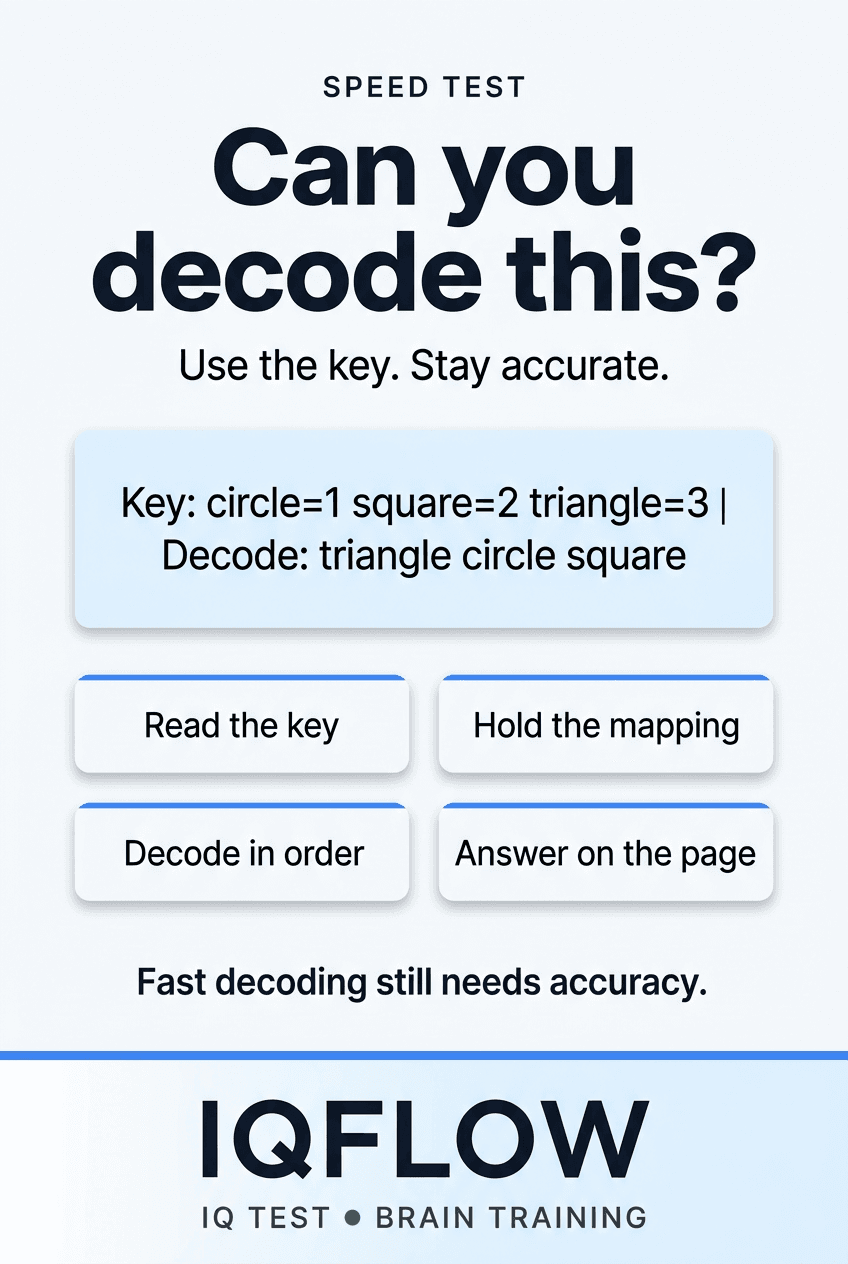
Symbol substitution test
Can you decode this?
Symbol substitution tasks measure how efficiently you can use a simple rule under light time pressure.
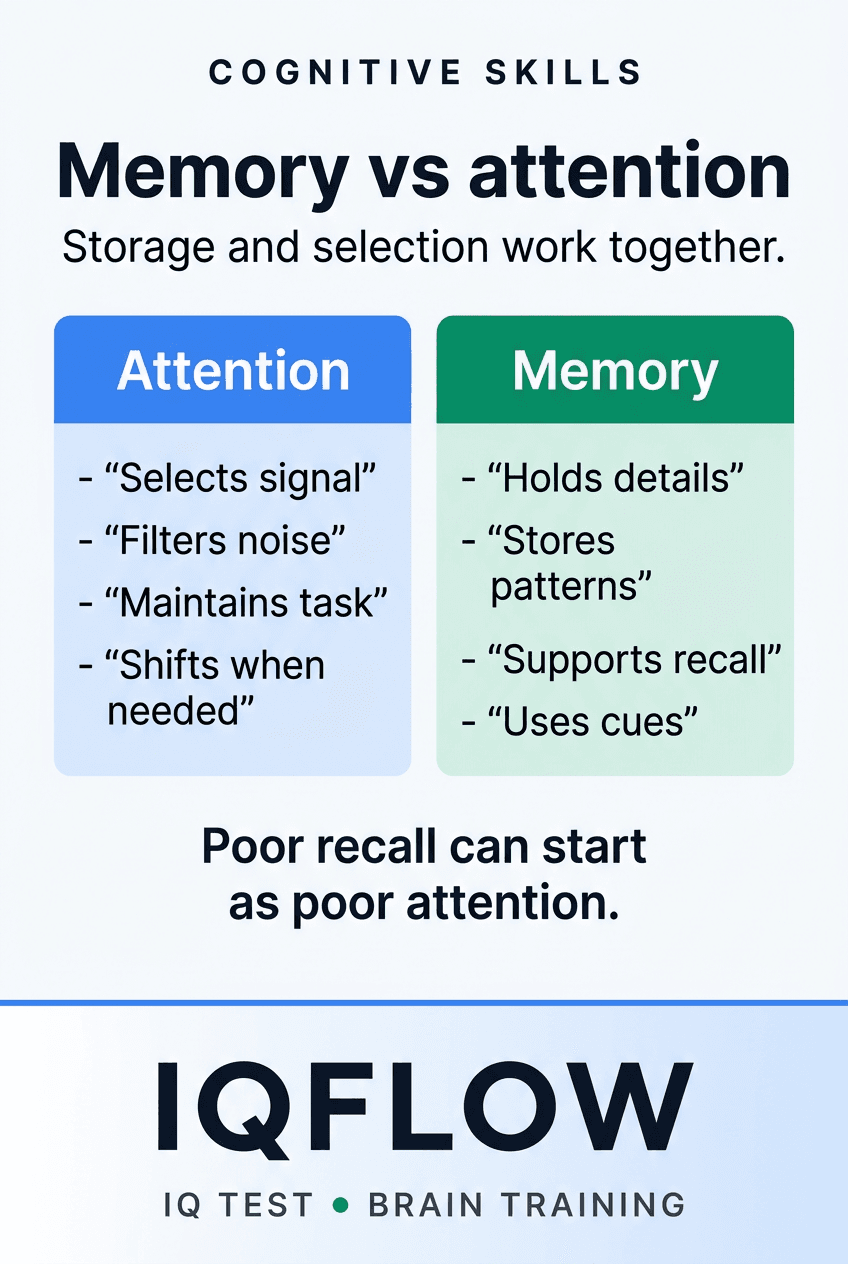
Cognitive skills
Memory vs attention
Attention selects the information. Memory holds and retrieves it. Many test results depend on both.
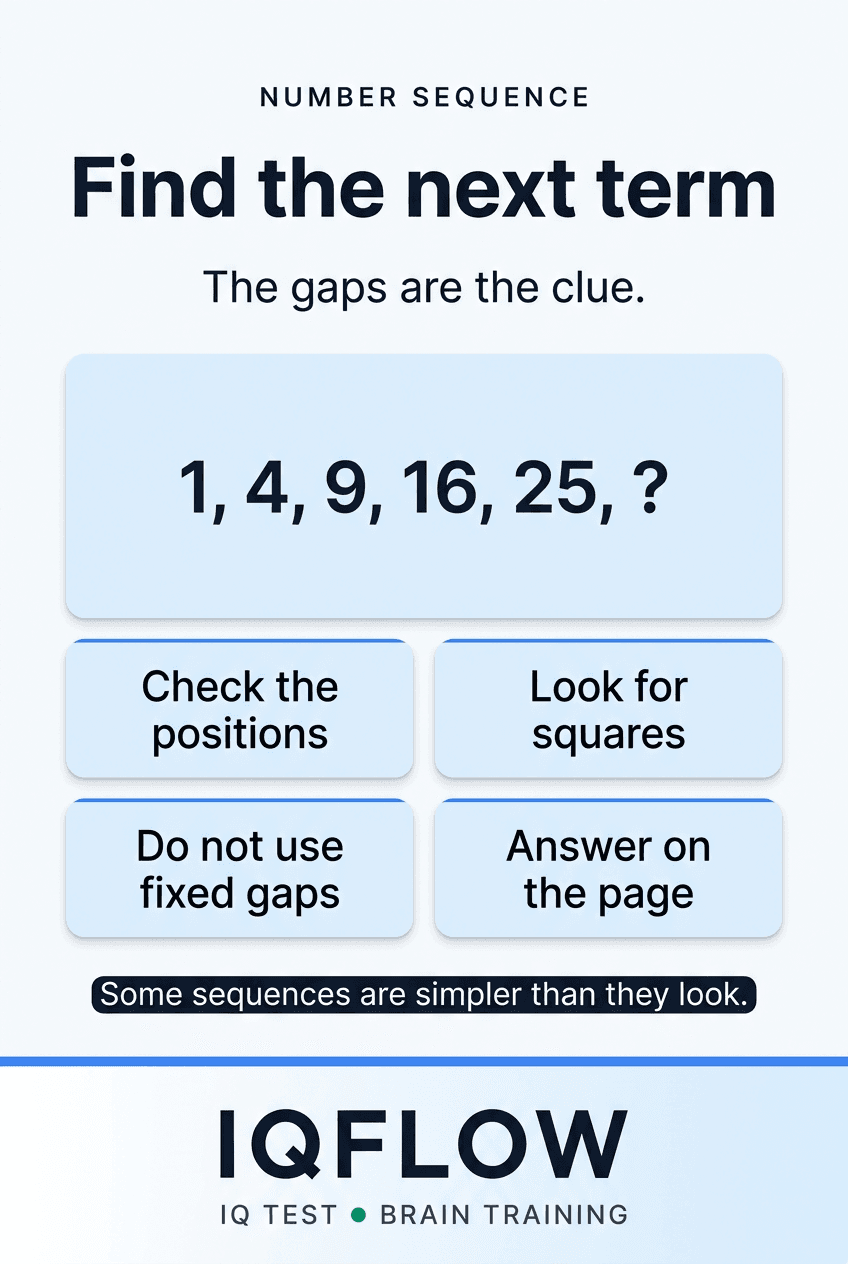
Number sequence puzzle
Find the next term
This sequence tests whether you recognize square numbers instead of forcing a complicated gap rule.
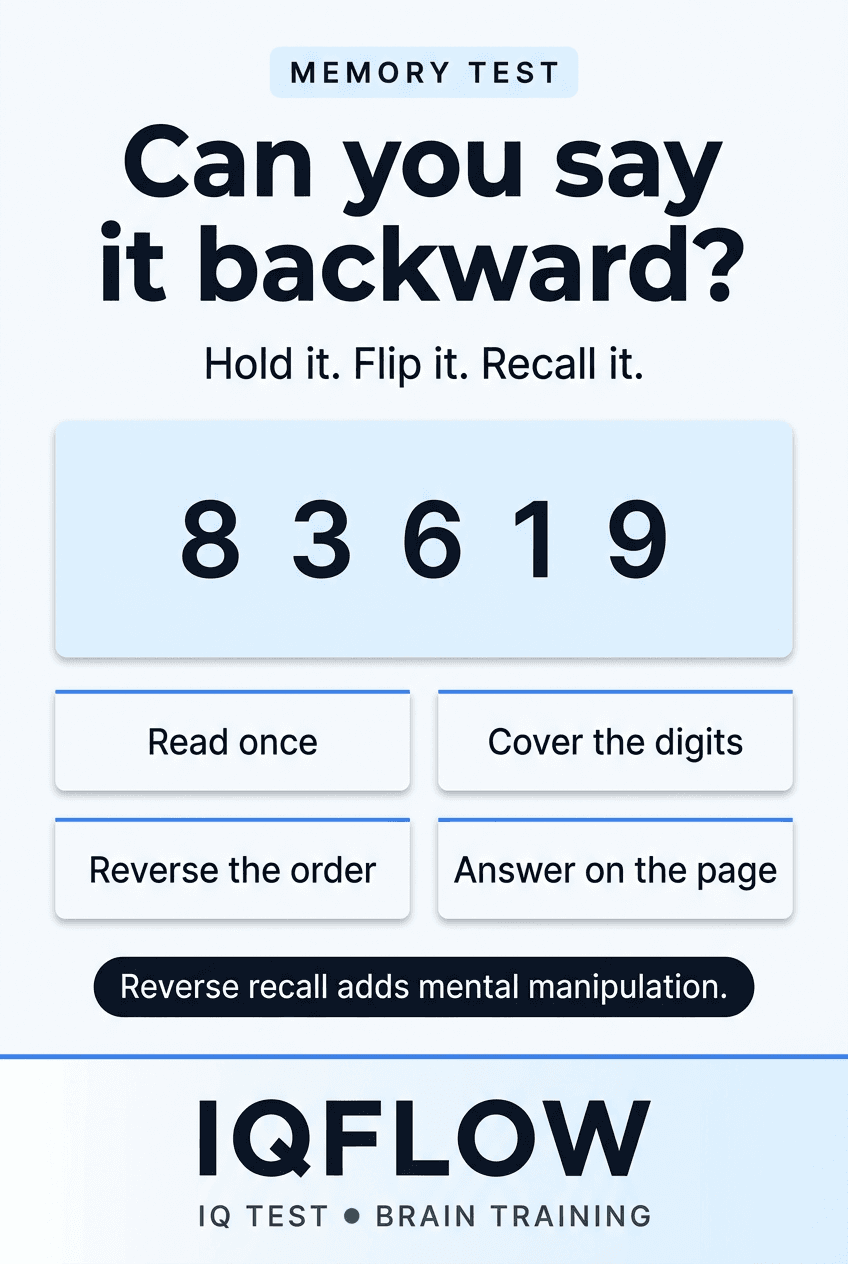
Reverse order memory test
Can you say it backward?
Reverse recall tests more than storage. You also have to manipulate the sequence in working memory.
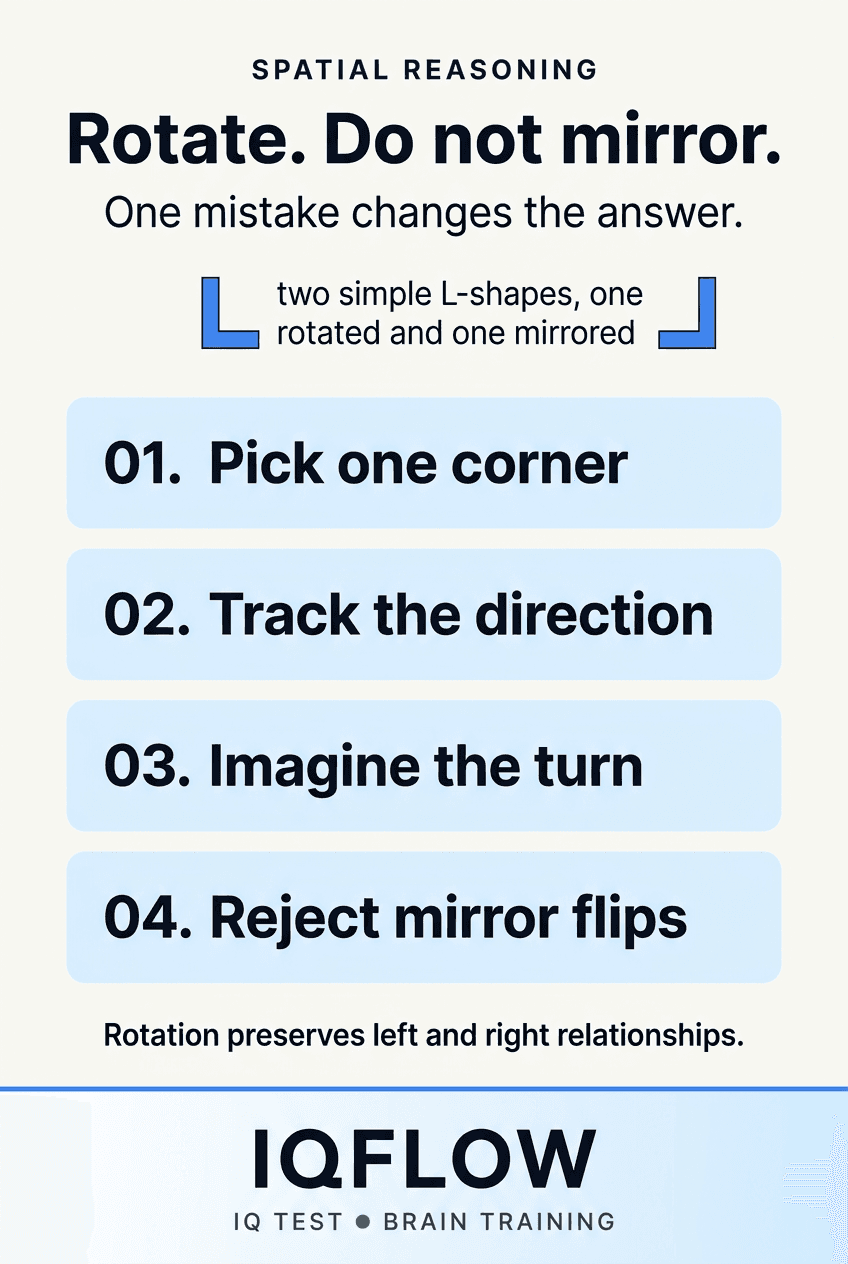
Spatial reasoning
Rotate. Do not mirror.
Mental rotation tasks become easier when you track orientation instead of treating mirrored shapes as rotated shapes.
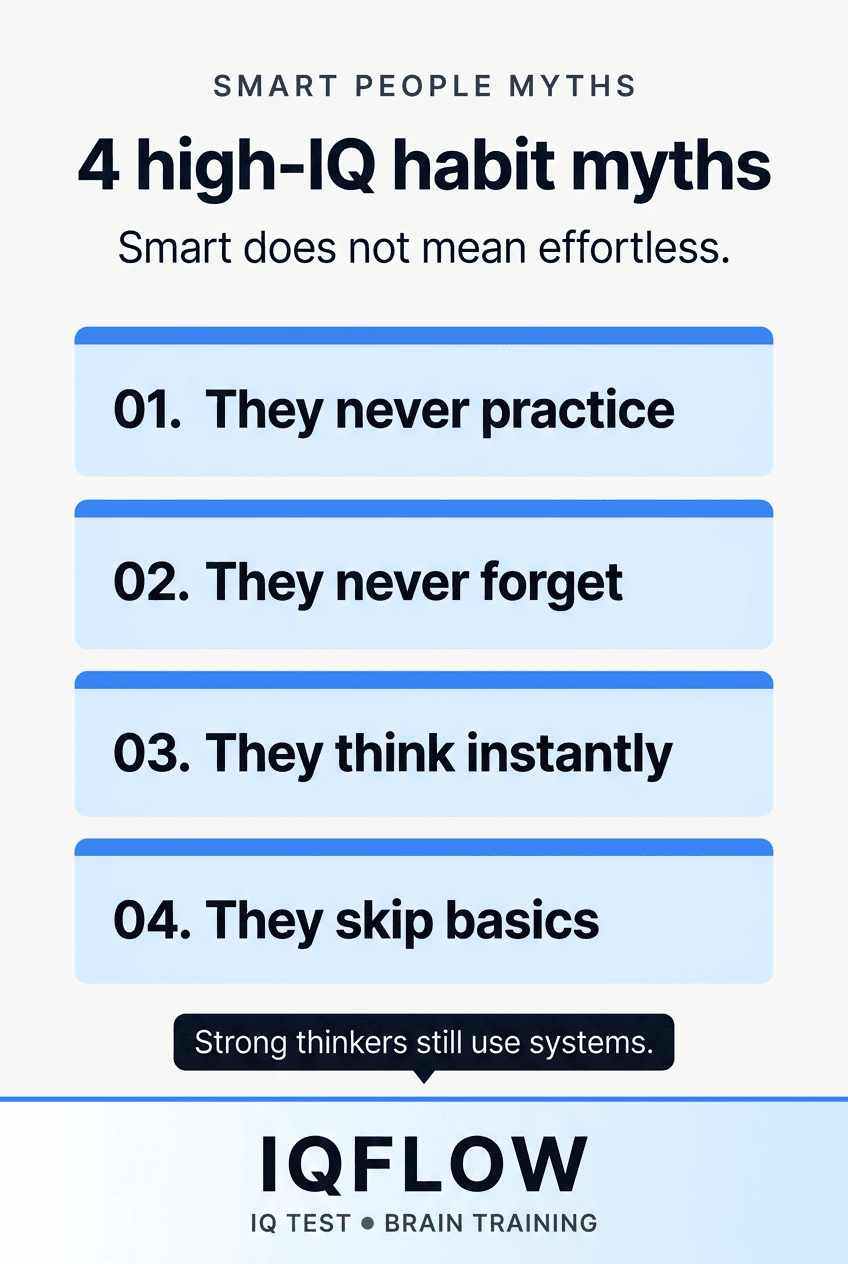
Smart people myths
4 high-IQ habit myths
High ability does not remove the need for practice, memory tools, careful checking, or basic routines.
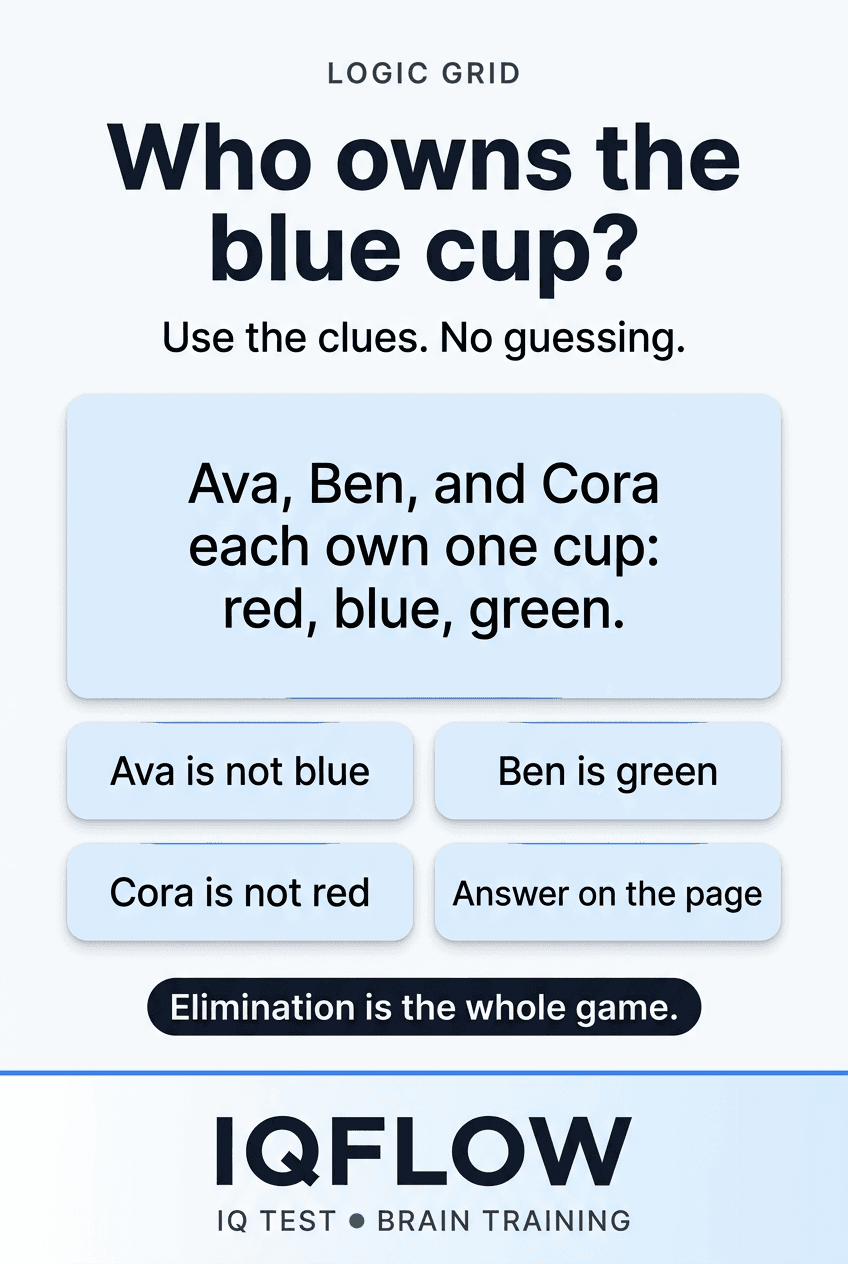
Logic grid challenge
Who owns the blue cup?
This mini logic-grid challenge uses elimination to connect people with cup colors.
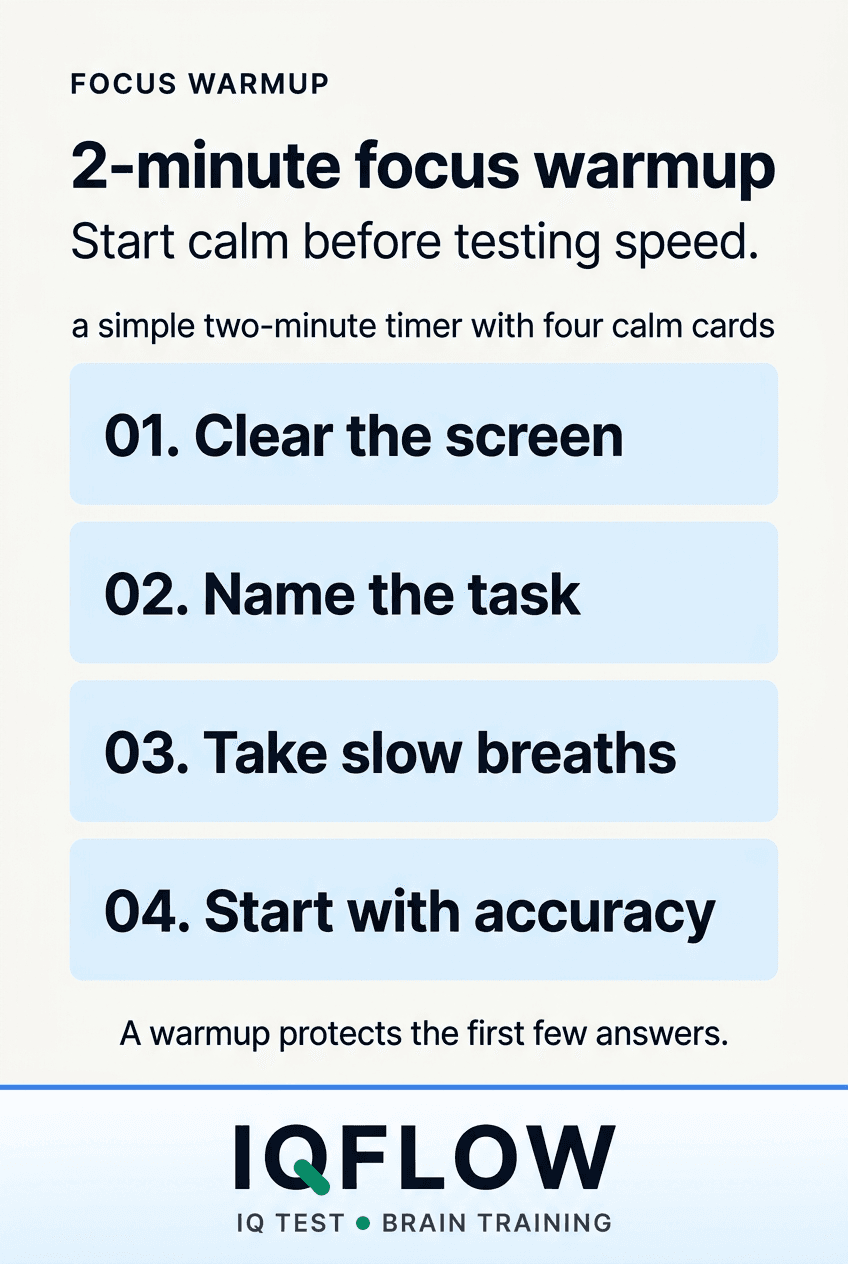
Focus warmup
2-minute focus warmup
A short warmup can reduce careless starts and make brain training results easier to compare.
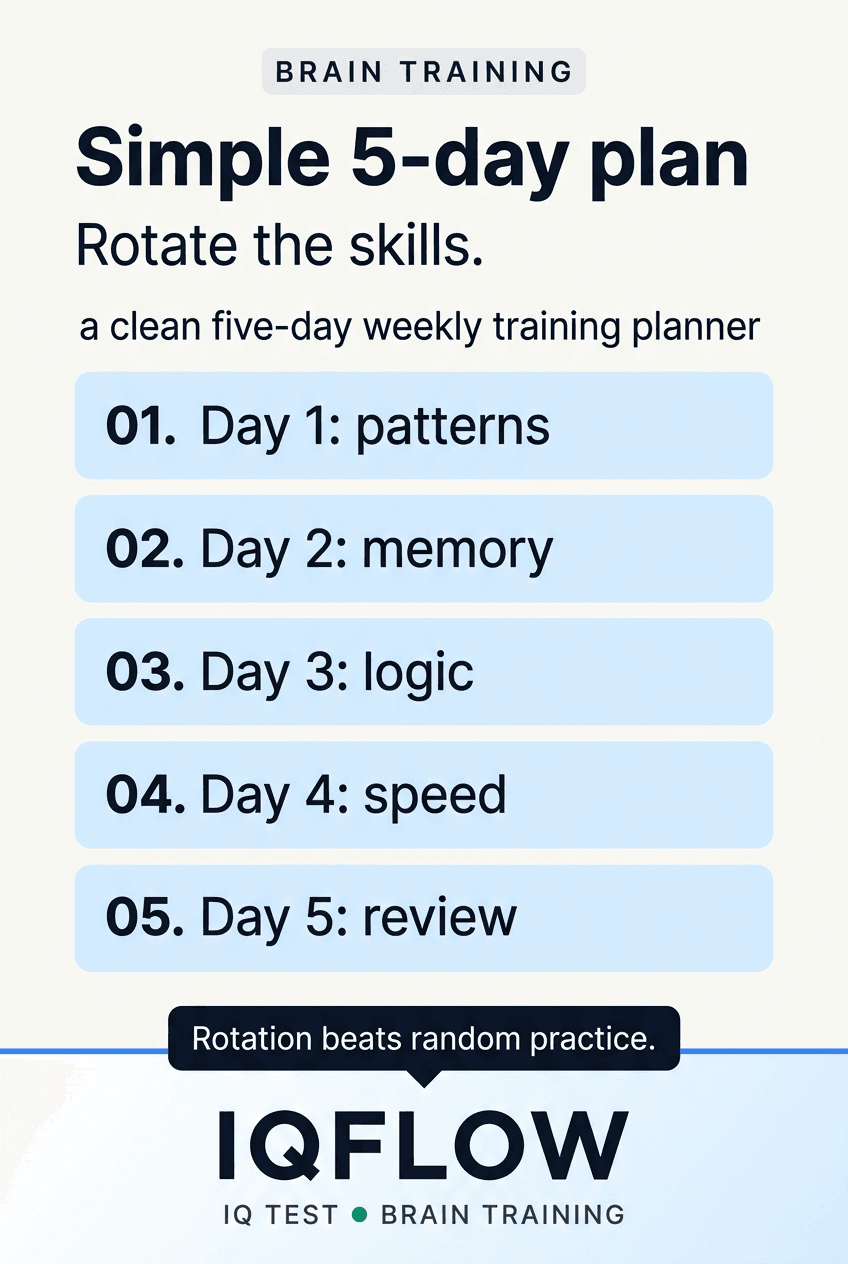
Brain training plan
Simple 5-day brain training plan
A balanced training week rotates different cognitive skills instead of doing the same puzzle repeatedly.
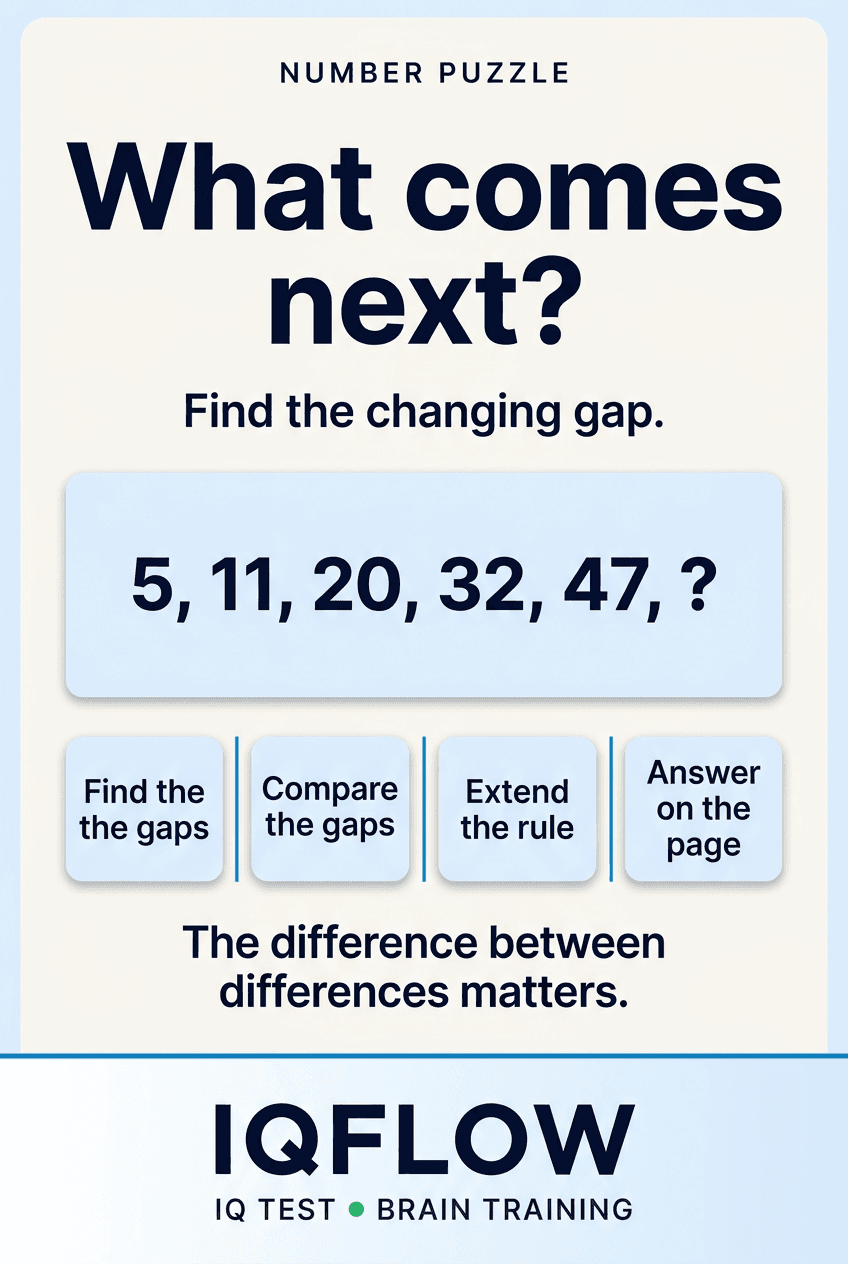
Arithmetic gap pattern
What comes next?
This sequence tests whether you can spot a second-level pattern in the gaps.
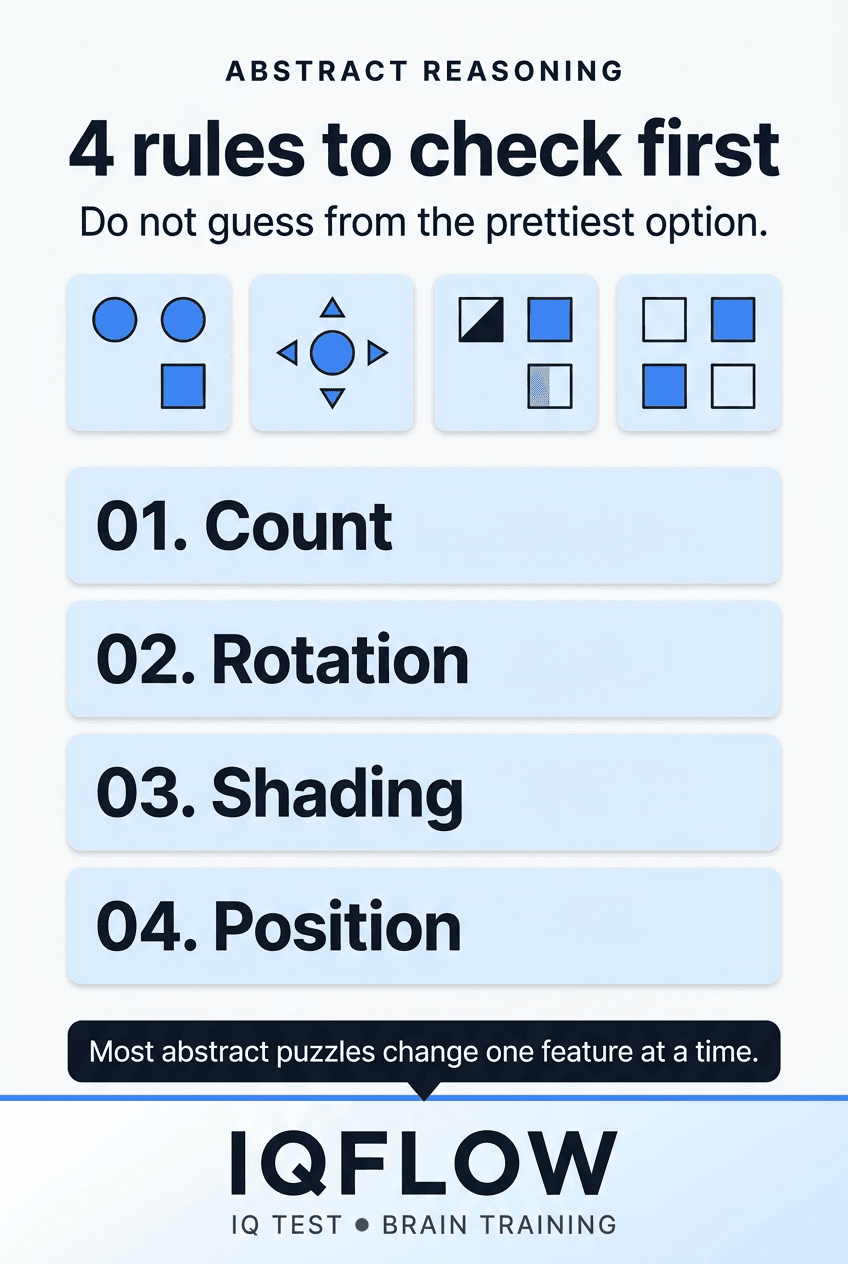
Abstract reasoning
4 rules to check first
Abstract reasoning puzzles often become easier when you check a short list of common changing features.
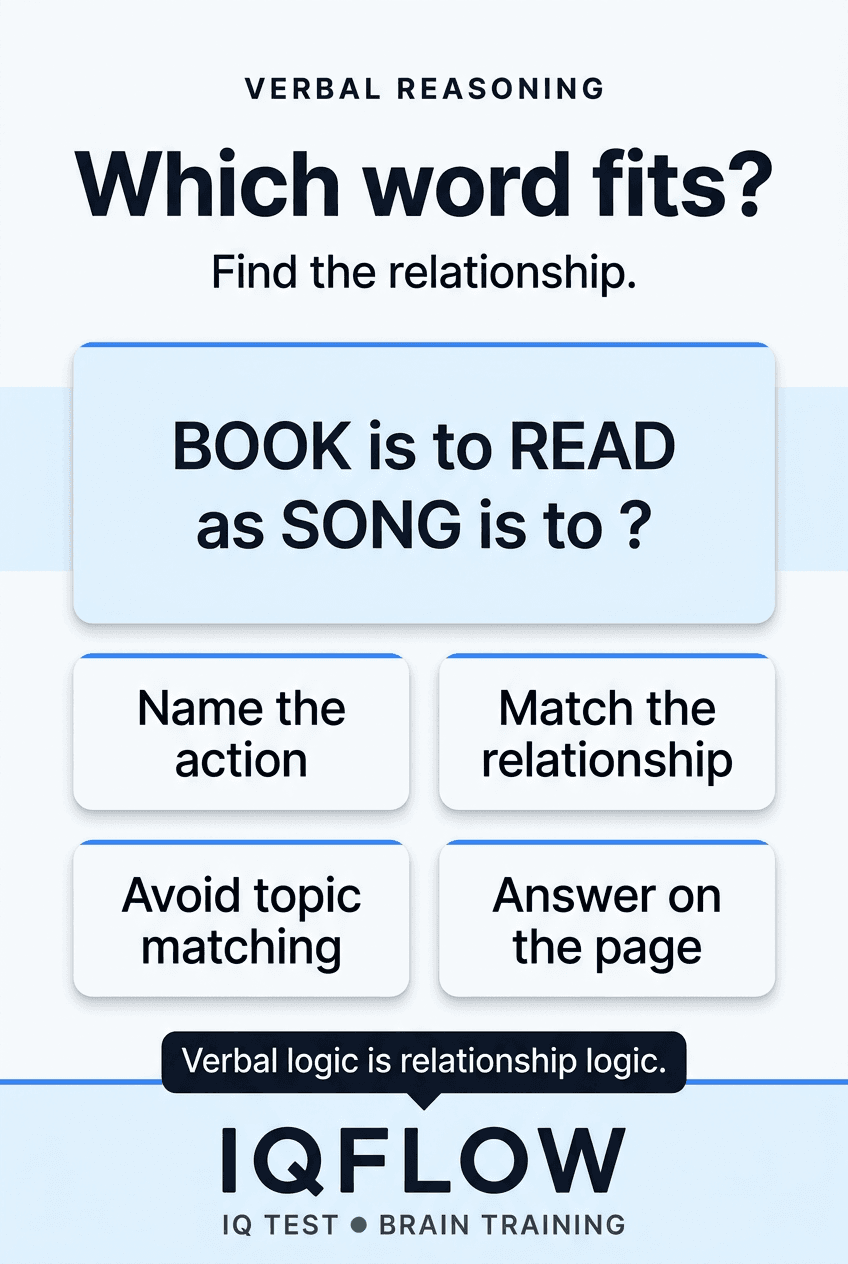
Verbal reasoning
Which word fits?
Verbal reasoning questions test whether you can identify the relationship between words and transfer it.
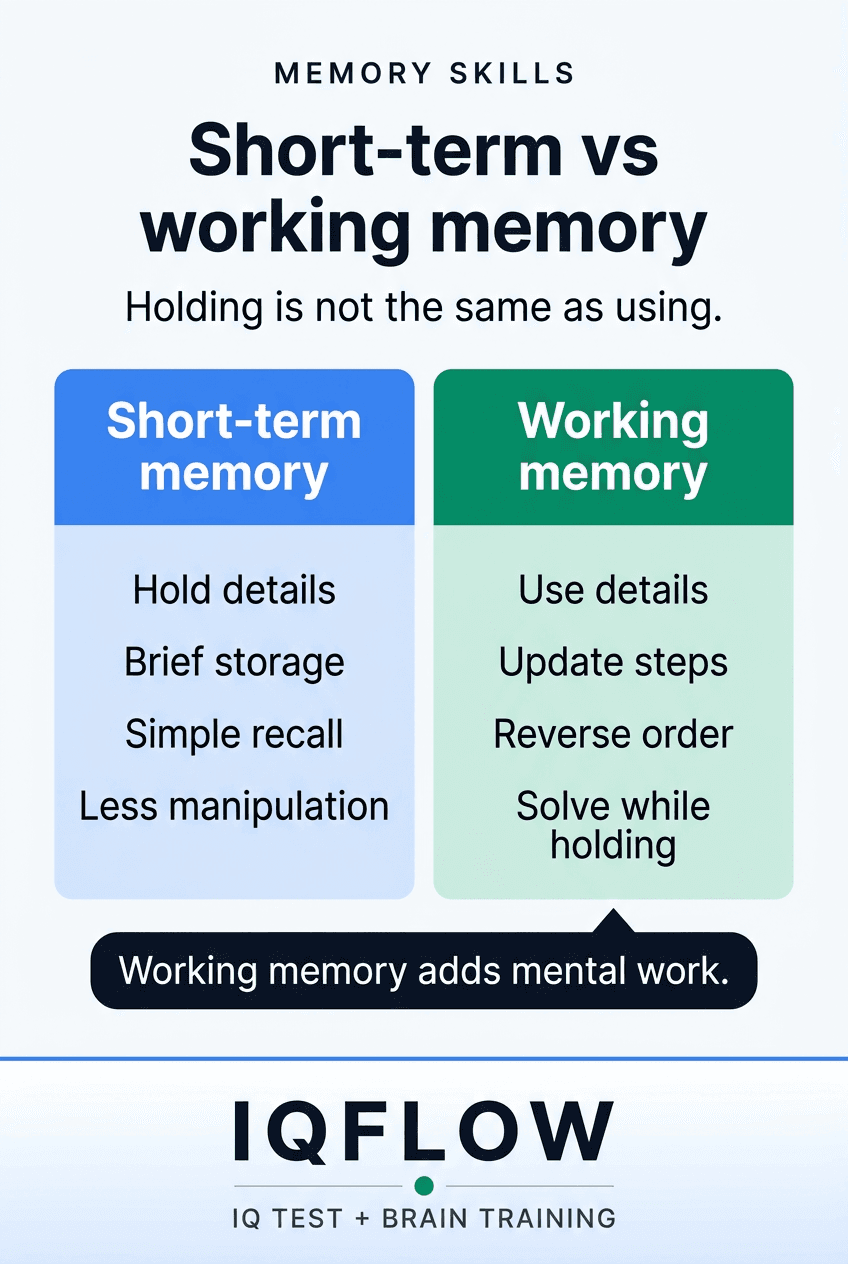
Memory skills
Short-term memory vs working memory
Short-term memory stores information briefly. Working memory keeps it active while you manipulate or use it.
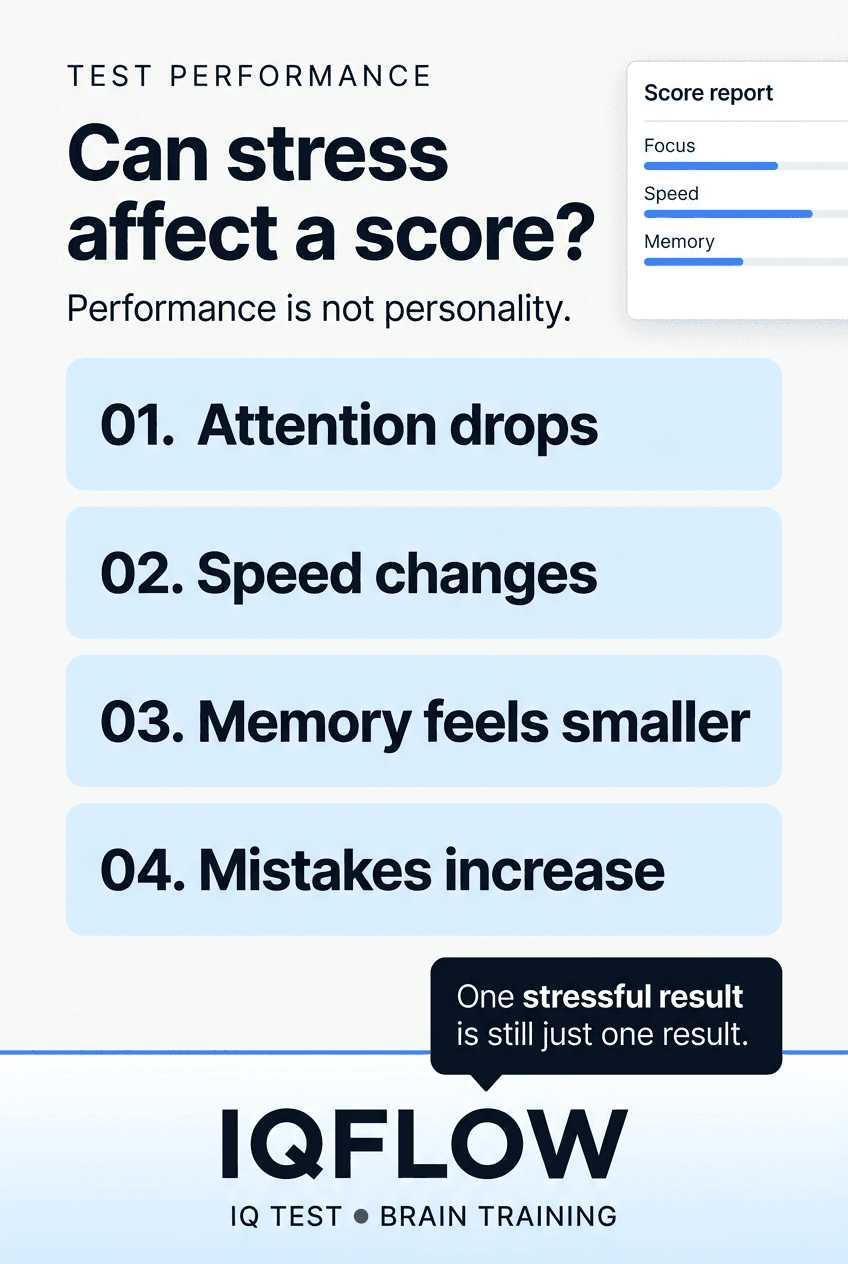
Test performance
Can stress affect a score?
Stress can change how attention, speed, and working memory show up during a test. That makes repeatable context important.
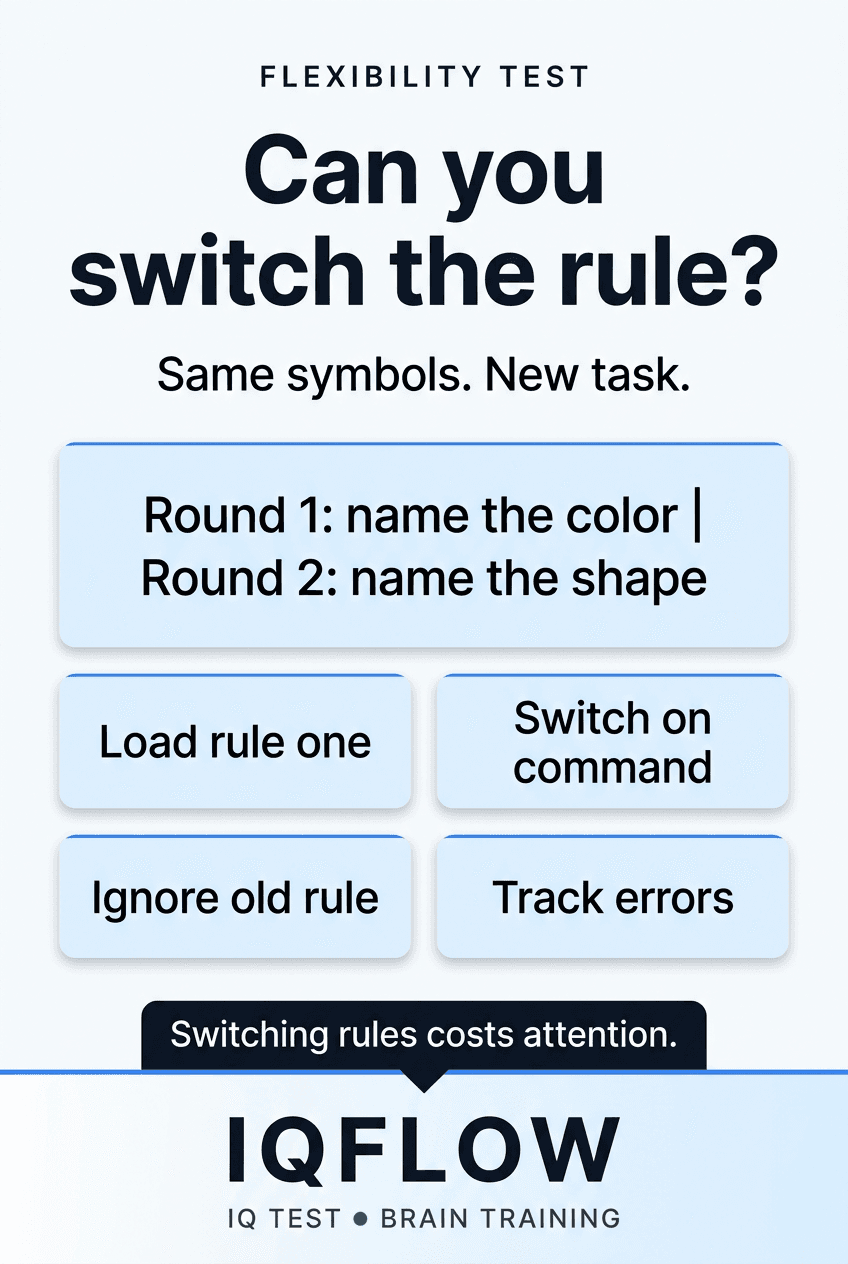
Cognitive flexibility
Can you switch the rule?
Cognitive flexibility is the ability to update the active rule and avoid letting the old rule interfere.
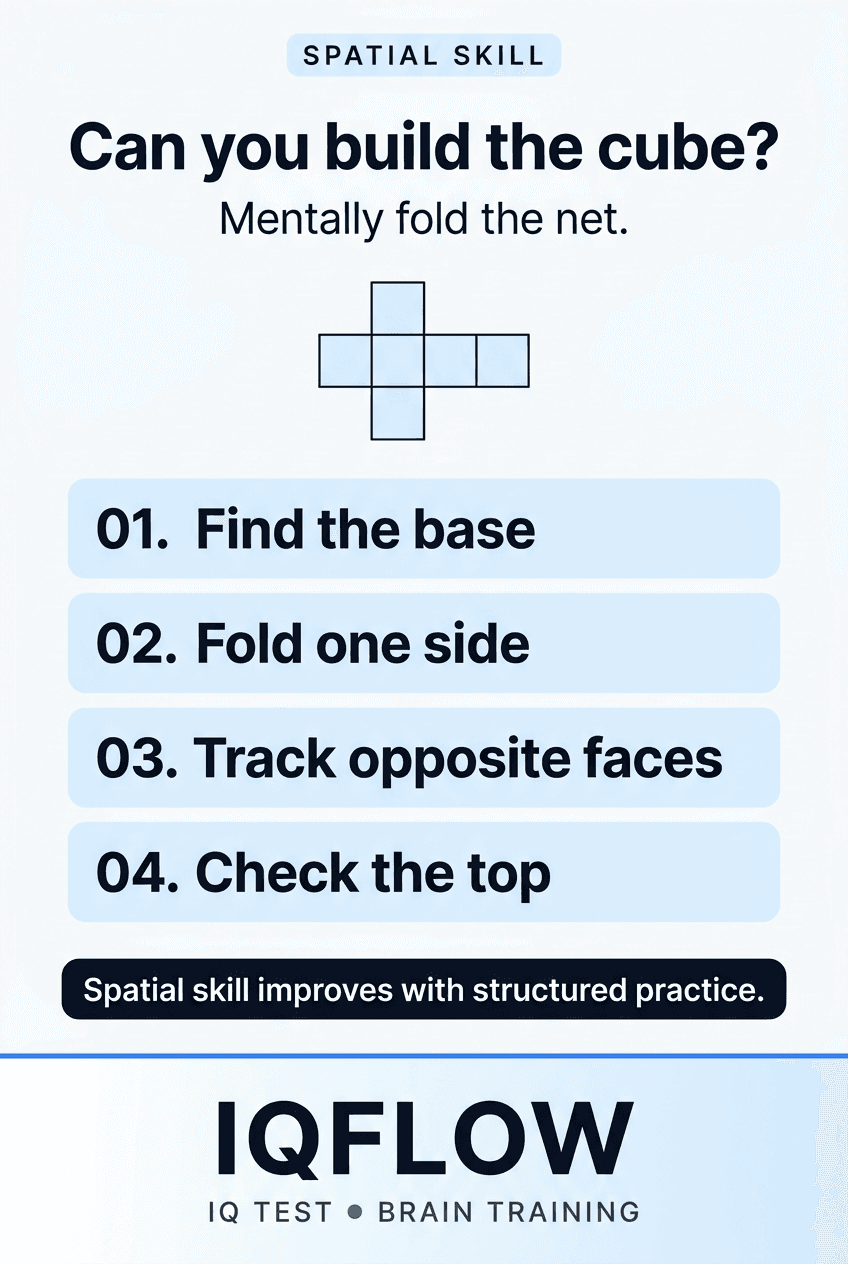
Spatial visualization
Can you build the cube?
Cube-net tasks train spatial visualization by asking you to imagine how a flat layout folds into a 3D object.
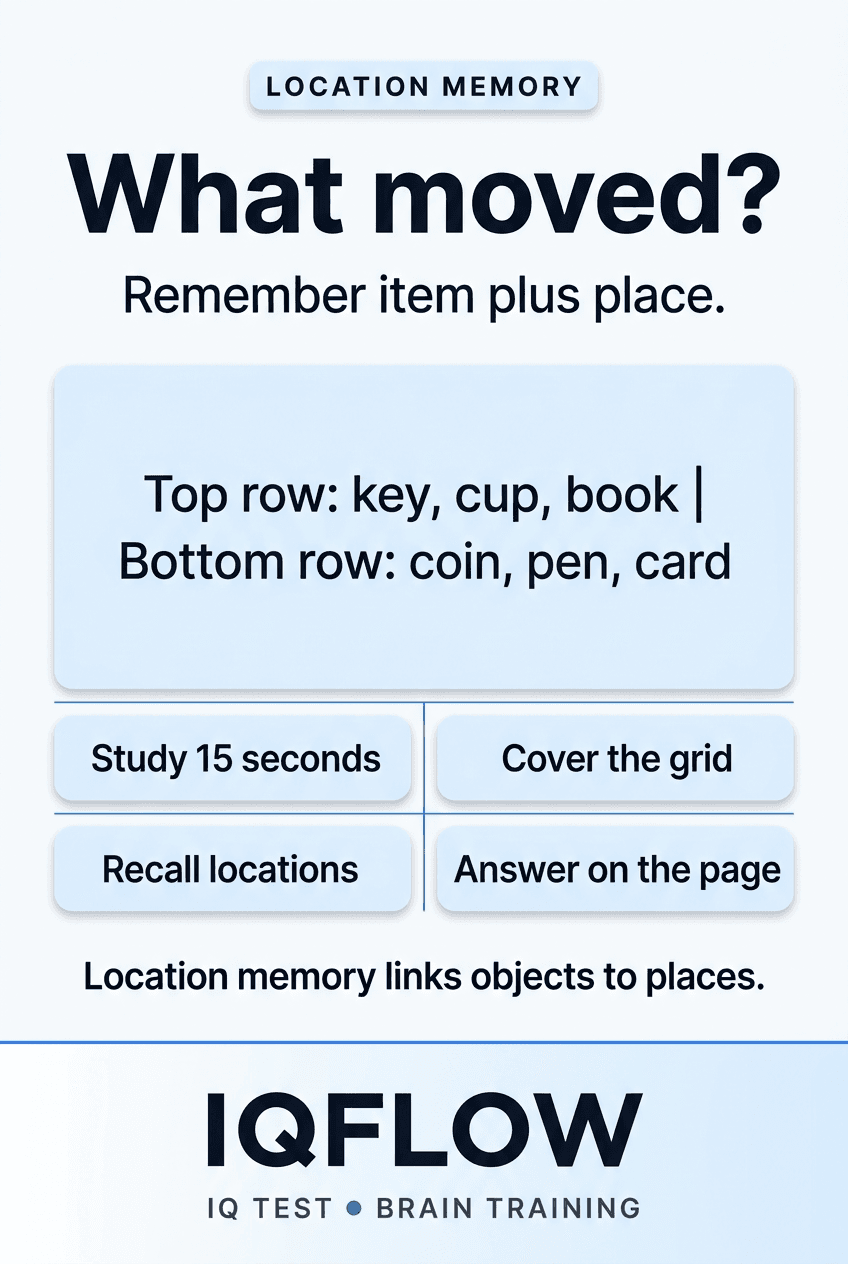
Object-location memory
What moved?
Object-location memory combines item recall with spatial position, which makes it different from simple word recall.
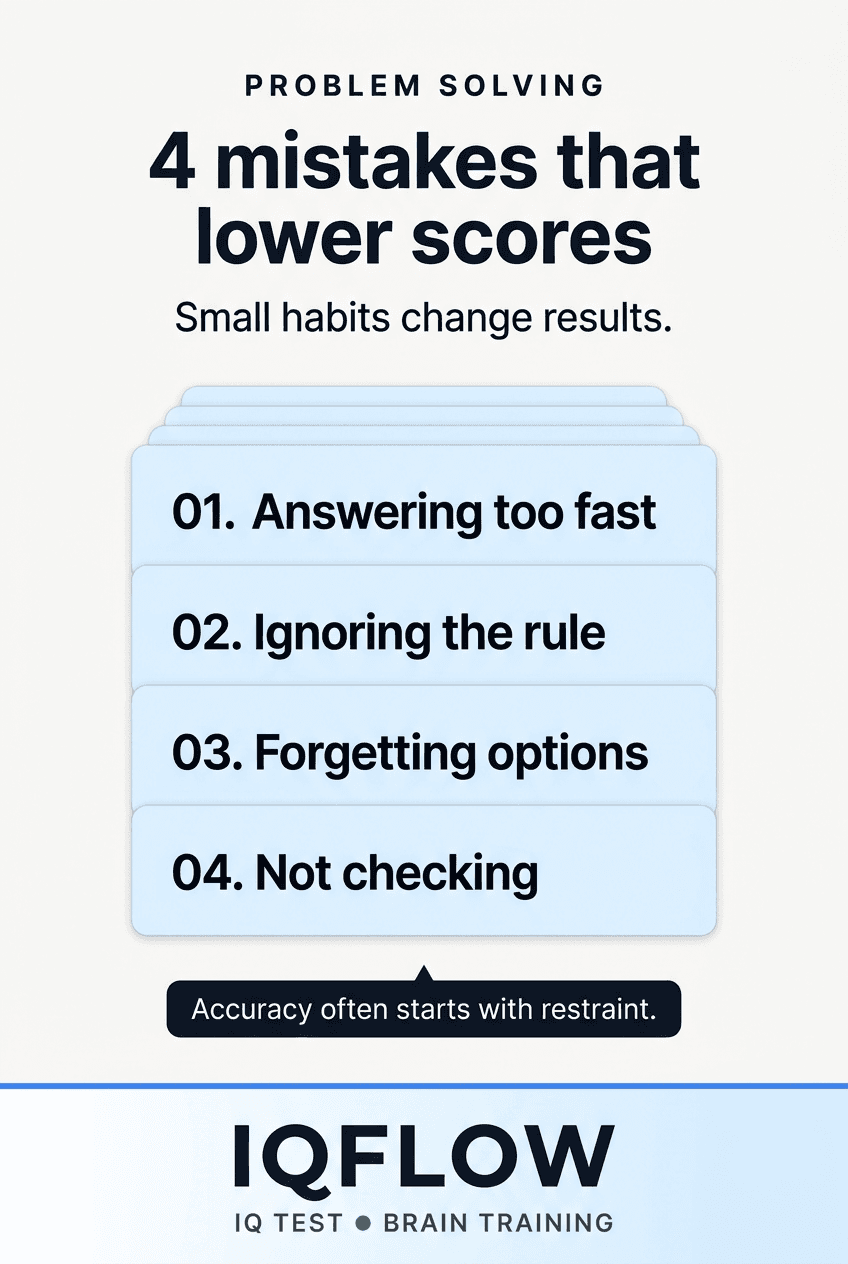
Problem solving
4 mistakes that lower scores
Many IQ-style mistakes are process mistakes: rushing, ignoring the rule, losing options, or skipping the final check.
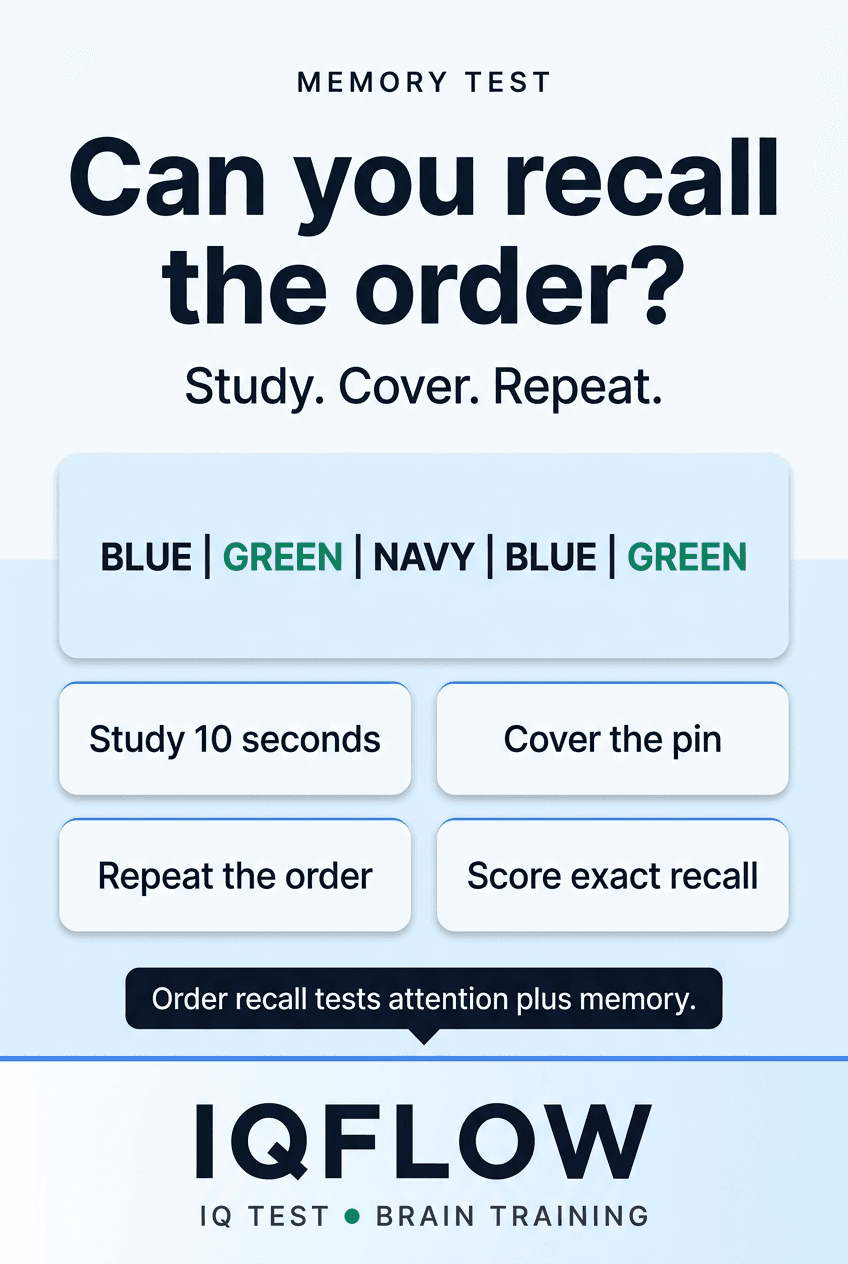
Color order memory test
Can you recall the order?
Color-order recall tests whether you can remember both the items and their sequence.
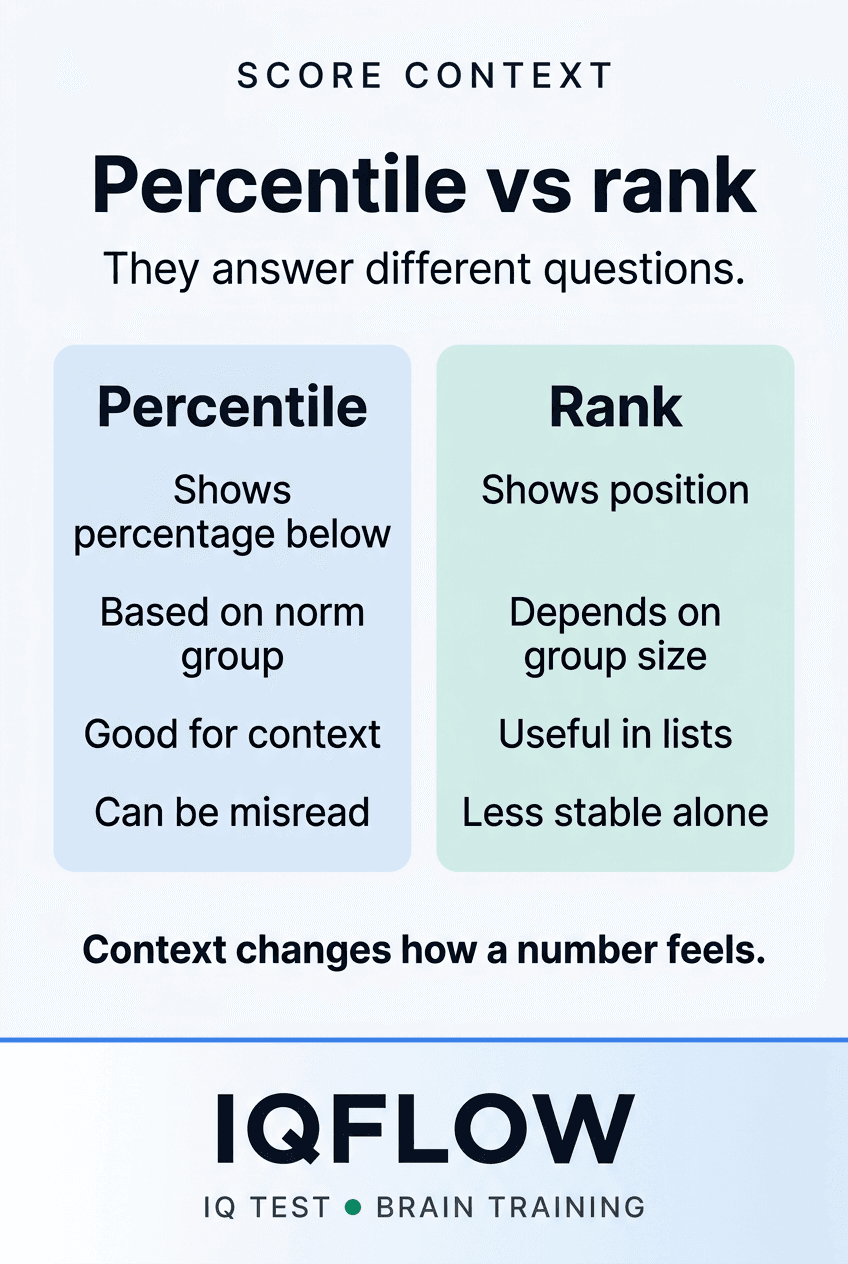
Score context
Percentile vs rank
Percentile and rank both compare performance, but they answer different questions and depend on the comparison group.
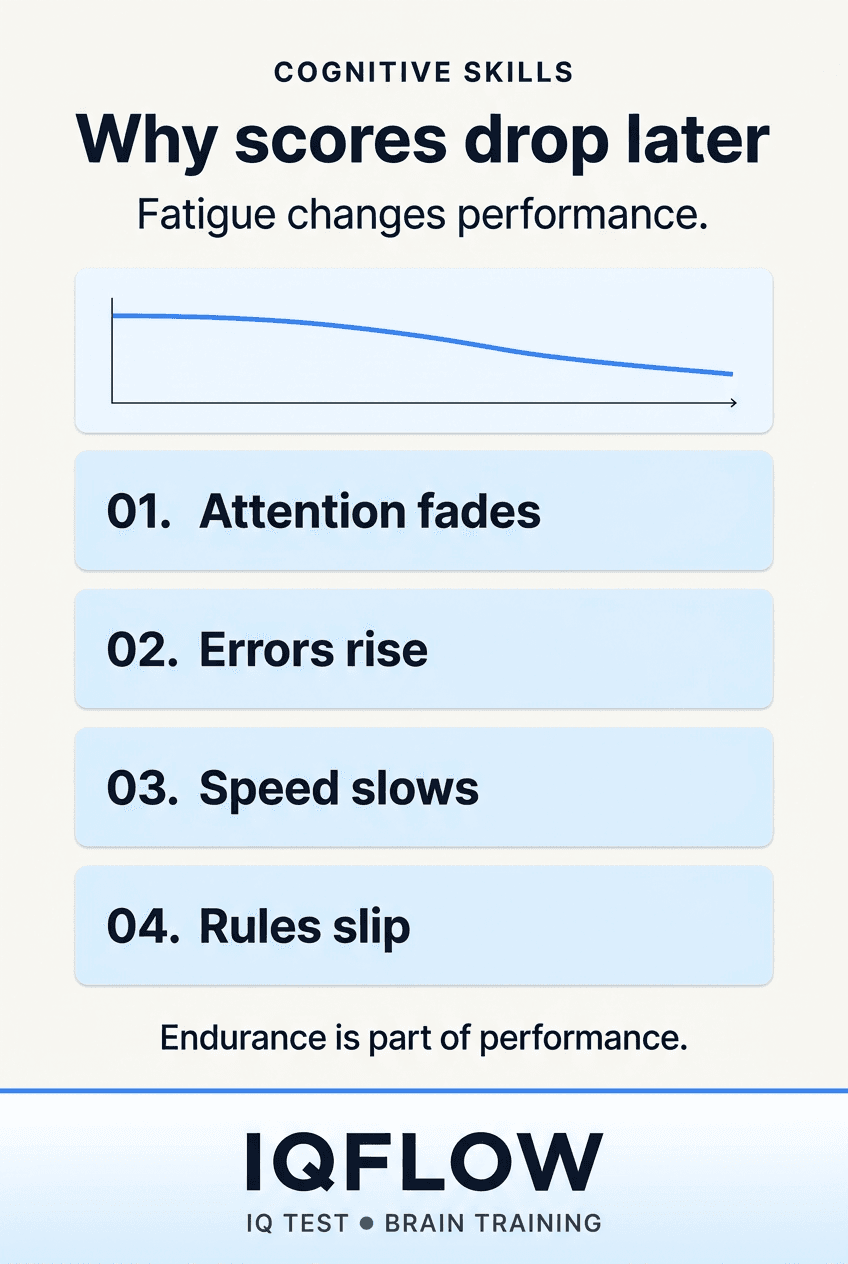
Cognitive endurance
Why scores drop later
Cognitive endurance is your ability to keep performance stable as a session continues.
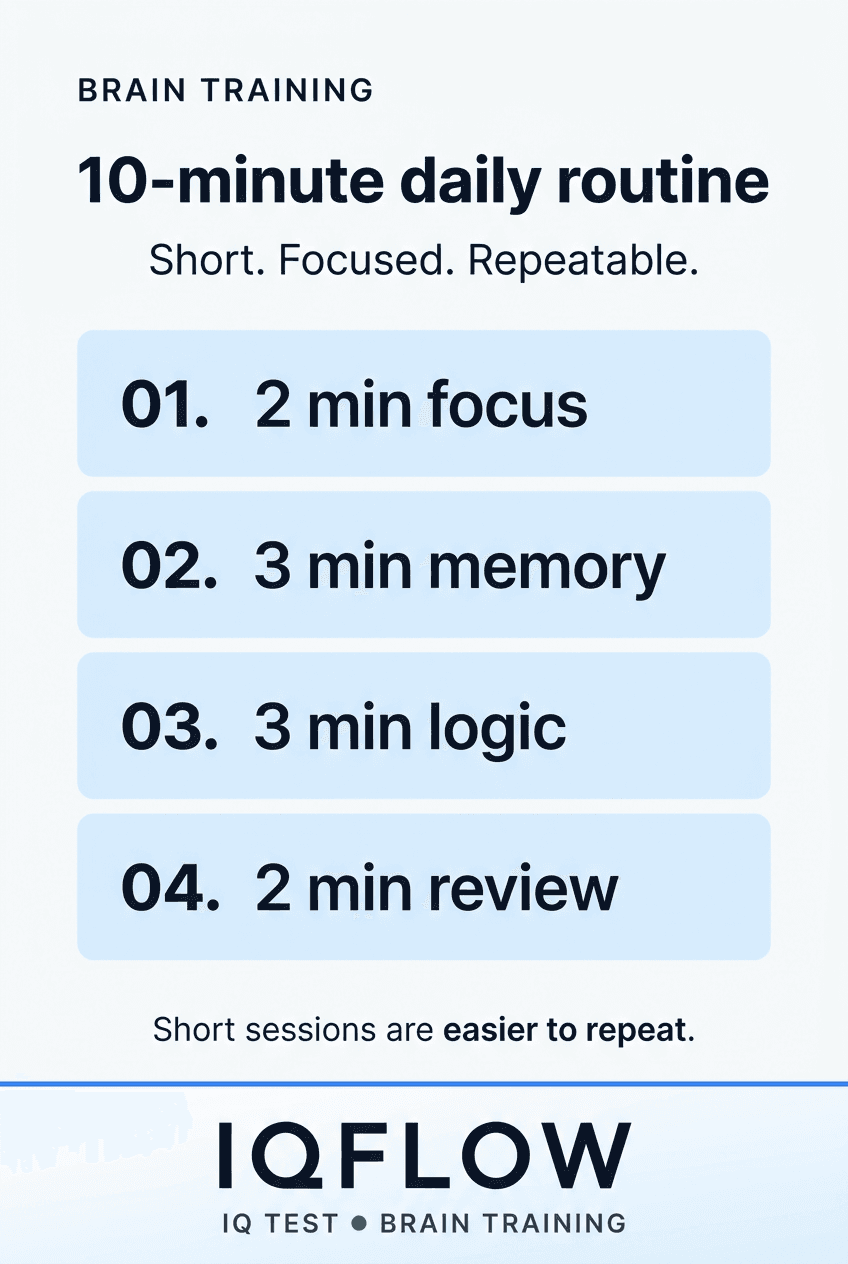
Daily brain training
10-minute daily routine
Short brain training sessions are easier to repeat when each block has a clear purpose.
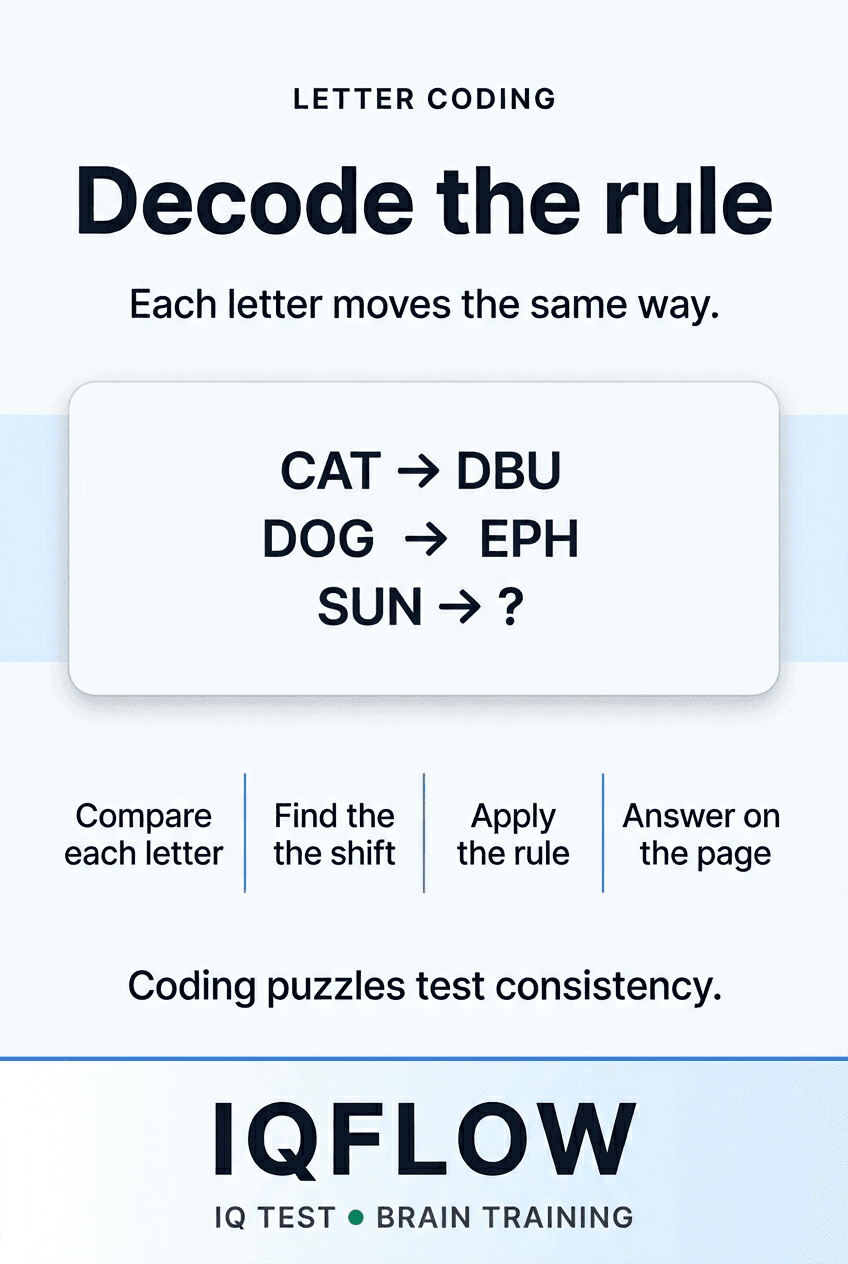
Letter coding puzzle
Decode the rule
Letter-coding puzzles test whether you can find an alphabet shift and apply it consistently.
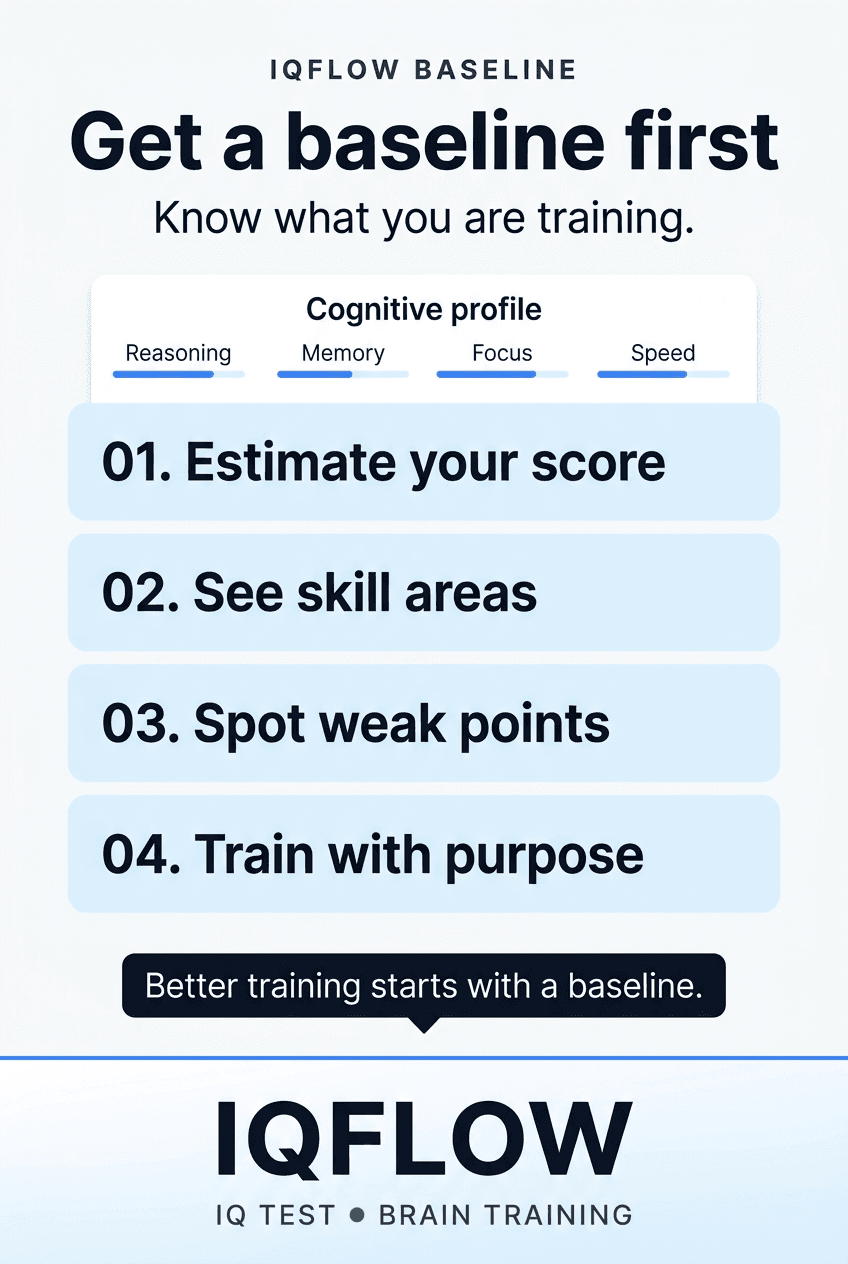
IQFlow baseline
Get a baseline first
A baseline helps brain training feel less random by showing which cognitive areas need the most attention.
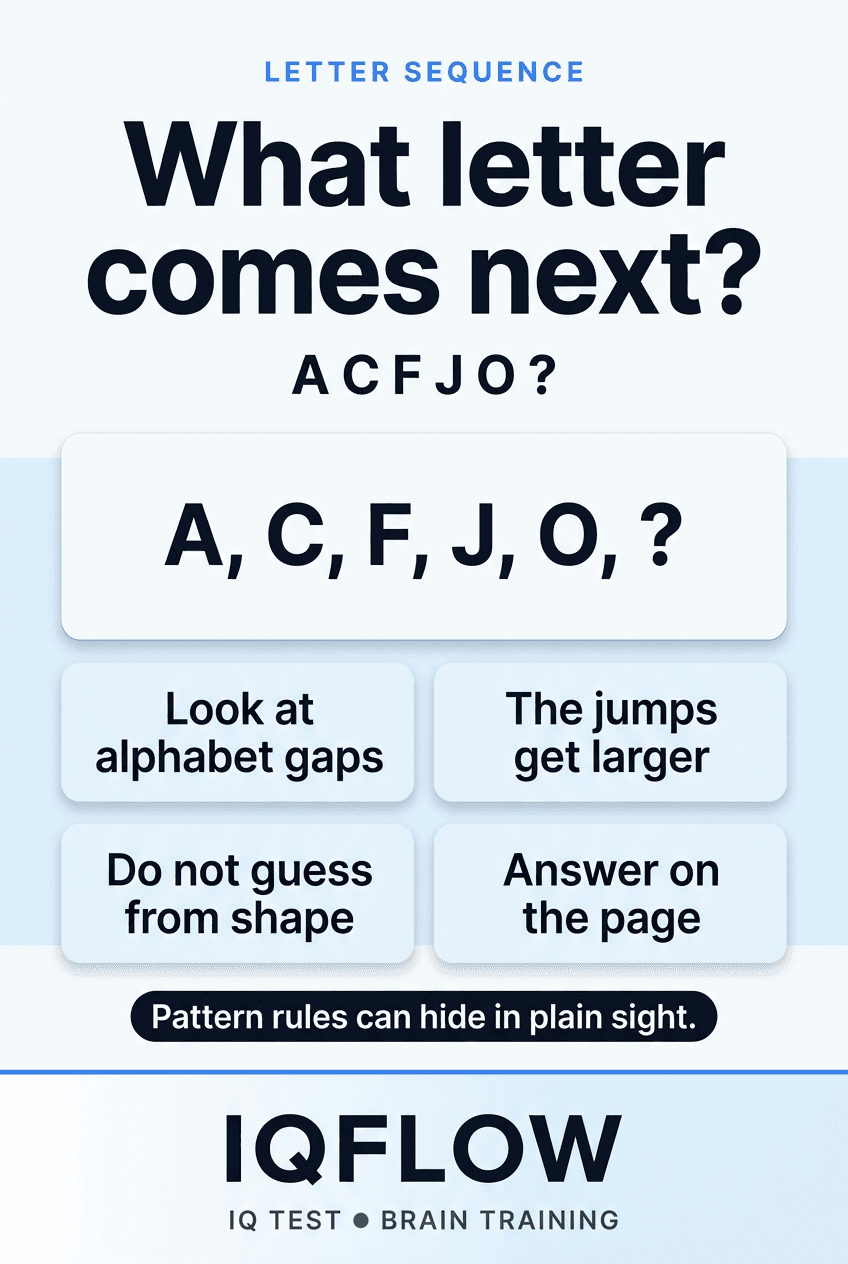
Letter sequence IQ test
What letter comes next?
A quick alphabet-pattern puzzle for testing sequence reasoning without doing math.
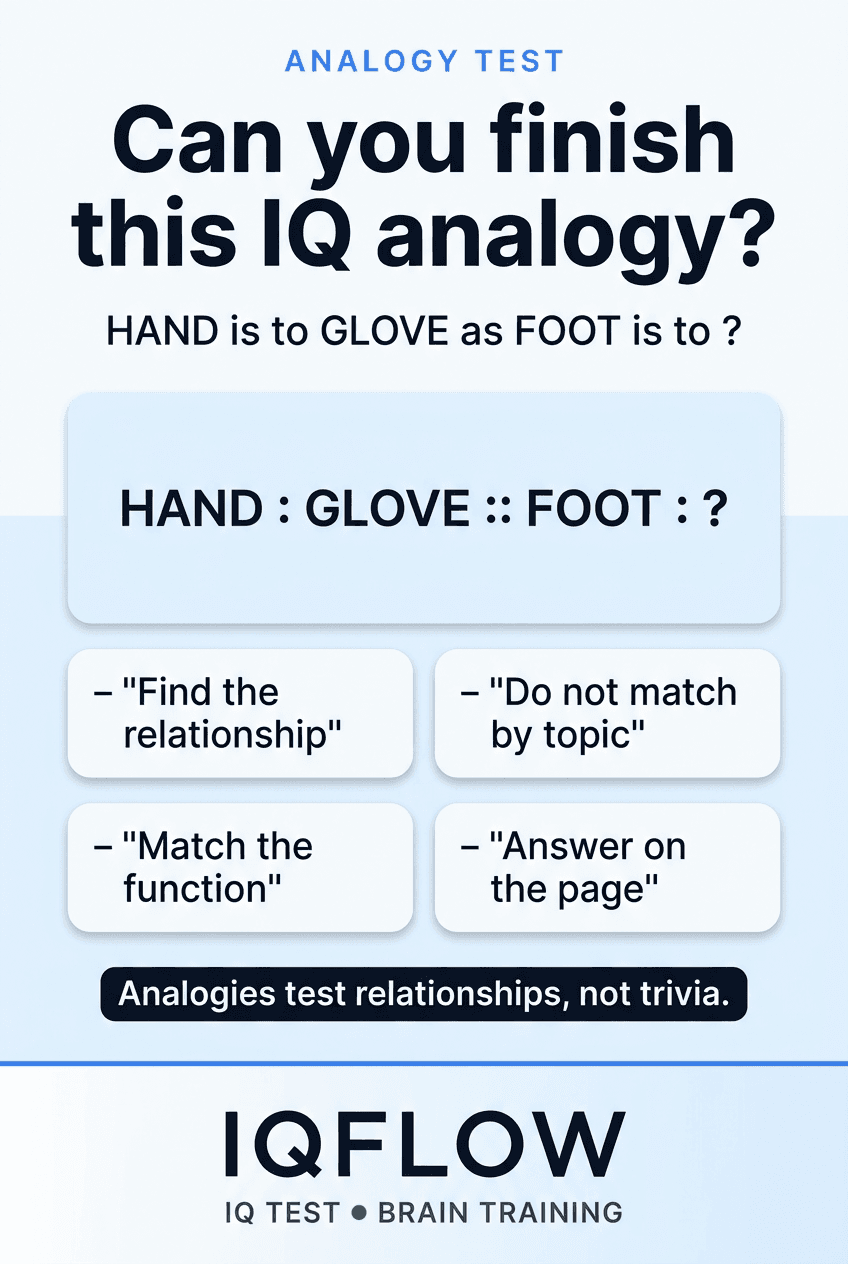
IQ analogy question
Can you finish this IQ analogy?
Analogy questions test whether you can map one relationship onto another instead of matching words loosely.
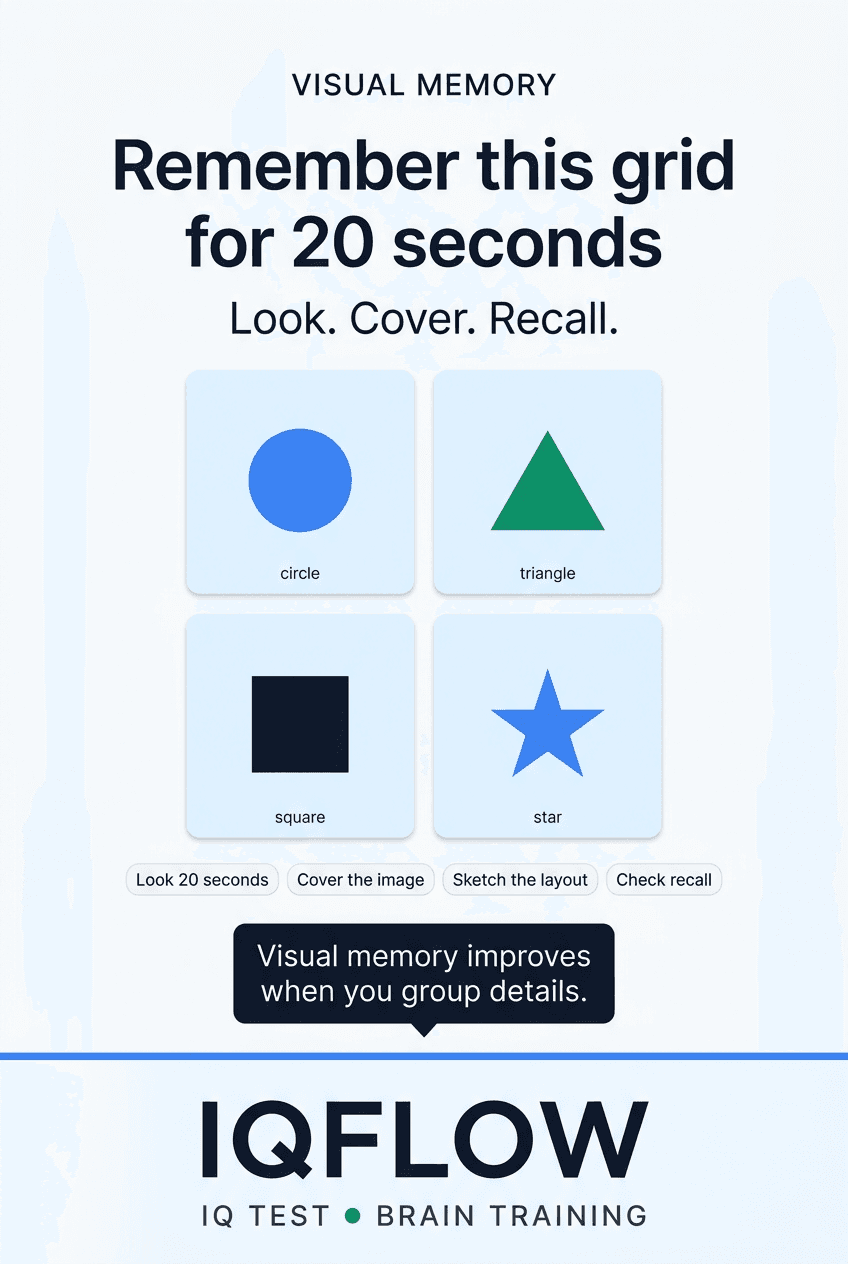
Visual memory test
Can you remember the grid?
A short visual memory challenge for testing how you encode shape, color, and position.
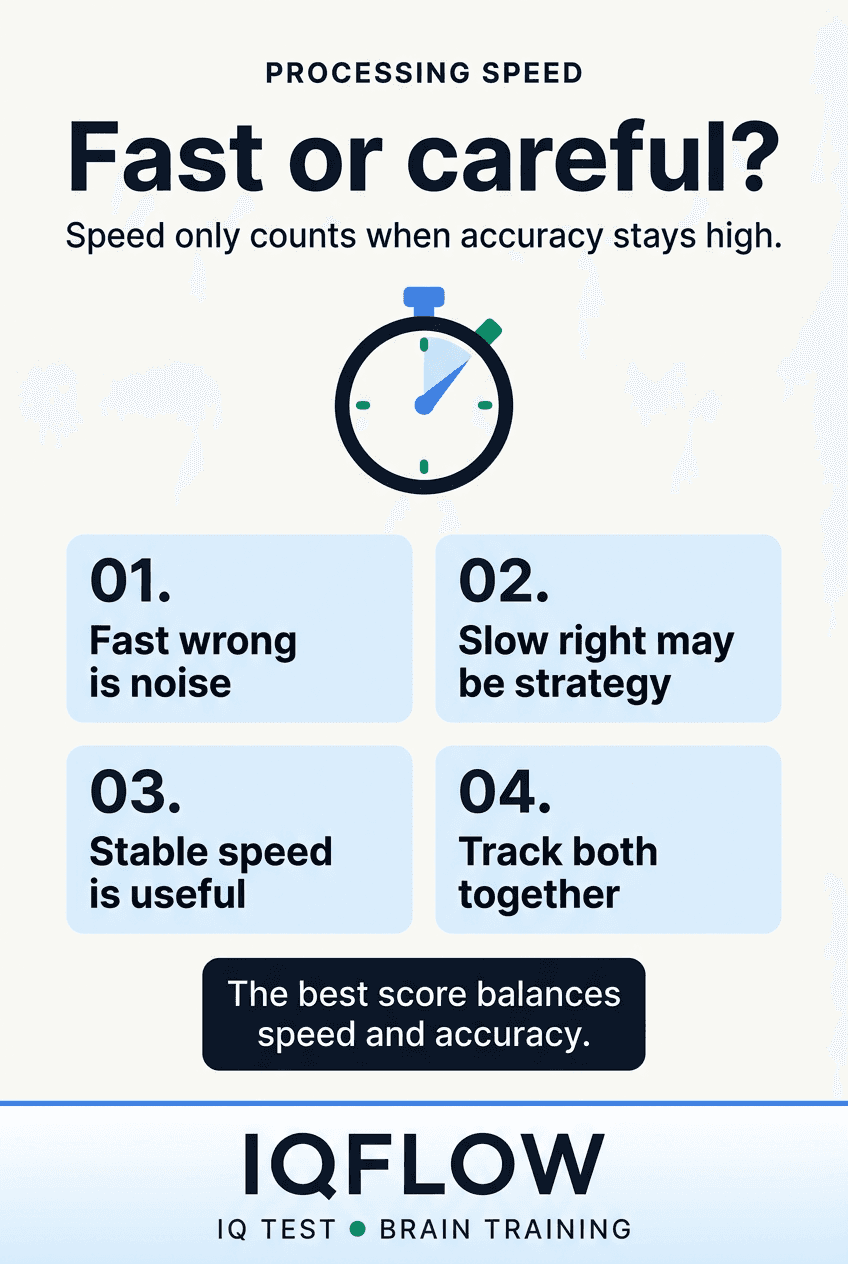
Processing speed test
Fast or careful?
Processing speed only becomes meaningful when it is interpreted alongside accuracy.
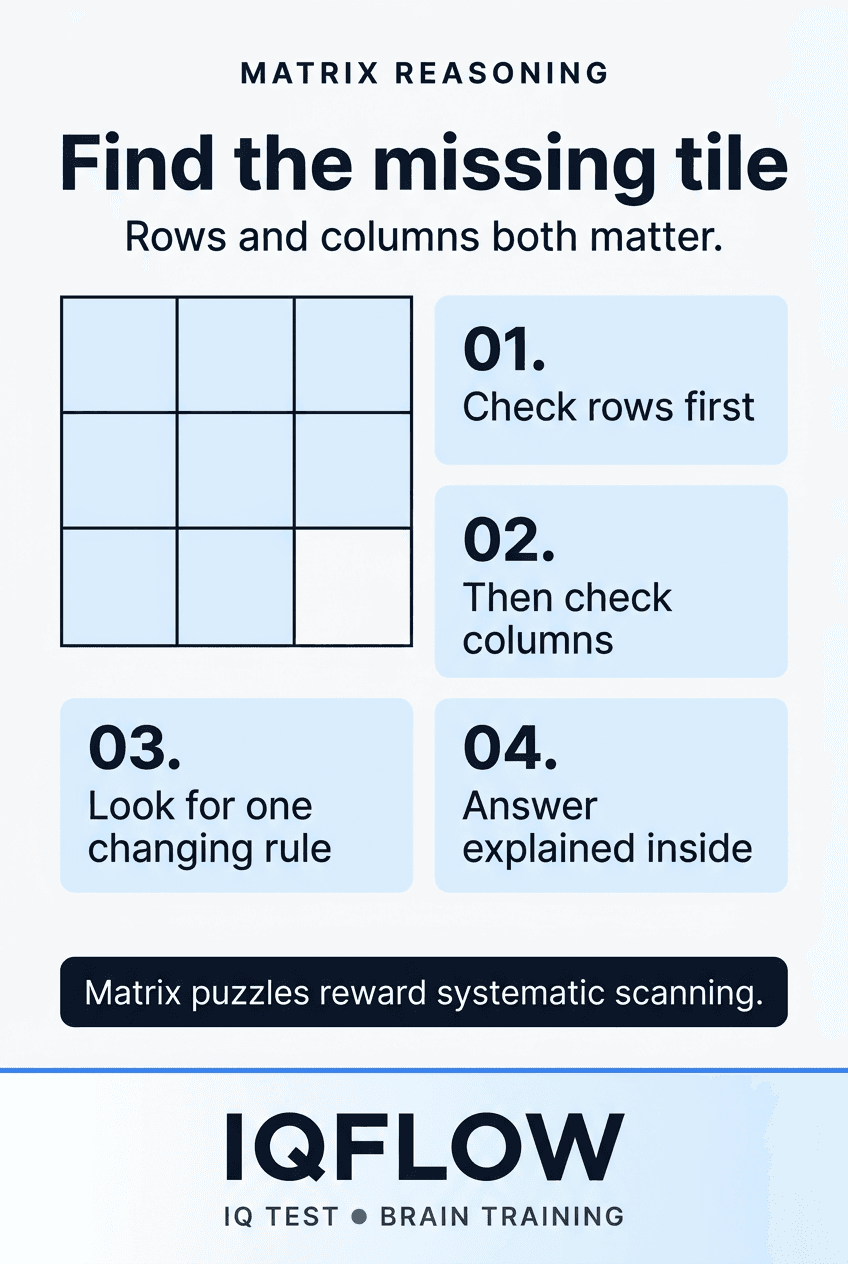
Matrix reasoning test
Find the missing tile
Matrix puzzles are easier when you scan rows and columns systematically instead of guessing from the nearest shape.
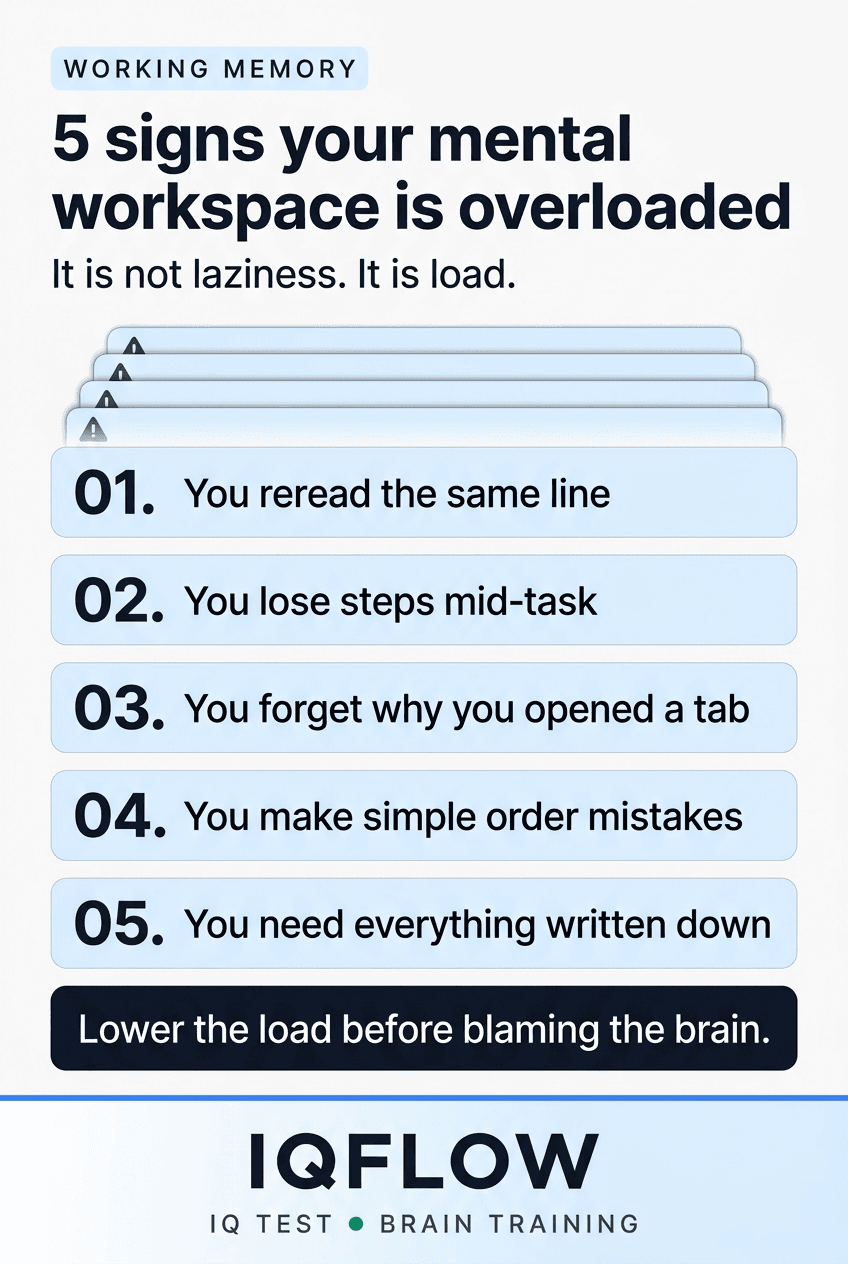
Working memory
5 signs your mental workspace is overloaded
Working memory is the mental workspace that holds details while you use them. When it is overloaded, even simple tasks feel noisy.
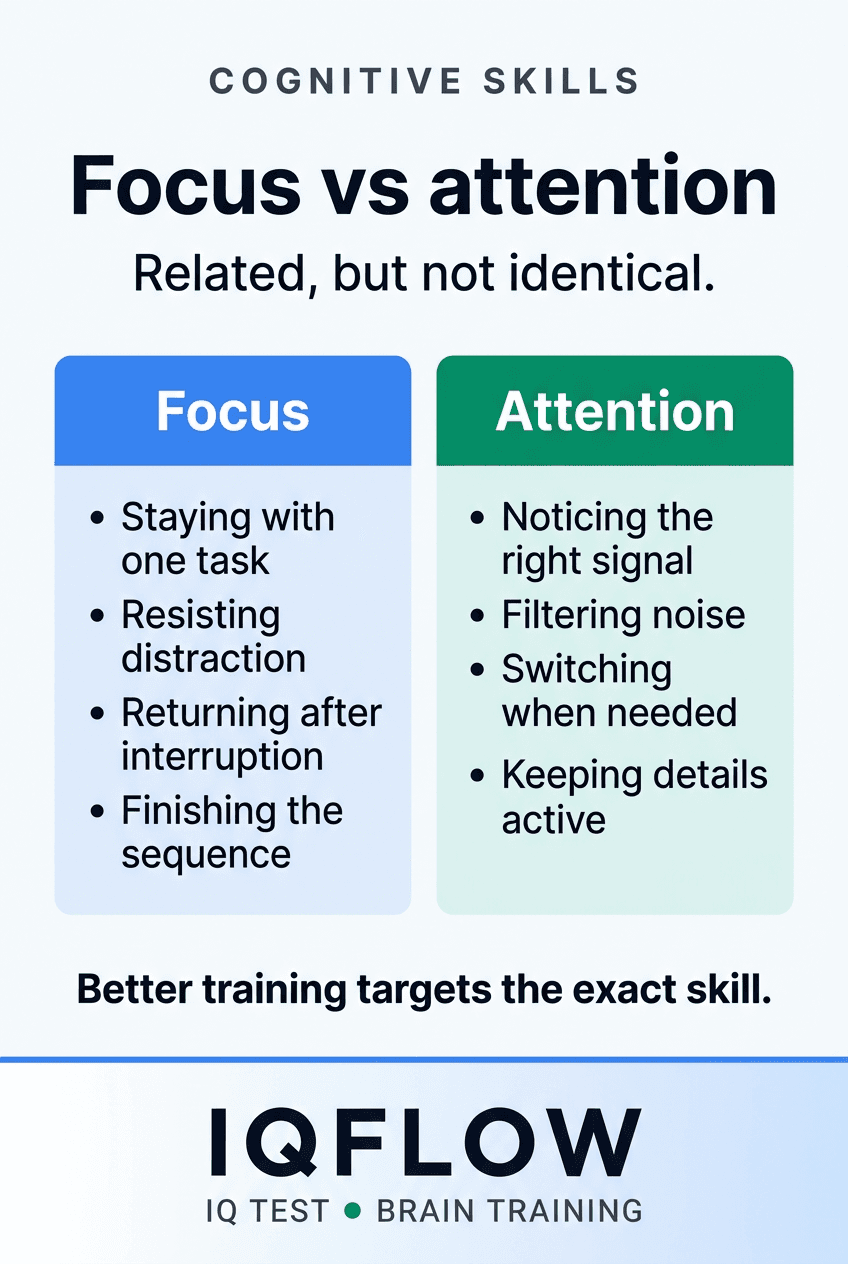
Cognitive skills
Focus vs attention: the simple difference
Focus helps you stay with a task. Attention helps you select and manage the information that matters.
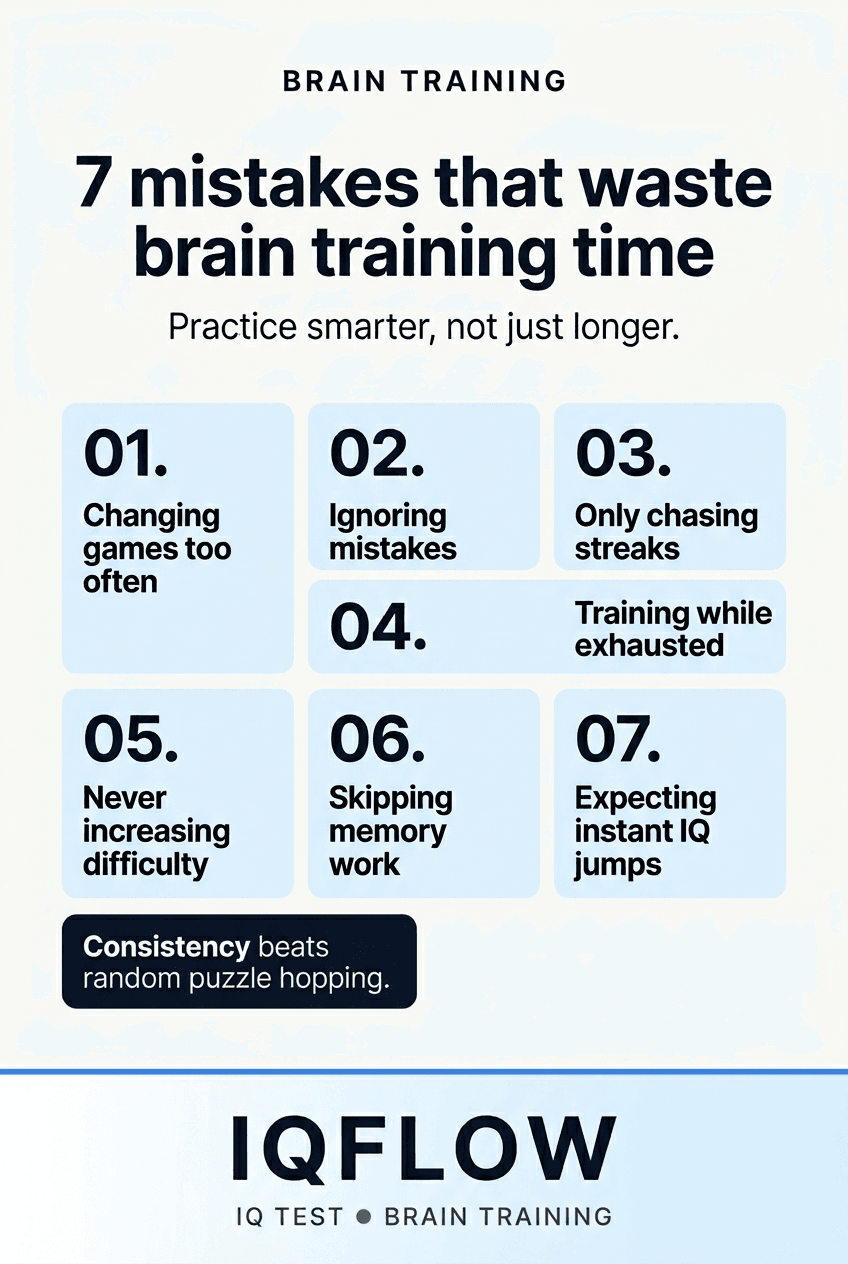
Brain training games
7 mistakes that waste brain training time
Brain training is most useful when practice is structured, repeated, and tied to specific cognitive skills.
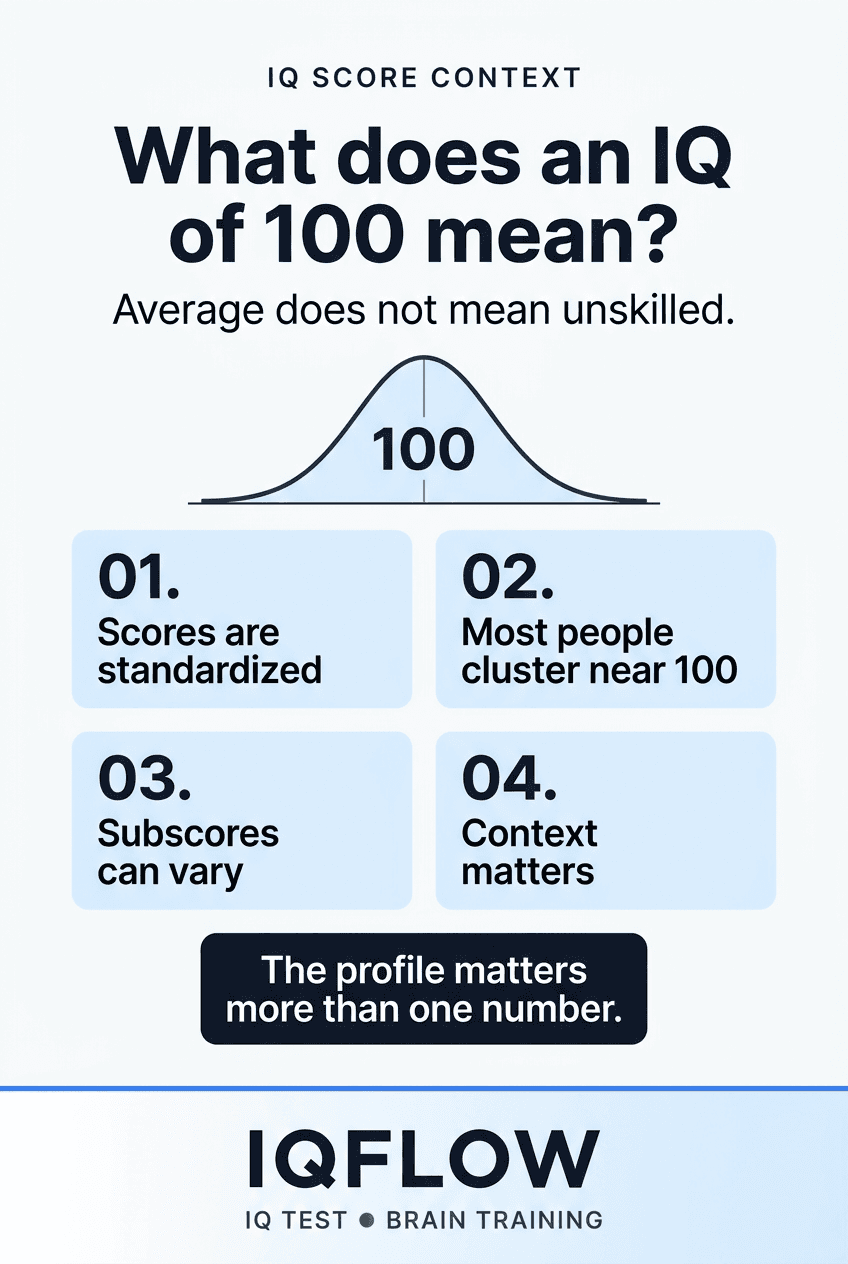
IQ scores explained
What does an IQ of 100 mean?
IQ scores are centered around a standardized average, but the useful part is understanding the skills behind the number.
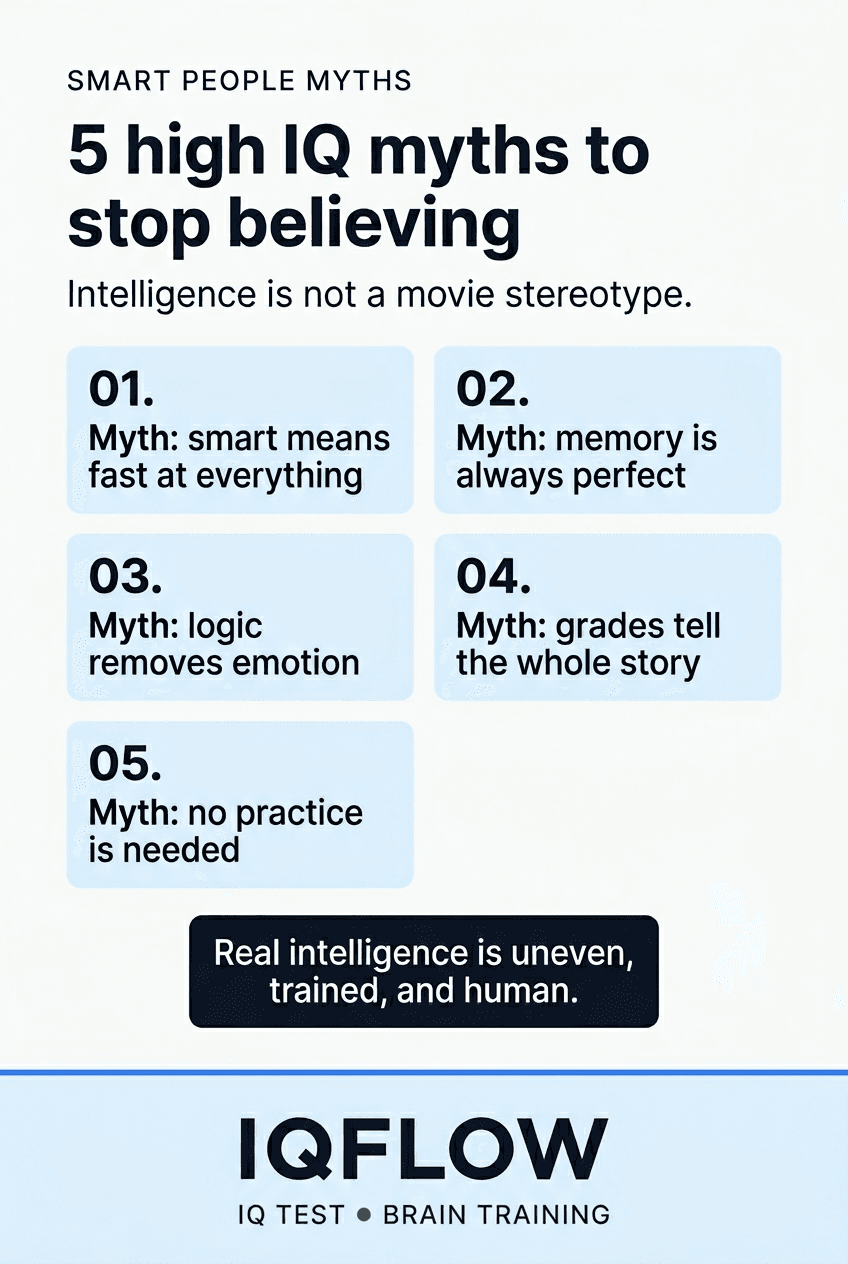
Smart people myths
5 high IQ myths to stop believing
Internet stereotypes make intelligence look simpler than it is. Real cognitive profiles are more uneven and more interesting.
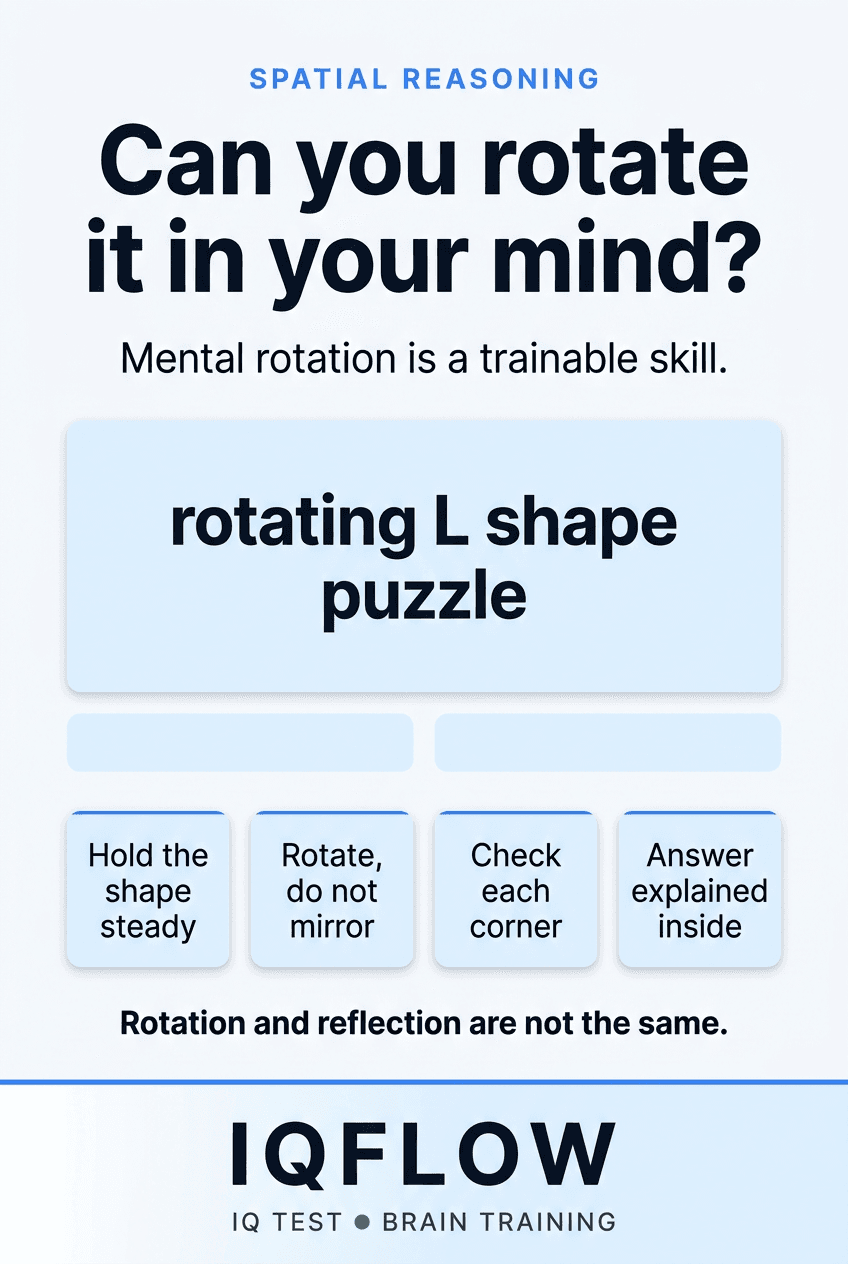
Spatial reasoning test
Can you rotate it in your mind?
Spatial reasoning helps you manipulate shapes mentally without physically moving them.
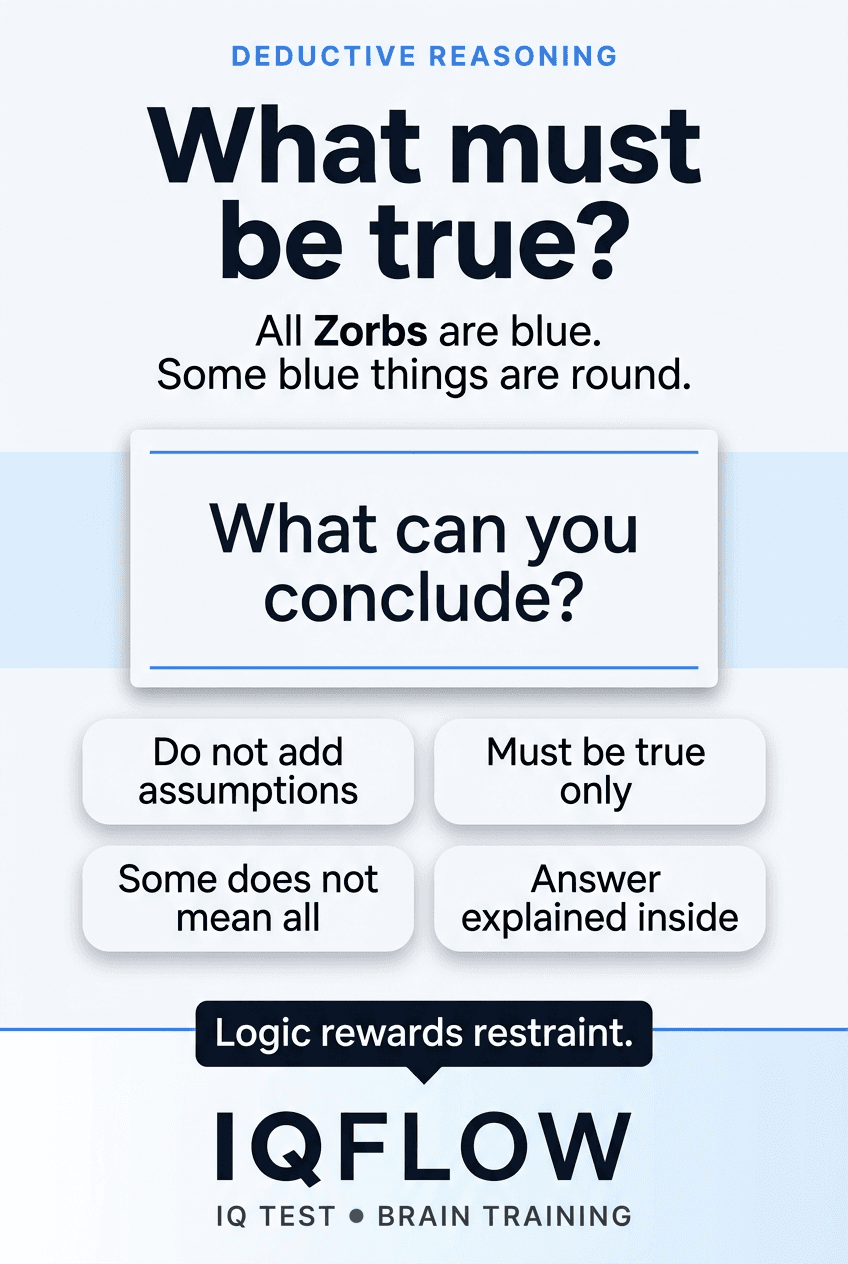
Deductive reasoning
What must be true?
Deductive reasoning is about what follows from the rules, not what feels likely.
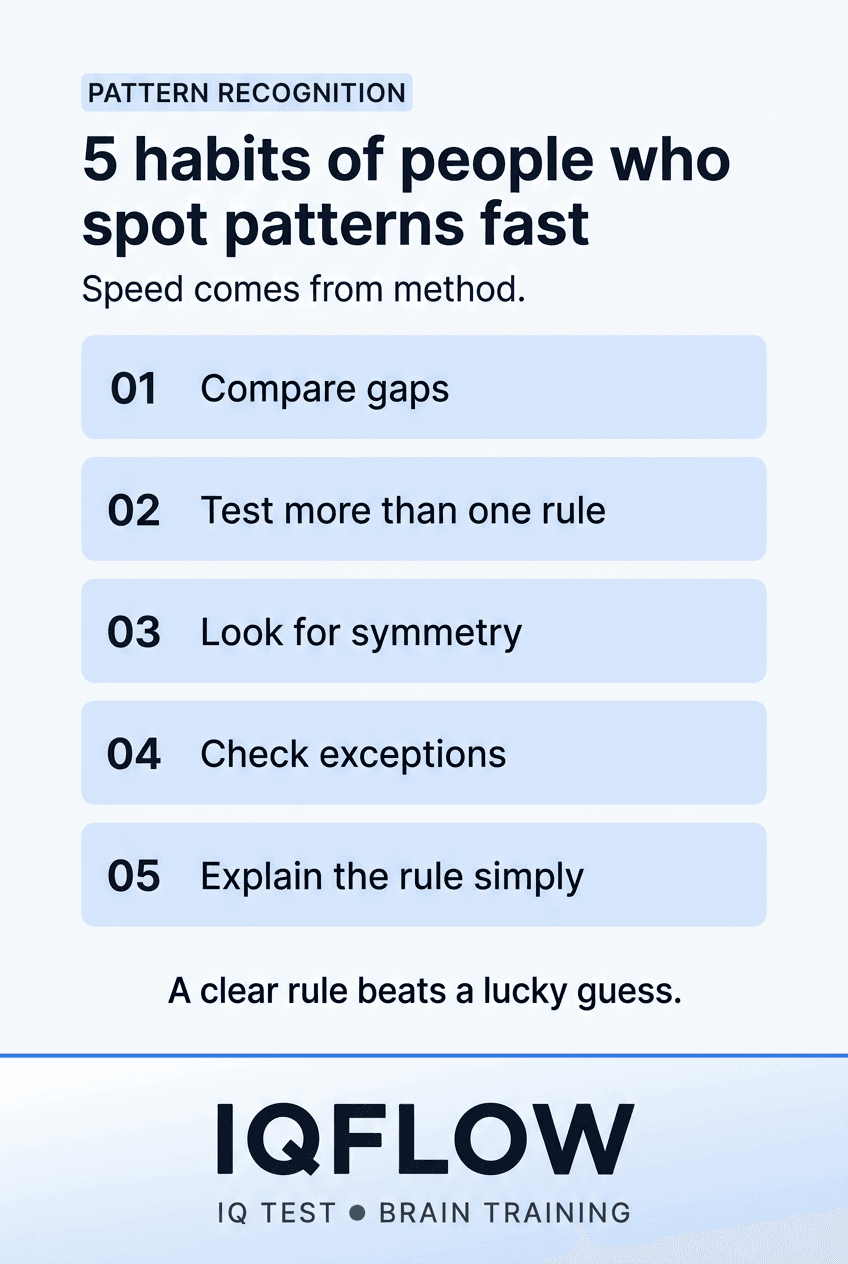
Pattern recognition
5 habits of people who spot patterns fast
Pattern recognition improves when you use a repeatable scan instead of waiting for the answer to pop out.
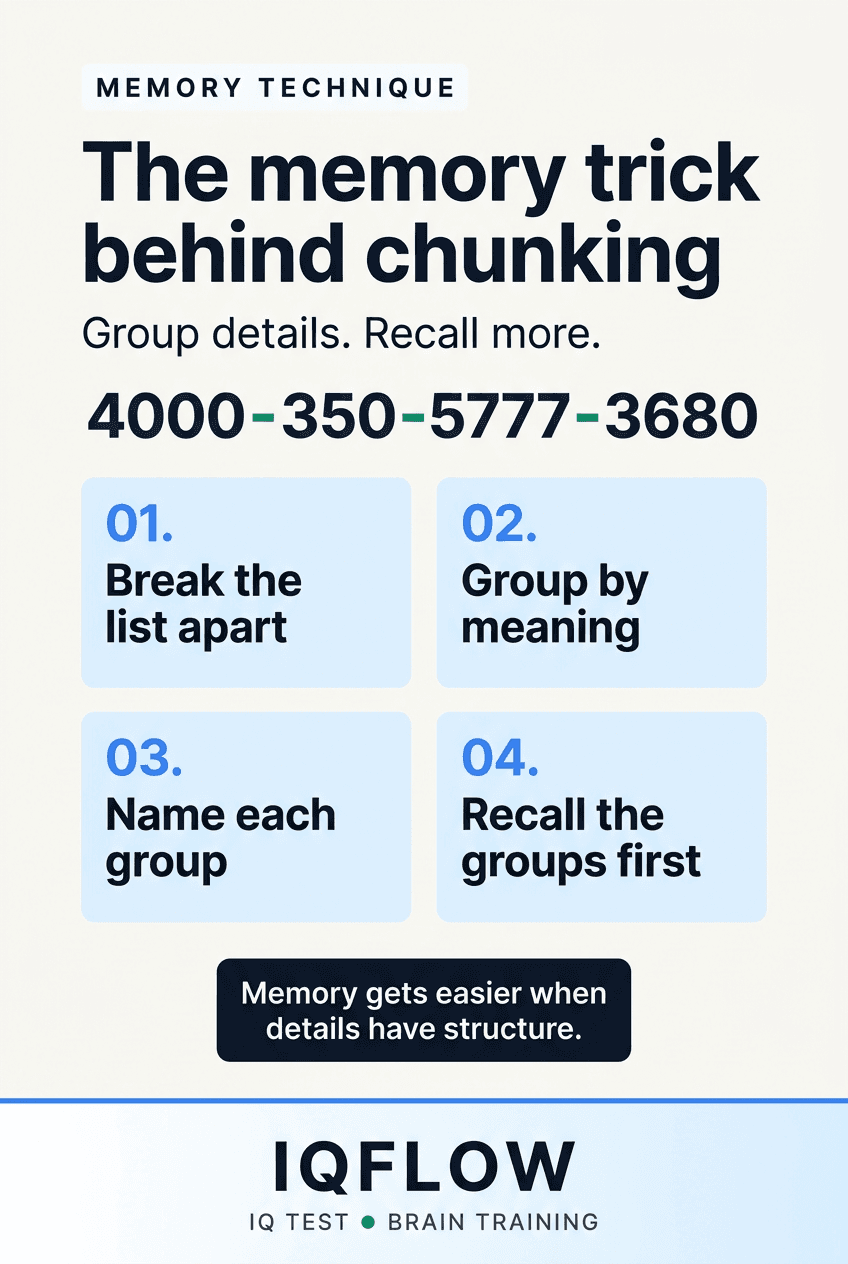
Memory technique
The memory trick behind chunking
Chunking helps you remember more by turning loose details into smaller meaningful groups.
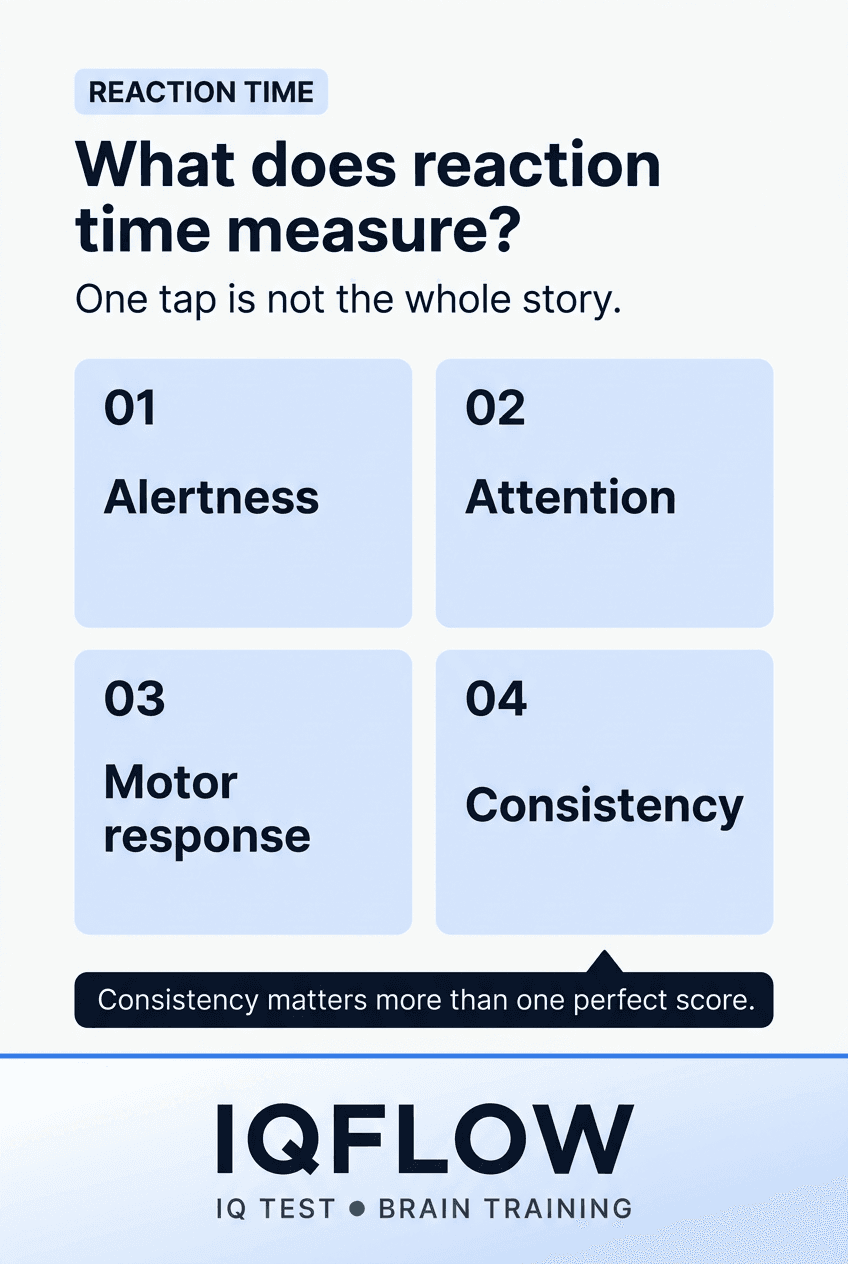
Reaction time test
What does reaction time really measure?
Reaction time is useful when you interpret it as a pattern, not a single lucky tap.
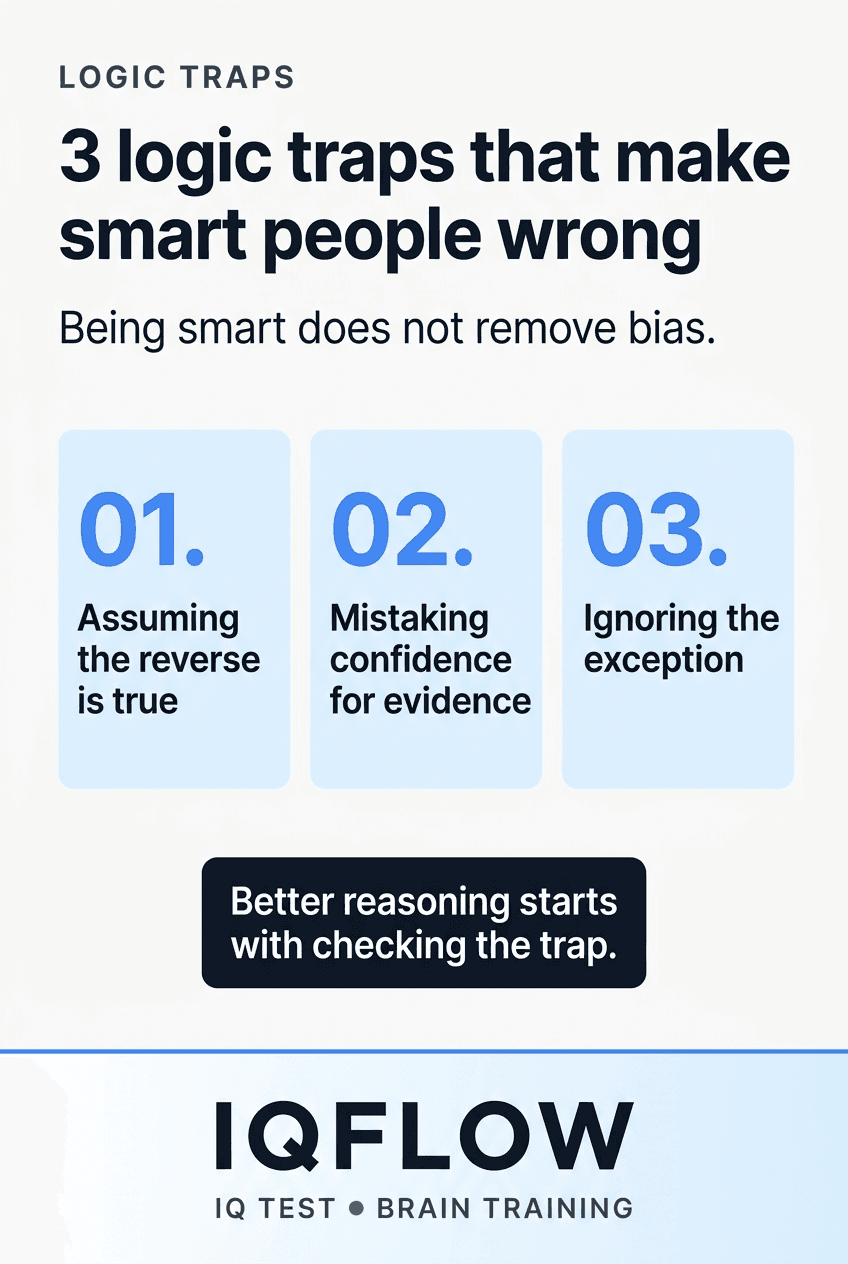
Logic traps
3 logic traps that make smart people wrong
Reasoning errors often come from unchecked assumptions, not lack of intelligence.
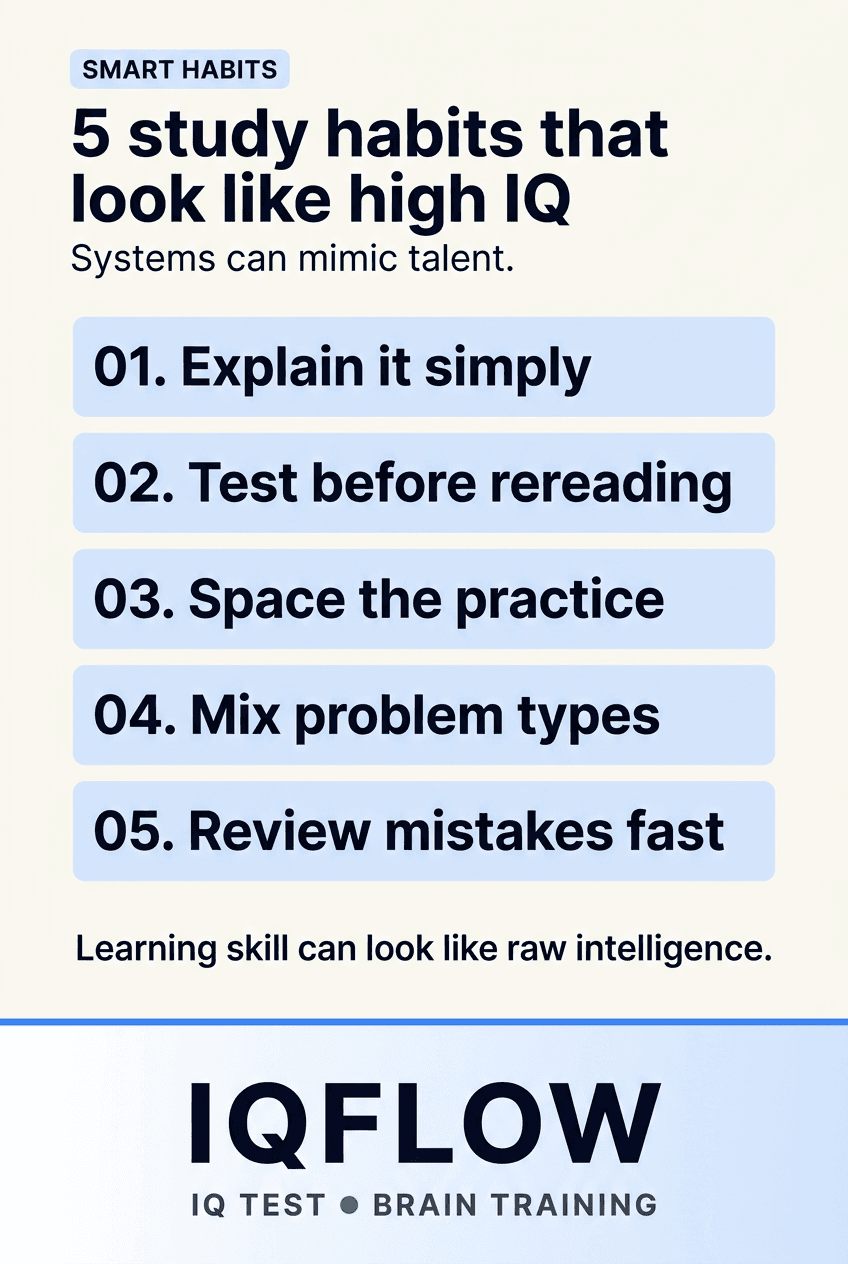
Smart habits
5 study habits that look like high IQ
Some people look naturally sharp because they use learning systems that make thinking easier.
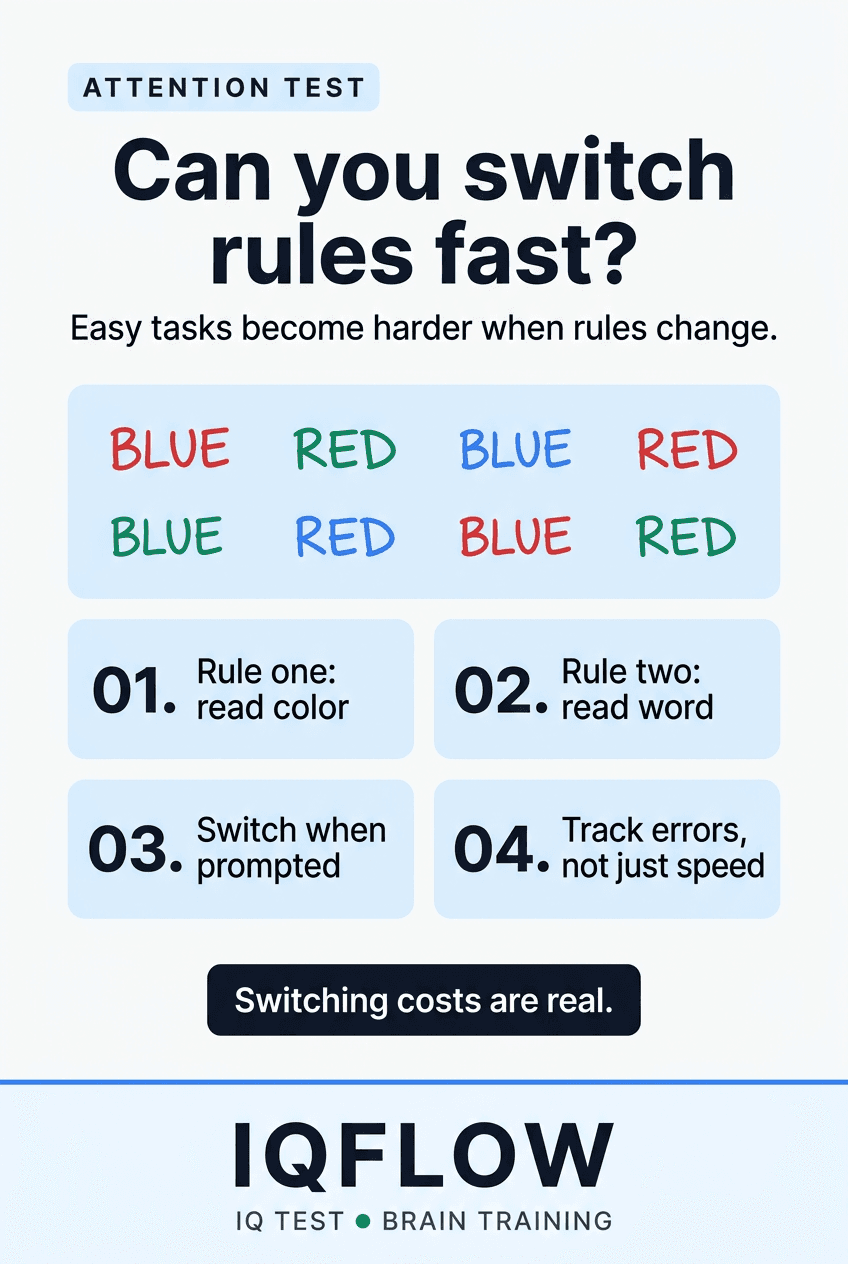
Attention switching
Can you switch rules fast?
Attention switching tests how quickly you can update the active rule without carrying the old one into the next task.
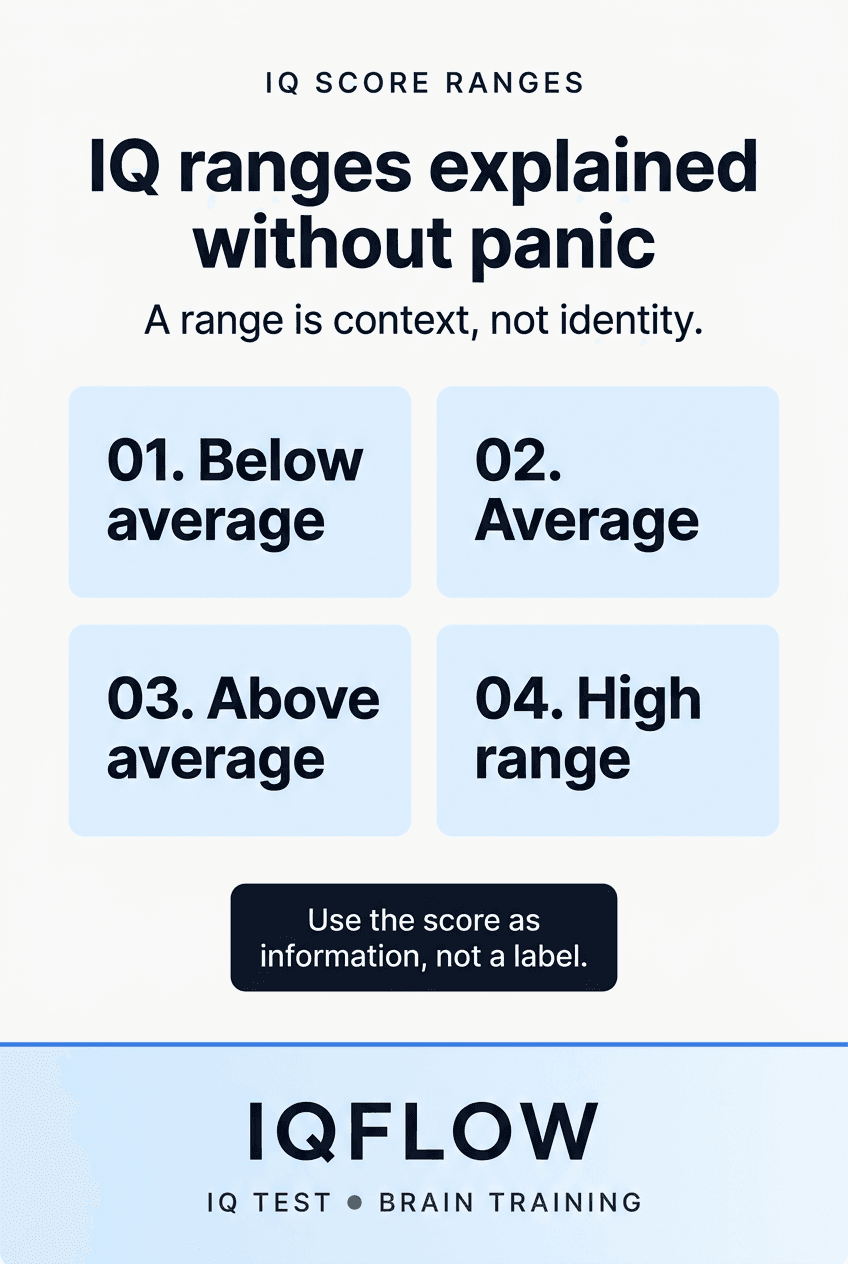
IQ scores explained
IQ ranges explained without panic
IQ score ranges can provide context, but they should not become a permanent identity label.
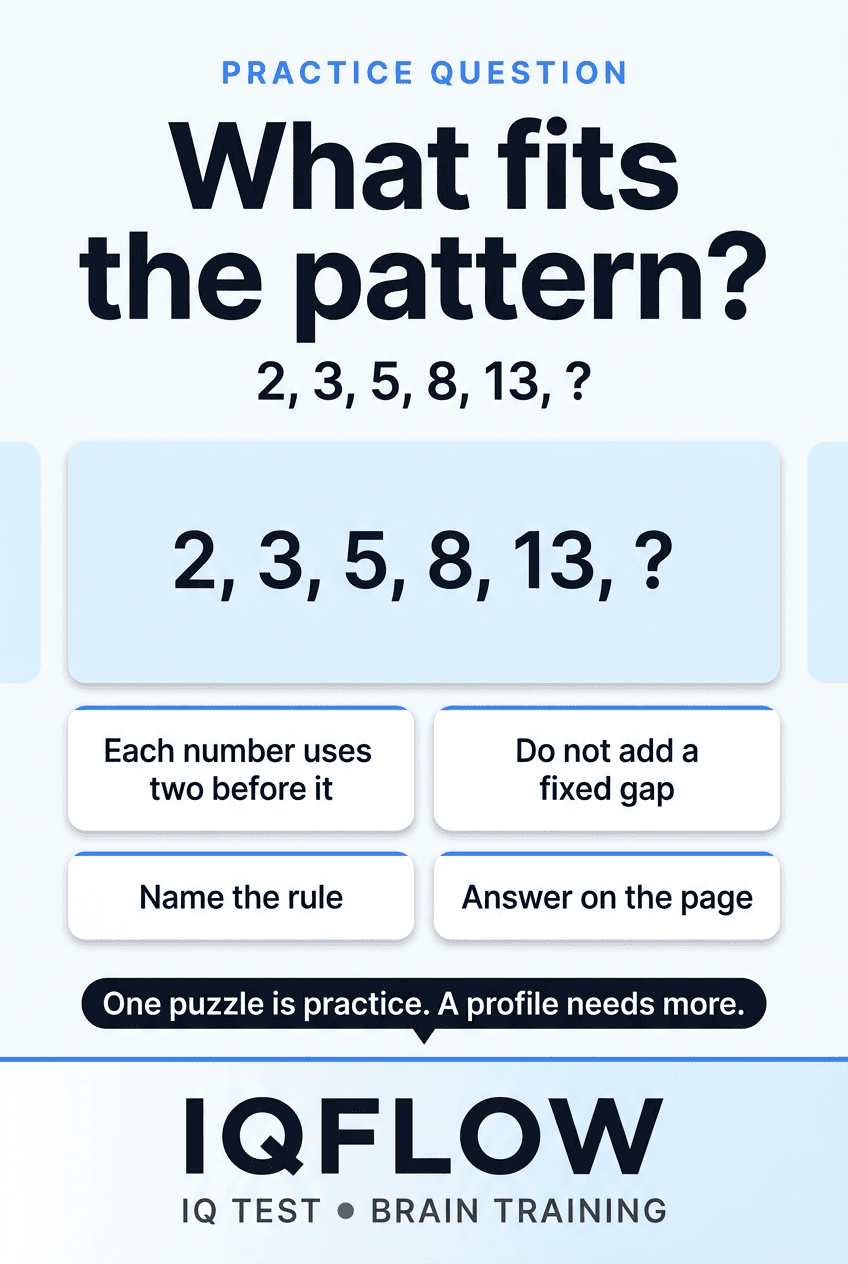
Practice question
What fits the pattern?
A quick sequence puzzle in the style of common reasoning practice questions.
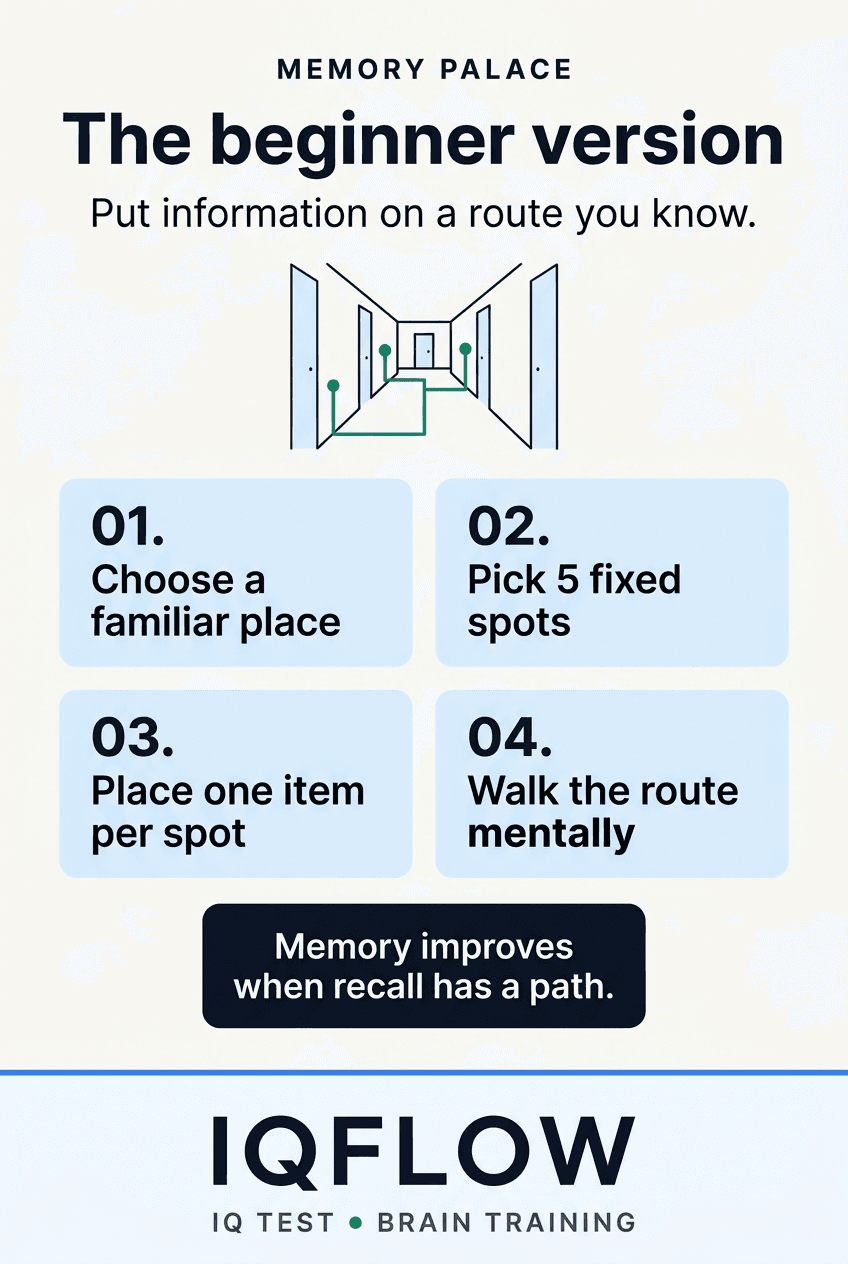
Memory palace
The beginner version
A memory palace uses spatial memory to give loose information a familiar path.
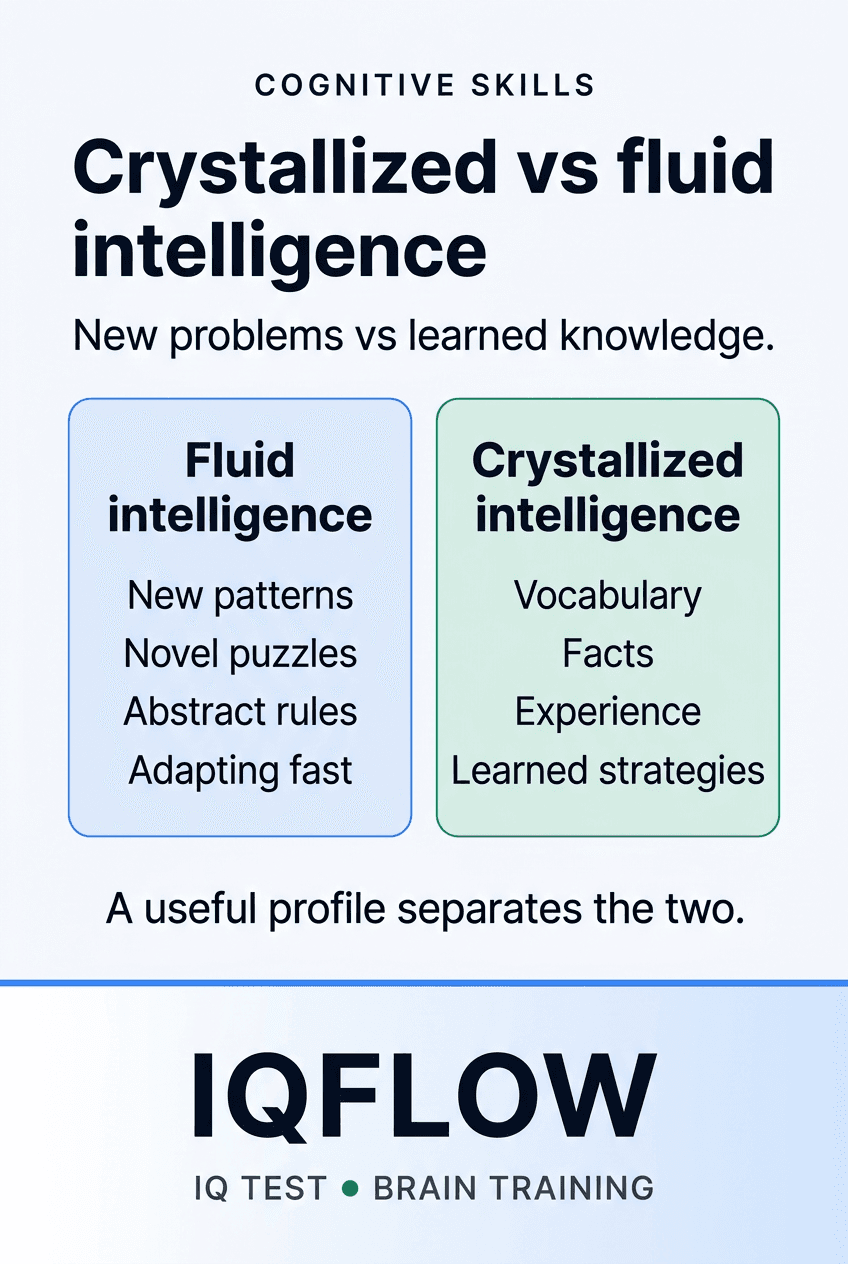
Cognitive skills
Crystallized vs fluid intelligence
Fluid intelligence and crystallized intelligence describe different strengths that often work together.
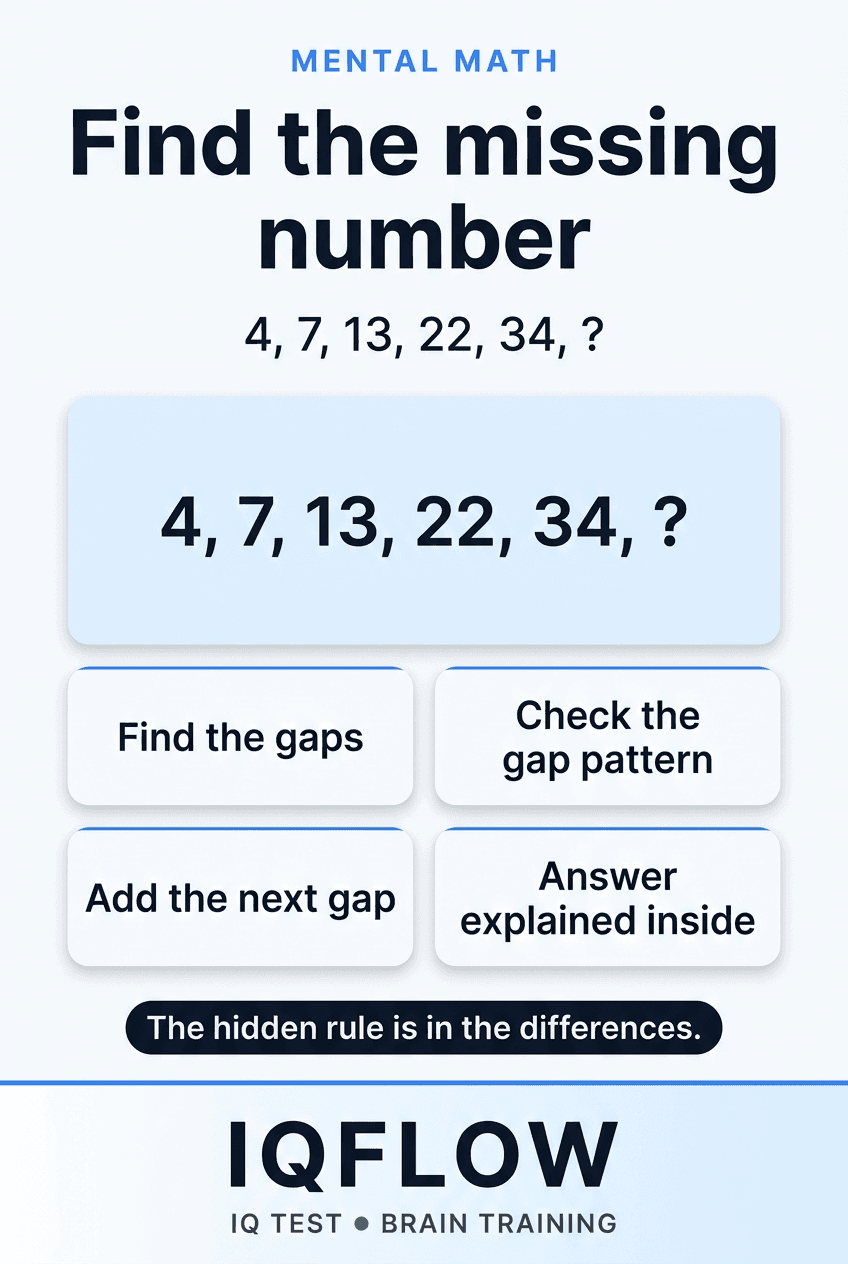
Mental math IQ question
Find the missing number
This missing-number puzzle tests whether you can find a changing gap pattern quickly.
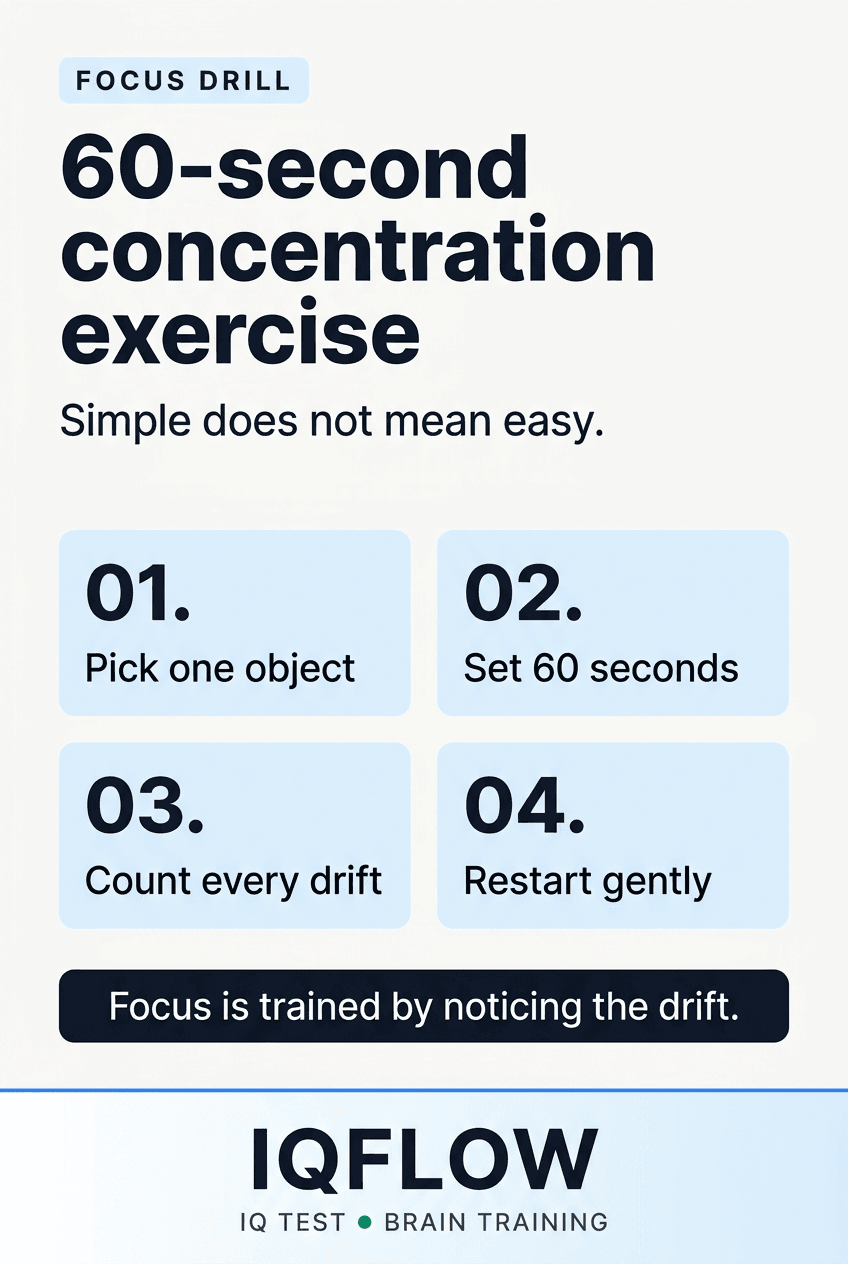
Focus drill
60-second concentration exercise
This quick drill helps you notice attention drift without turning focus into a moral test.
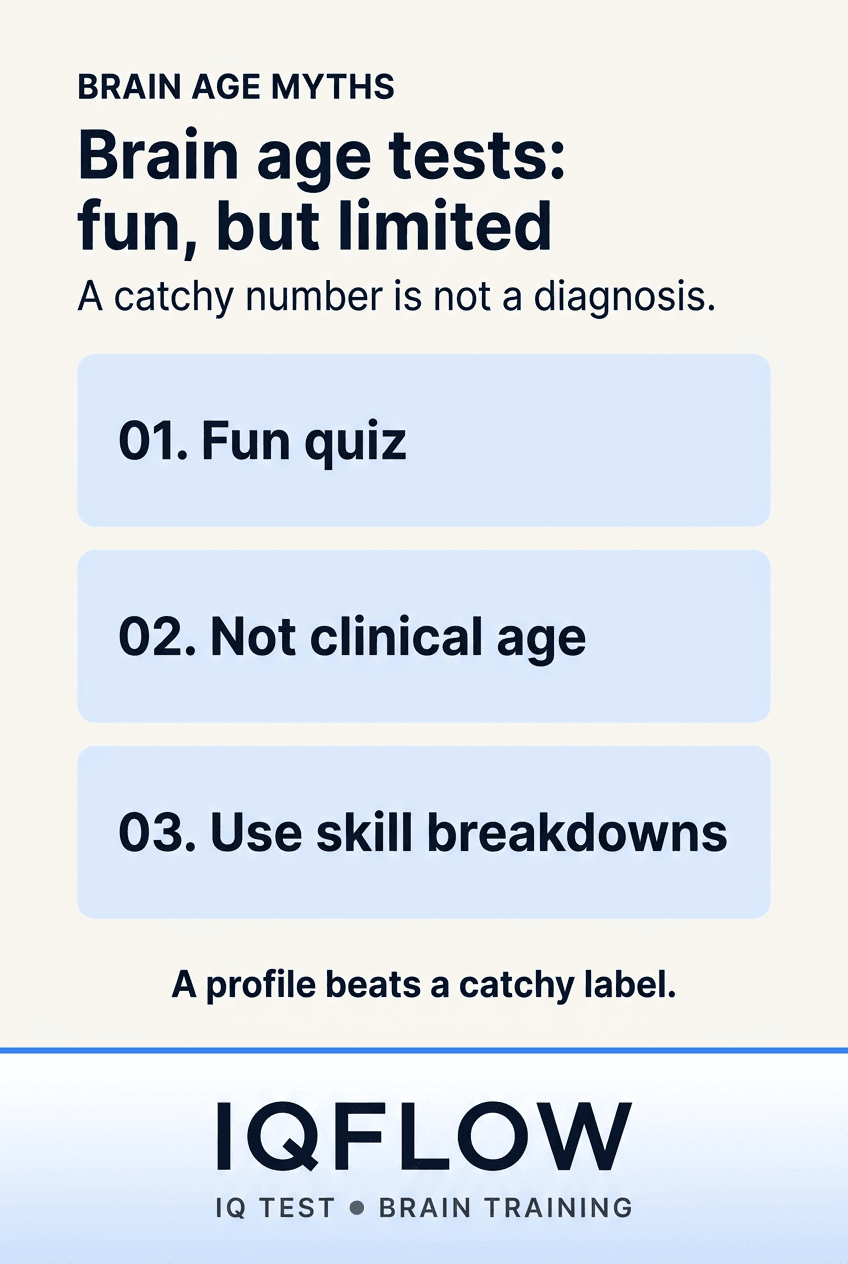
Brain age myths
Brain age tests: fun, but limited
Brain age numbers can be entertaining, but they often compress too many skills into one catchy label.
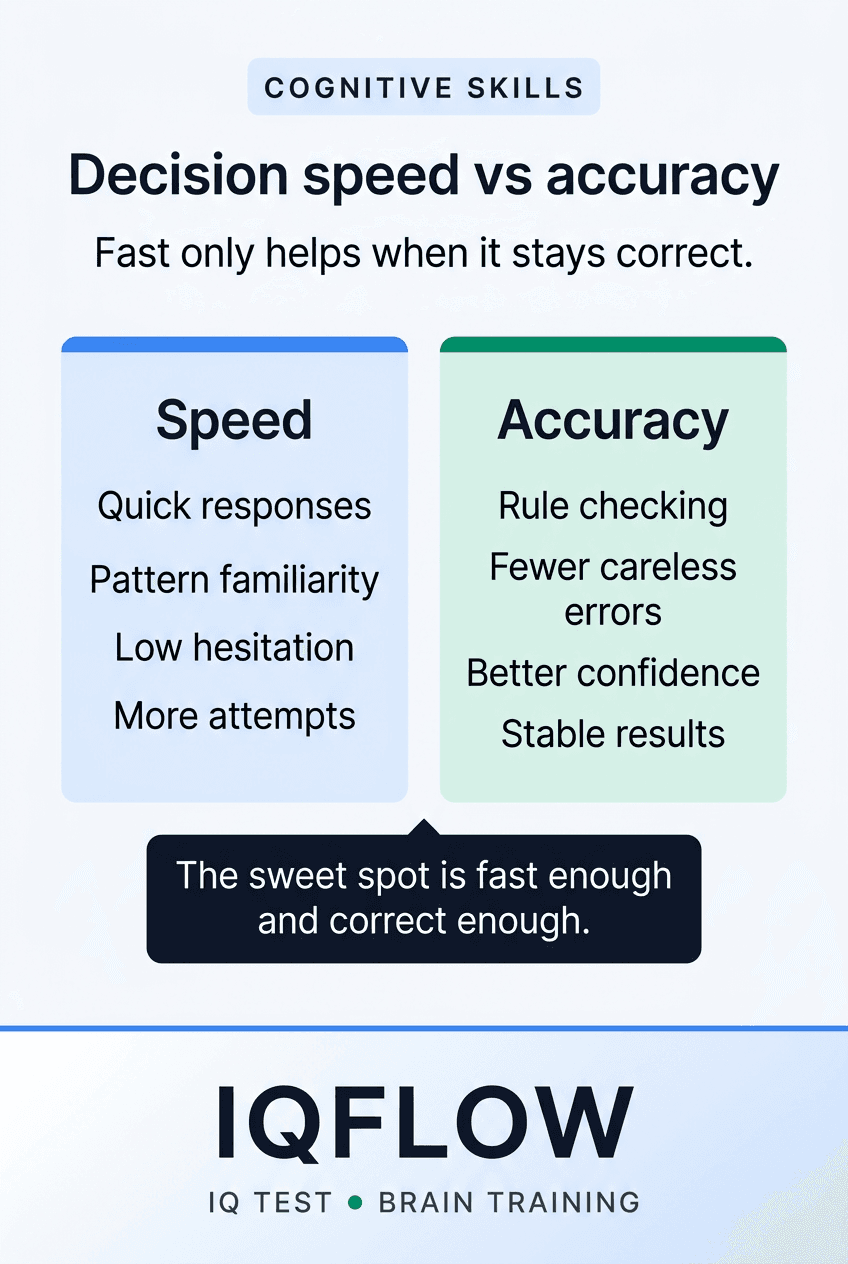
Cognitive skills
Decision speed vs accuracy
Speed feels impressive, but accuracy tells you whether the fast answer was useful.
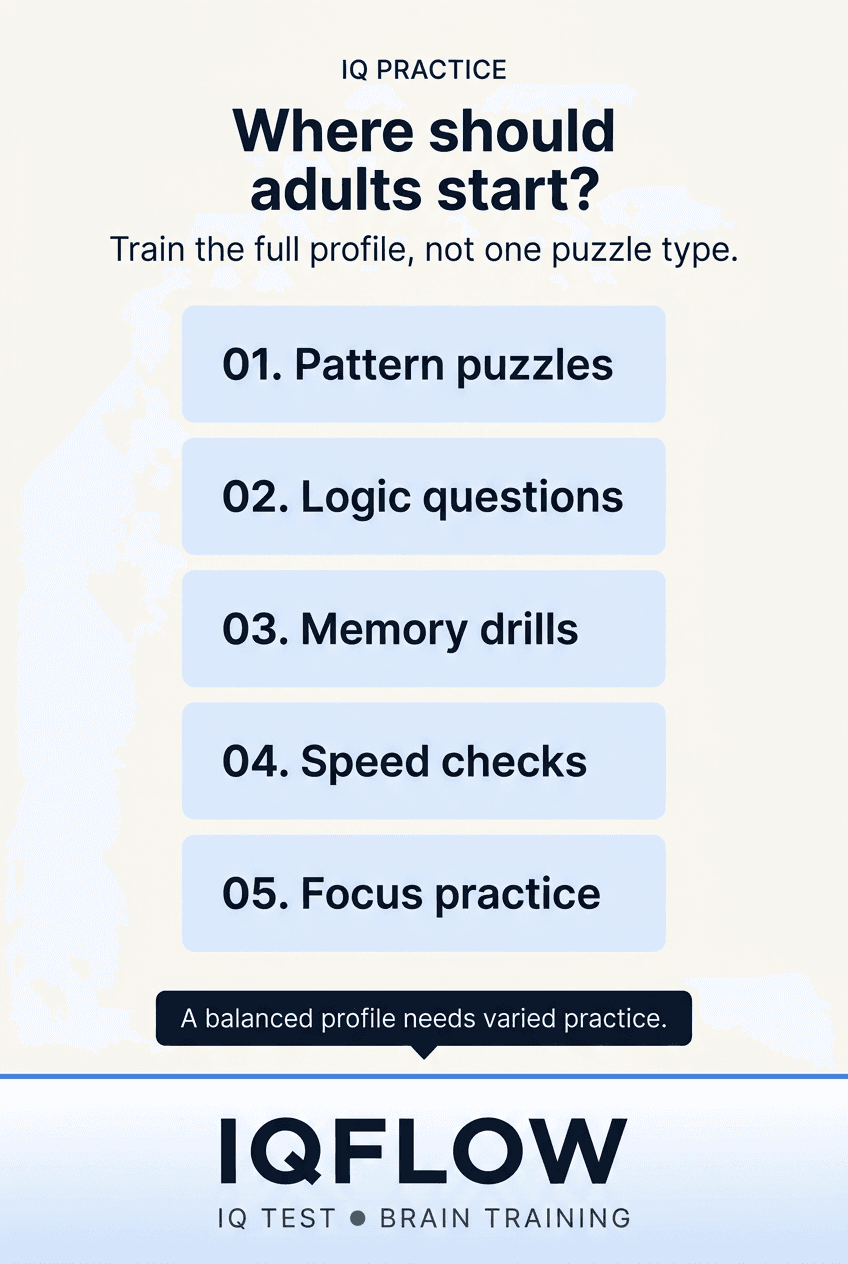
IQ practice for adults
Where should adults start?
Adult IQ practice works best when it covers more than one puzzle type.
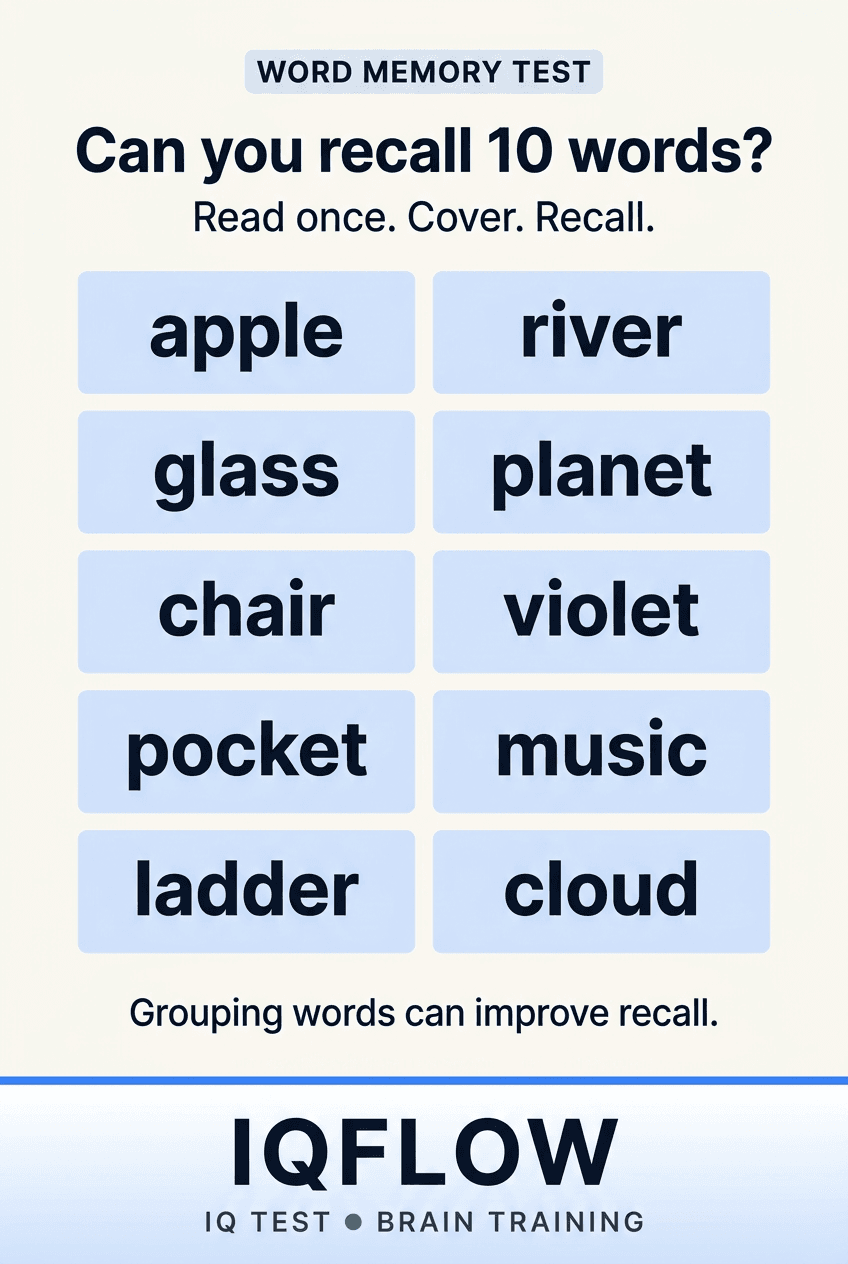
Word memory test
Can you recall 10 words?
This word recall challenge tests attention, encoding, and retrieval strategy.
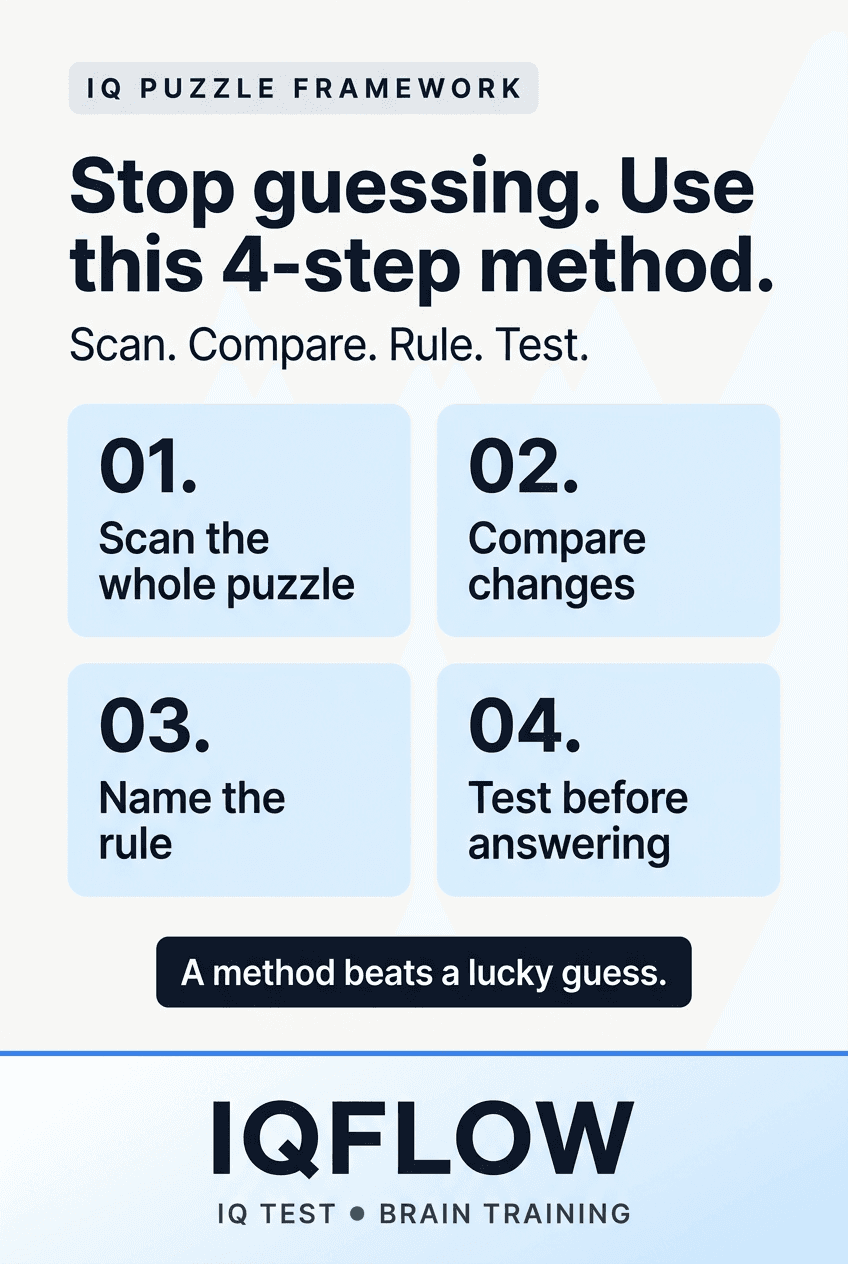
IQ puzzle framework
How to solve IQ puzzles without guessing
A simple four-step framework can make IQ-style puzzles feel less random.
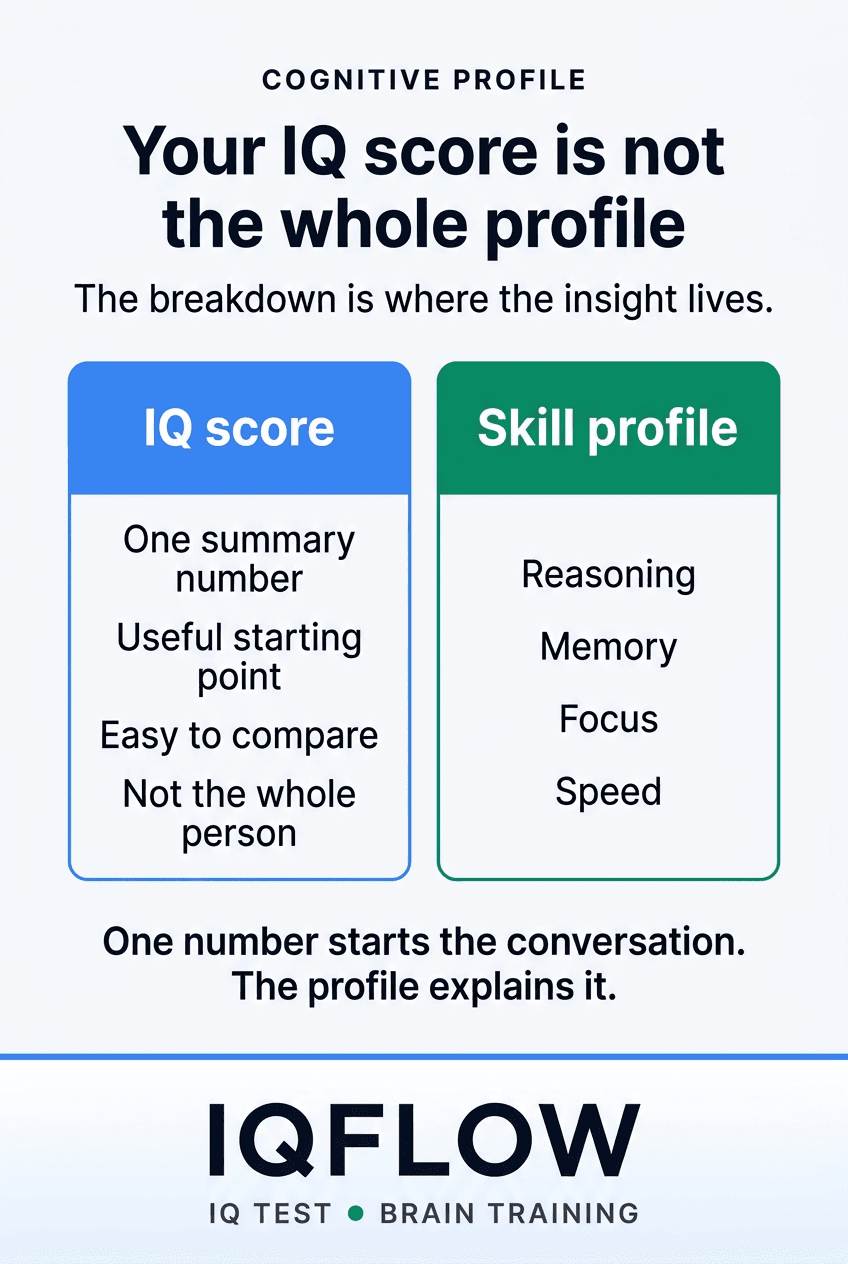
Cognitive profile
Your IQ score is not the whole profile
A cognitive profile explains the skill mix behind a score: reasoning, memory, focus, and speed.
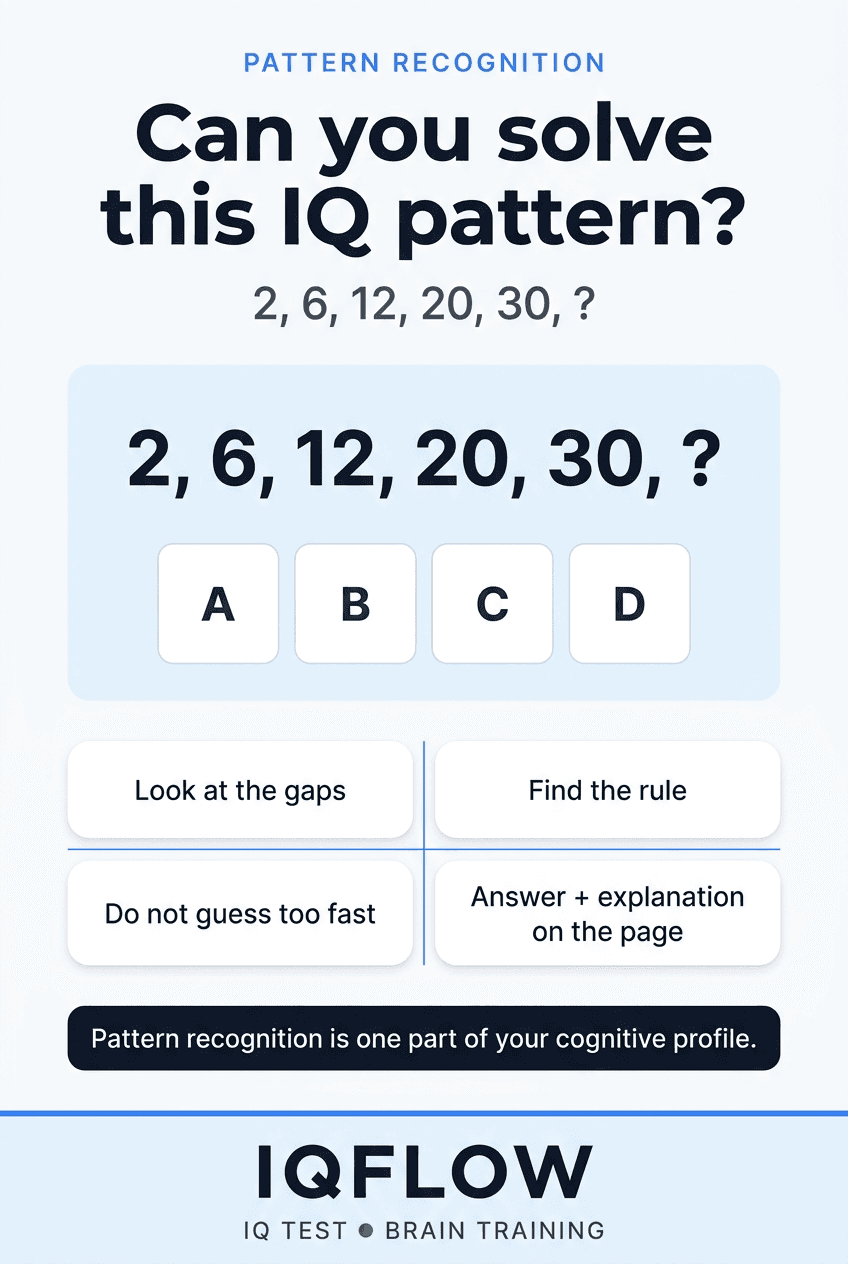
IQ pattern test
Can you solve this IQ pattern?
This quick sequence checks whether you can spot a rule from changing gaps instead of guessing from the last number.
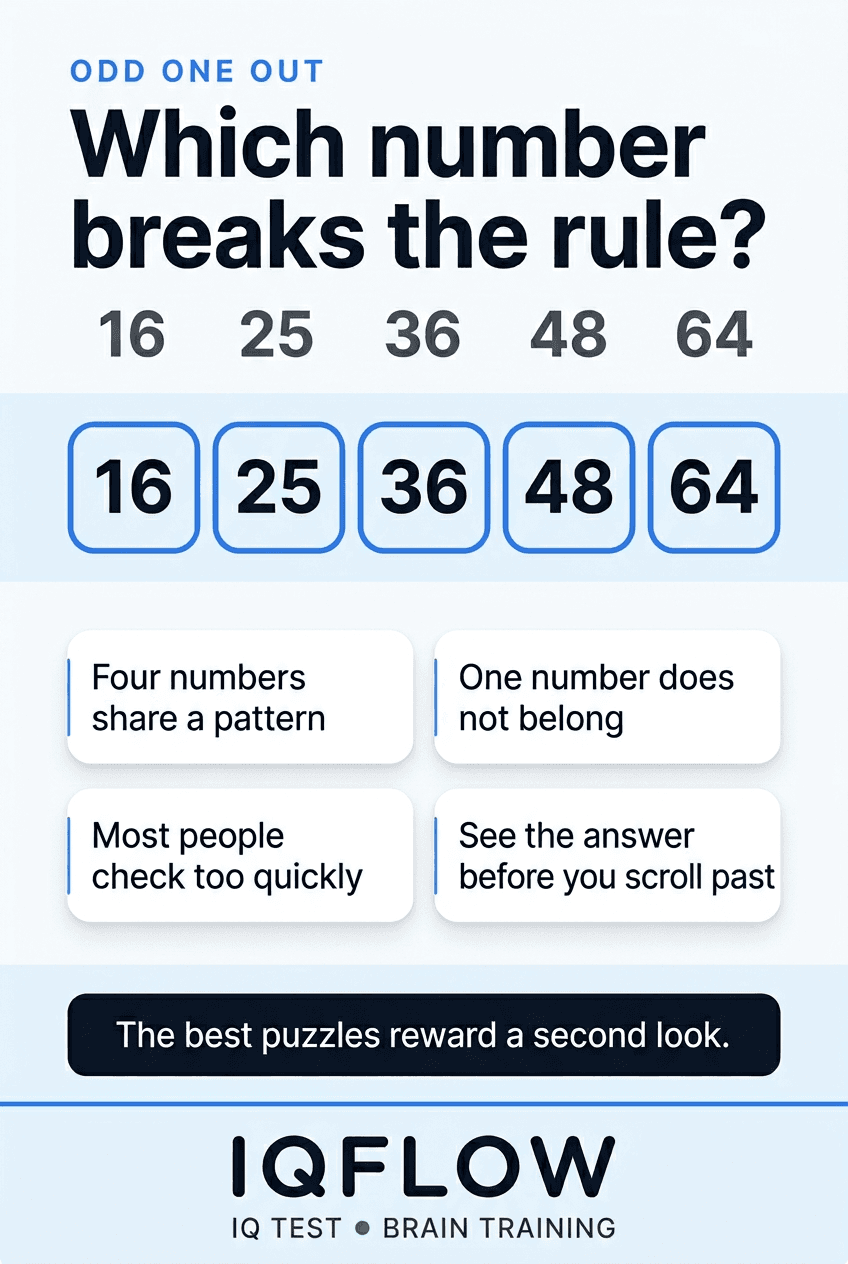
Odd one out IQ test
Which number breaks the rule?
Odd-one-out puzzles reward a second look because the obvious visual pattern is often hiding a stricter rule.
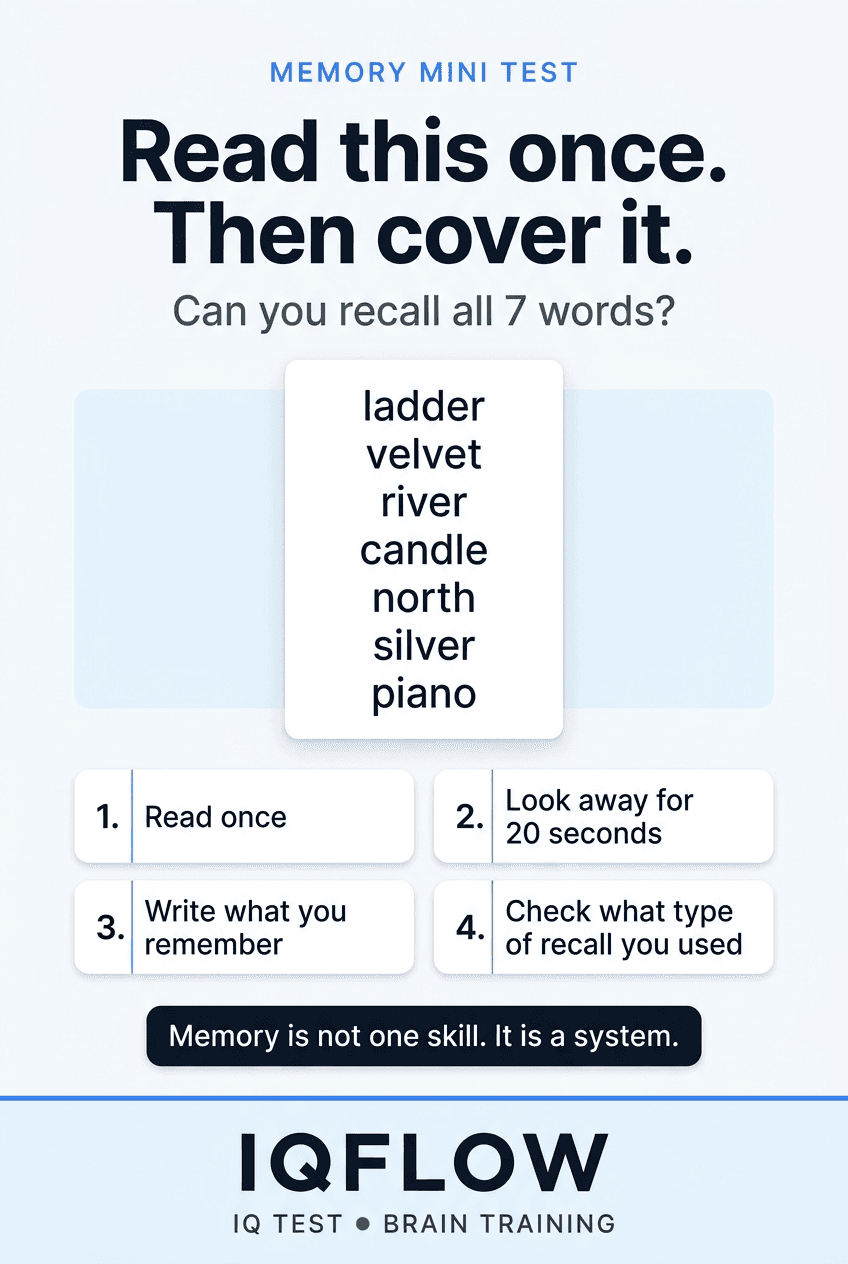
Memory mini test
Can you recall all 7 words?
A simple recall challenge can show how your memory strategy works: repetition, imagery, grouping, or pure attention.
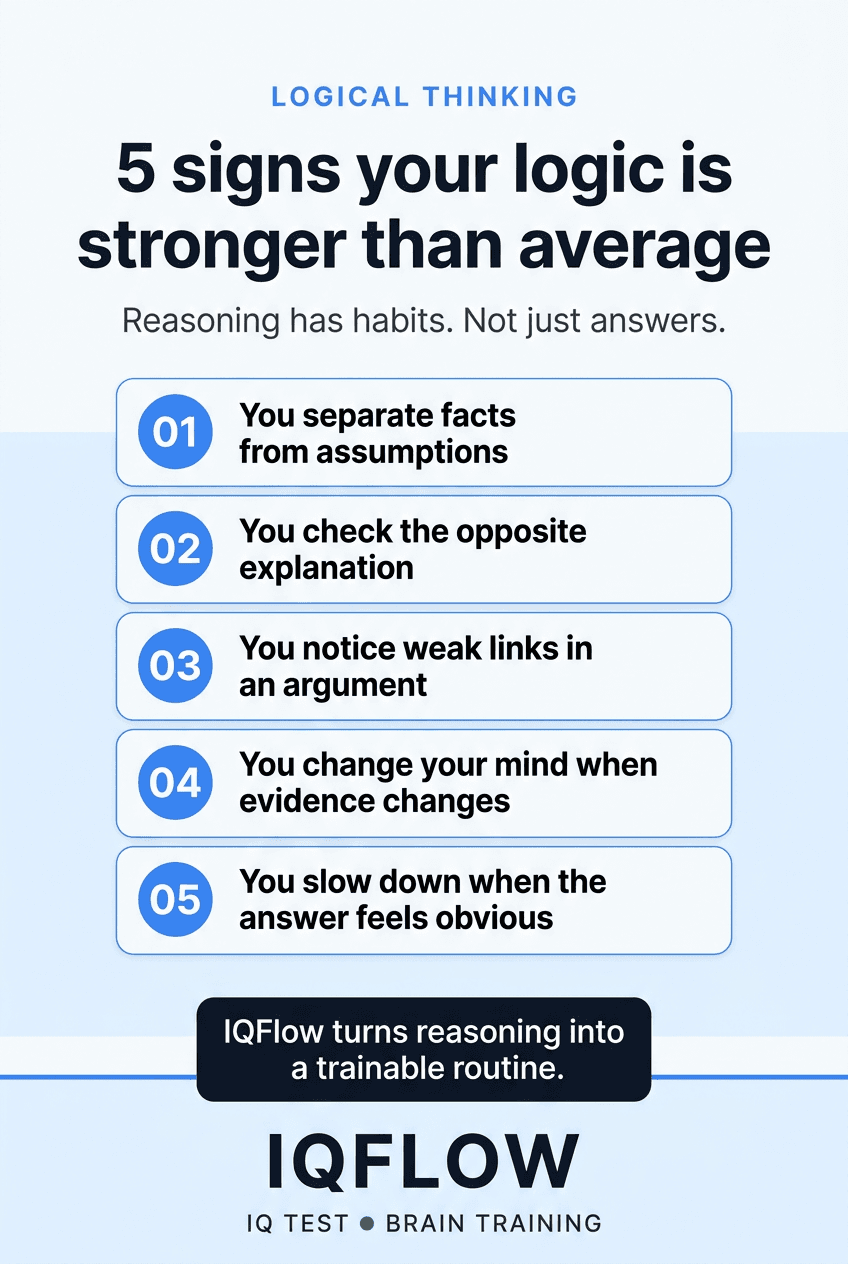
Logical thinking
5 signs your logic is stronger than average
Good logic is not just getting answers right. It shows up in how you test assumptions, evidence, and alternative explanations.
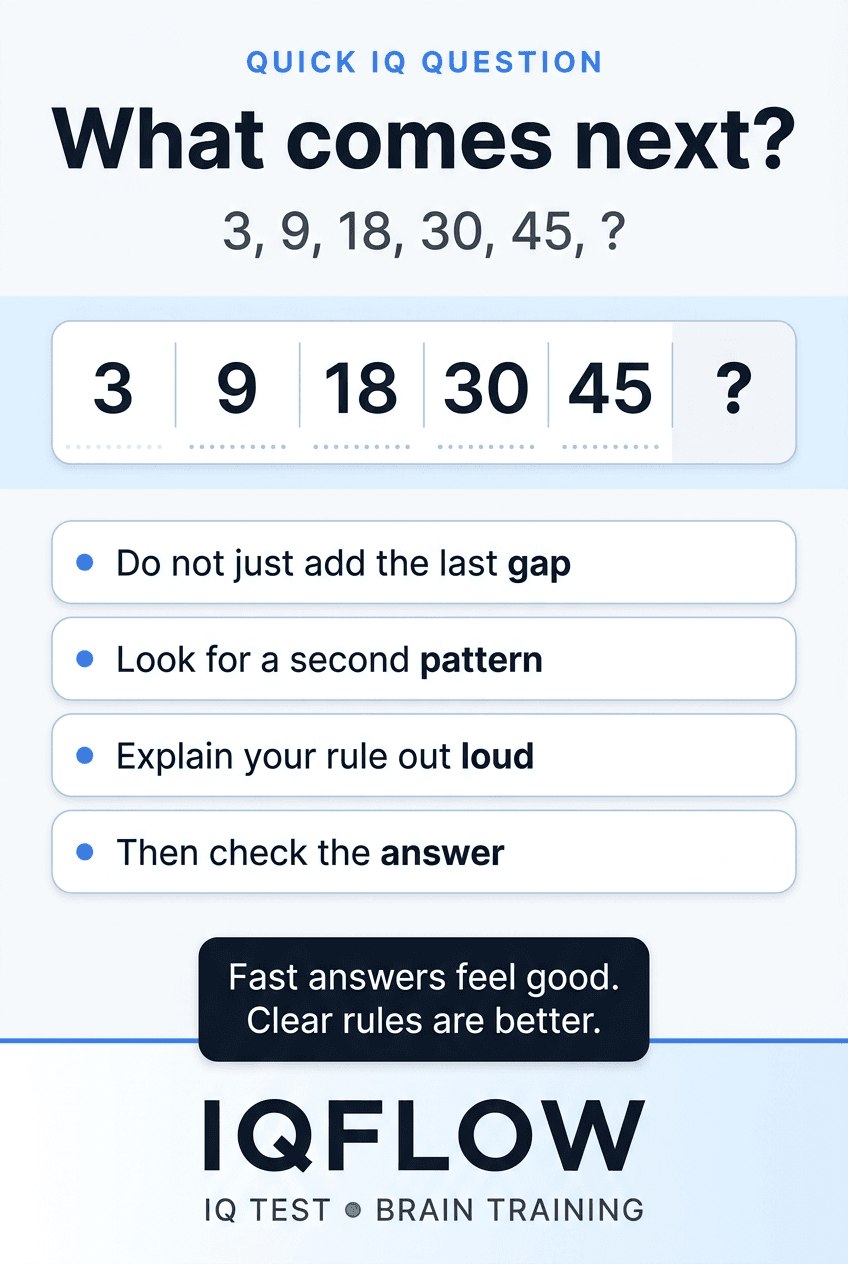
Quick IQ question
What comes next in this number sequence?
This sequence looks simple, but the rule sits inside the gaps. That makes it a useful quick test of pattern thinking.
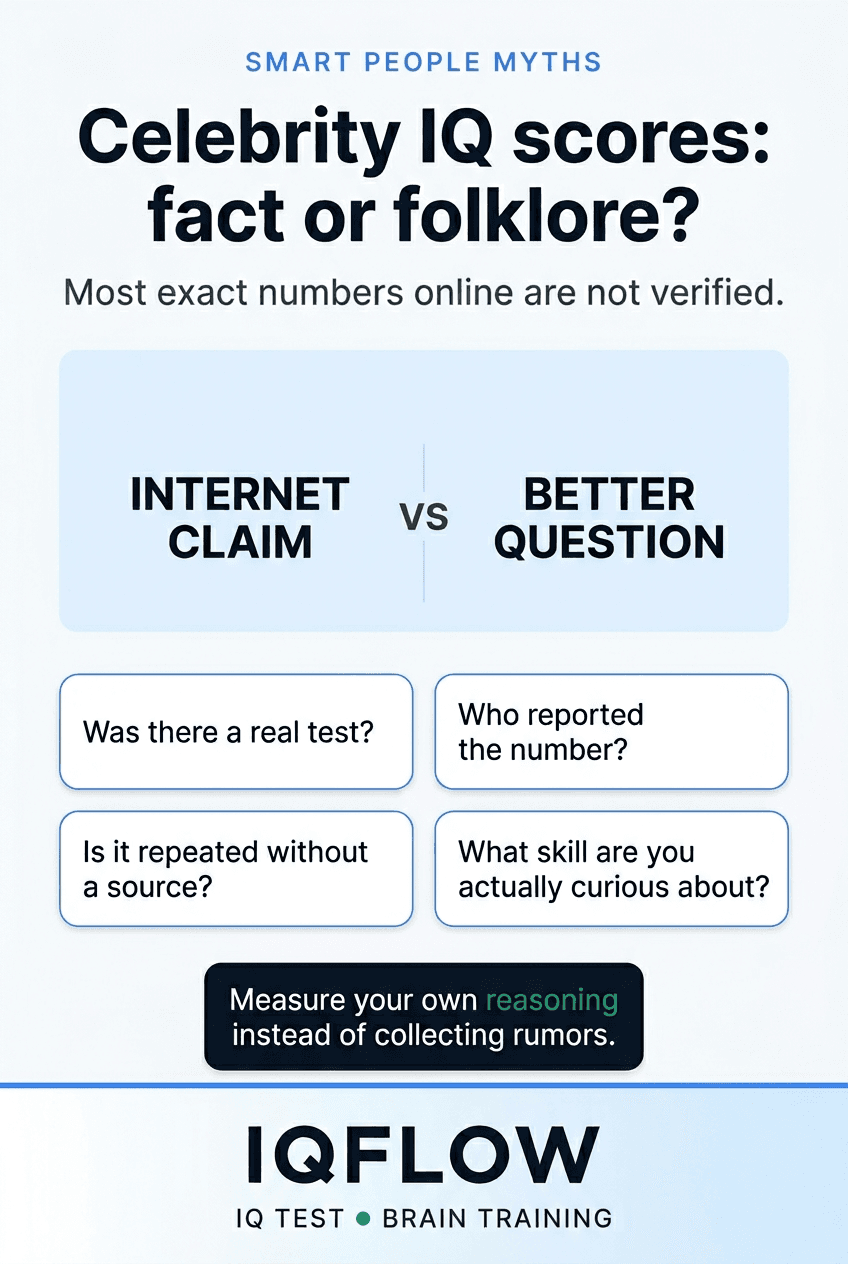
Smart people myths
Celebrity IQ scores: fact or folklore?
Exact celebrity IQ numbers spread quickly online, but many are unsourced. The better question is what kind of intelligence you want to understand.
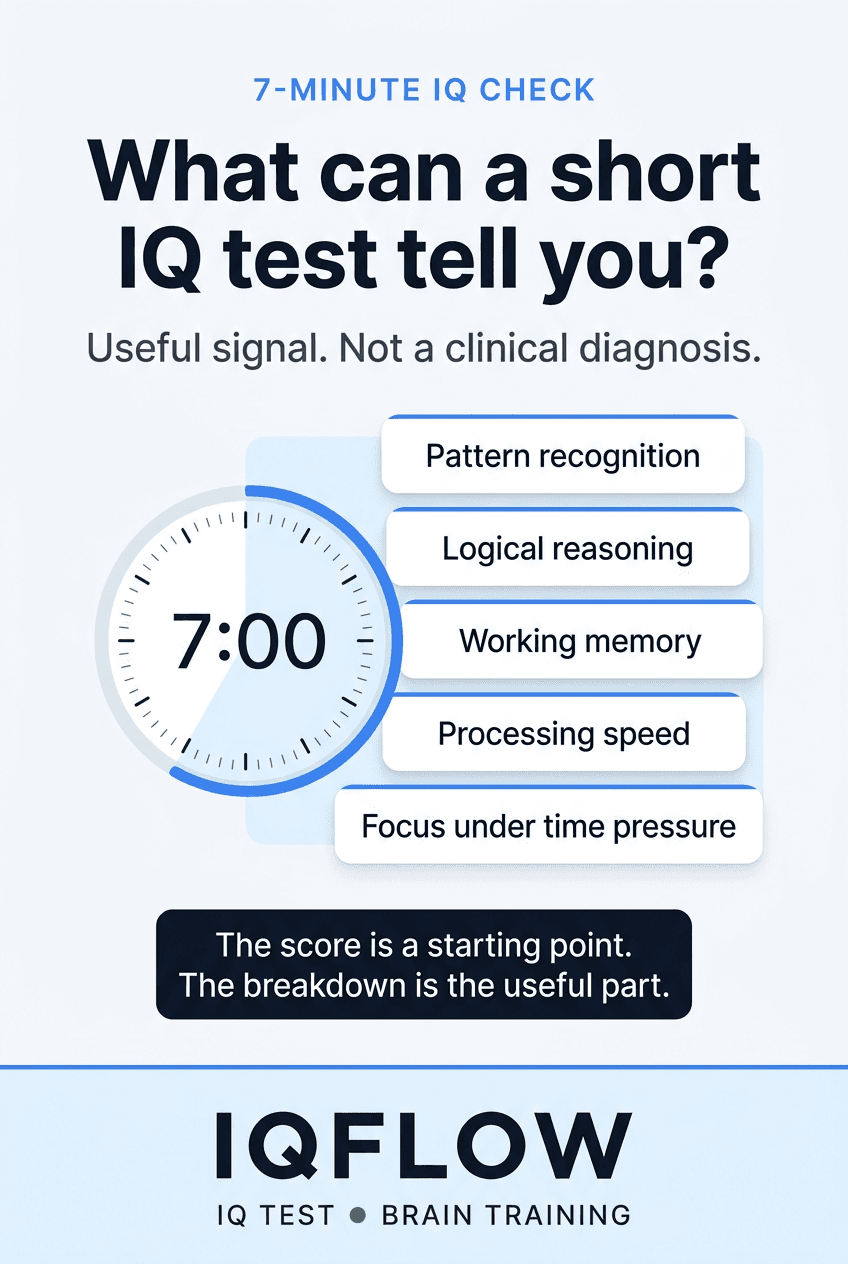
7-minute IQ check
What can a short IQ test tell you?
A short IQ-style test can give a useful signal when it samples different skills and stays honest about its limits.
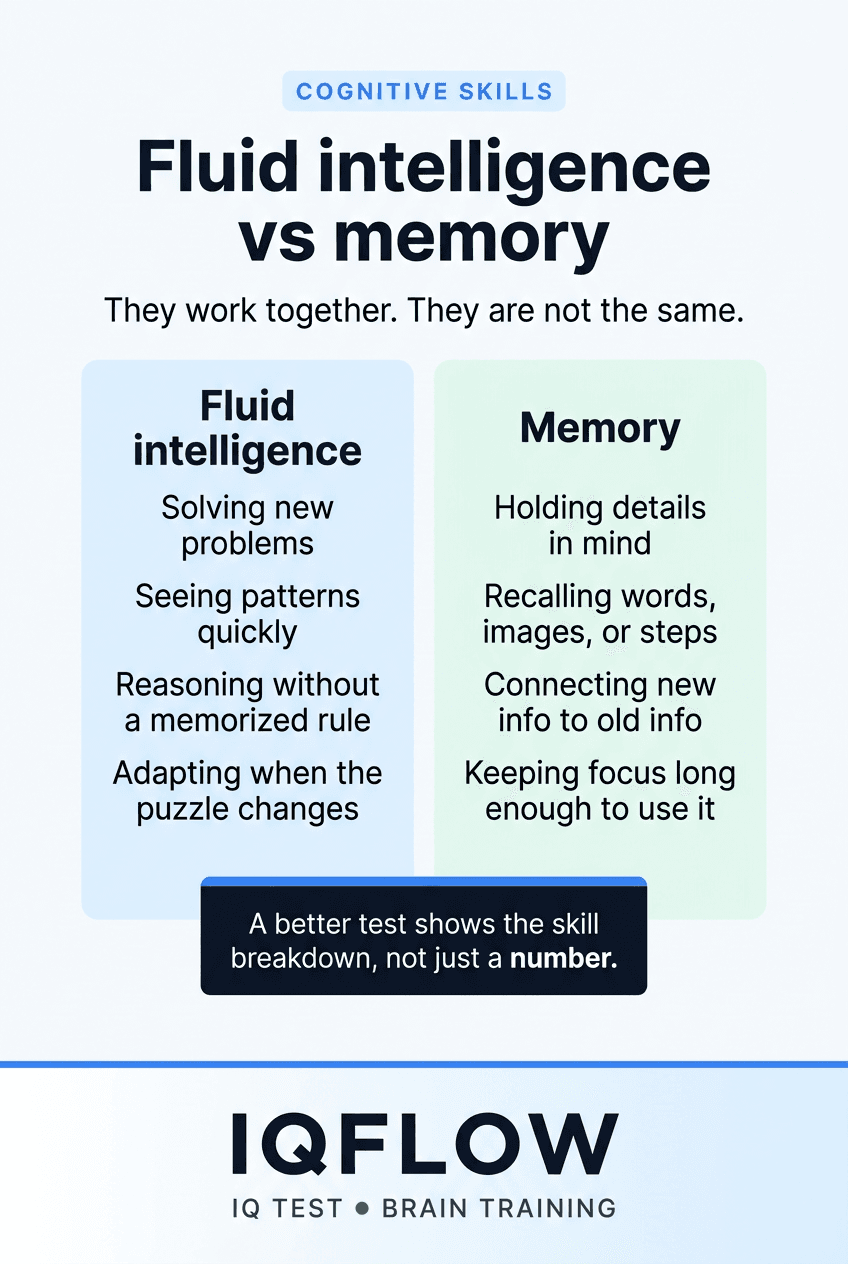
Cognitive skills
Fluid intelligence vs memory: the simple difference
Fluid intelligence and memory work together, but they are not the same. One helps you solve new problems; the other helps you hold and recall information.
Brain training games
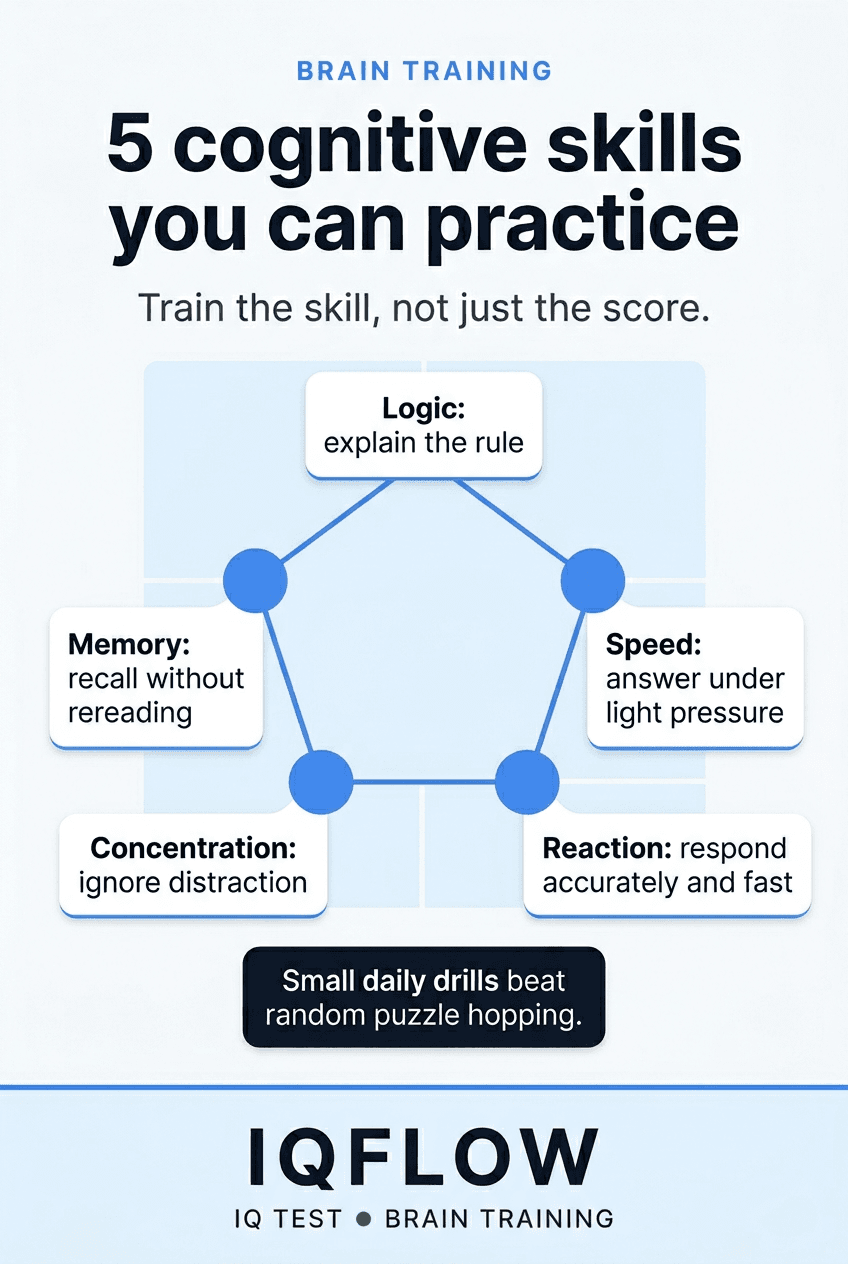
5 cognitive skills you can practice
Brain training works best when each exercise has a target skill: logic, memory, speed, concentration, or reaction.
IQ score context
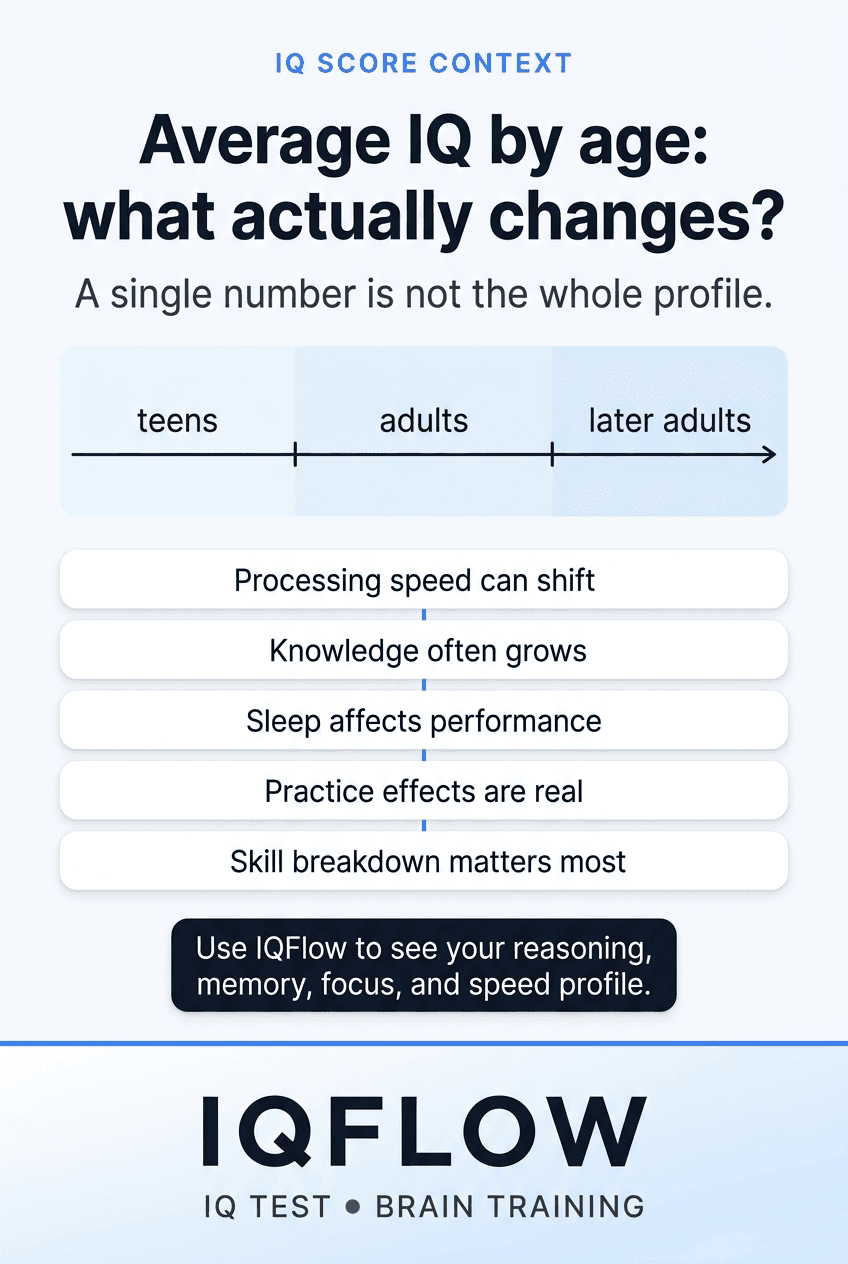
Average IQ by age: what actually changes?
IQ scores are standardized, but the skills behind performance can shift with attention, speed, sleep, practice, and life stage.
IQFlow
Ready for your own score?
Take the 7-minute IQFlow check and see your reasoning, memory, focus, and speed breakdown.